Most operational disruption in growing companies does not start with a catastrophic failure. In enterprise IT, breakdown usually begins with small issues that were not reviewed on time. A missed security patch. A battery that has exceeded healthy cycle thresholds. A device that stayed in circulation past its refresh window.
Across 50 to 500 plus employees, these small gaps multiply. Without structured preventive maintenance forms, equipment failure becomes a pattern rather than an exception.
When devices fail unexpectedly, leadership must decide quickly whether assets should be repaired or replaced. That decision is more expensive when made under pressure.
Preventive maintenance forms stabilize the maintenance schedule and introduce structured lifecycle oversight across distributed teams.
What preventive maintenance forms mean in ITAM and UEM environments
In the context of IT Asset Management and Unified Endpoint Management, preventive maintenance forms are operational controls.
They standardize:
- Which asset is reviewed
- What technical and security conditions must be validated
- How often inspections occur within the maintenance schedule
- What action must follow when risk is identified
Preventive maintenance checklists ensure patch compliance, encryption status, battery health, and hardware condition are reviewed consistently. Instead of discovering issues after equipment failure disrupts onboarding or daily operations, IT teams identify early warning signals.
For IT Managers, this creates lifecycle predictability. For HR Directors, it reduces day one friction caused by non compliant or degraded hardware.
Why equipment failure is usually a process problem
Equipment failure in enterprise IT rarely appears without indicators. Most failures follow a pattern: gradual degradation combined with inconsistent validation.
Maintenance schedule drift
When inspections are informal or undocumented, the maintenance schedule begins to drift. Devices miss review cycles. Refresh timelines extend. Security controls are not revalidated after updates.
Over time, this creates hidden risk across the device fleet.
Reactive repair decisions
Without preventive maintenance forms, organizations operate reactively. A device fails. Productivity drops. The conversation shifts immediately to whether it should be repaired or replaced.
Reactive decisions create:
- Budget instability
- Emergency procurement
- Cross border shipping delays
- Increased downtime
Preventive maintenance checklists shift these decisions into planned lifecycle reviews
Key components of effective preventive maintenance forms
Preventive maintenance forms should not be complex. They should be precise. The objective is to reduce equipment failure while keeping the maintenance schedule predictable.
Asset identification and ownership clarity
Every preventive maintenance form must clearly identify the asset. This includes asset ID, device model, serial number, assigned user, and physical or remote location.
Incomplete identification weakens the maintenance schedule and makes it difficult to determine whether a device should be repaired or replaced at the right lifecycle stage.
Clarity at the beginning prevents confusion during audits, support cases, and recovery workflows.
Defined inspection tasks aligned with IT standards
Preventive maintenance checklists should specify measurable validation steps rather than general reminders.
Typical enterprise IT inspections include:
- Operating system support status
- Patch management validation
- Encryption enablement confirmation
- Battery health and cycle review
- Disk condition indicators
Specific inspection tasks reduce guesswork and ensure consistency across regions.
Inspection cadence tied to risk
A preventive maintenance form must define frequency. The maintenance schedule should align with asset criticality and usage intensity.
Without defined cadence, inspections become reactive. When cadence is documented and followed, lifecycle decisions become predictable.
Documented outcomes and lifecycle decisions
Each inspection must record findings and define next action. The form should clearly indicate:
- No action required
- Remediation scheduled
- Repair required
- Refresh recommended
Over time, this documentation builds lifecycle intelligence. IT leaders can identify recurring failure patterns and plan procurement accordingly.
Sample preventive maintenance form template
Theory is helpful. But most leaders want to see what a preventive maintenance form actually looks like.
Below is a simple example you can adapt for your own preventive maintenance checklists. This structure works well for IT equipment, operational tools, and office infrastructure.
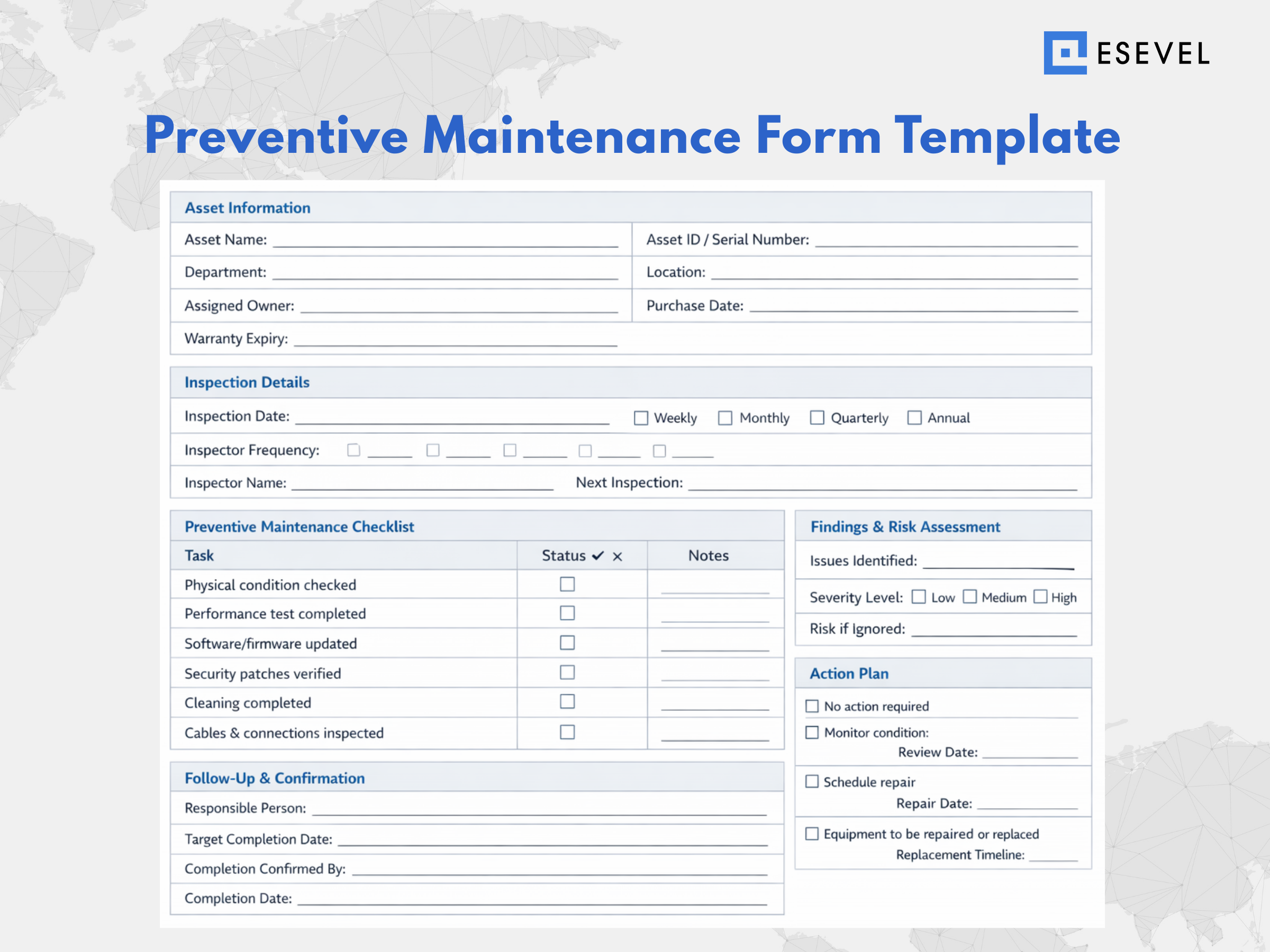
This form ensures inspections follow a defined maintenance schedule and generate the data required to decide whether devices should be repaired or replaced before equipment failure affects operations.
From preventive maintenance forms to global hardware lifecycle logistics
Preventive maintenance forms are only effective when integrated into centralized lifecycle management.
As companies expand across regions, IT teams must coordinate:
- Global device procurement
- Standardized configuration
- Unified endpoint monitoring
- Structured device recovery after offboarding
- Planned refresh cycles
Without centralized oversight, maintenance schedules fragment and equipment failure risk increases.
Esevel enables distributed organizations to centralize hardware procurement, asset tracking, and lifecycle logistics. Instead of managing fragmented local vendors or reacting to device downtime, IT teams gain structured visibility across the entire device estate.
The result is reduced hardware downtime, predictable refresh planning, and smoother onboarding across global teams.
Frequently asked questions
What are preventive maintenance forms in enterprise IT?
Preventive maintenance forms are structured documents used to standardize endpoint inspections and maintain a consistent maintenance schedule.
How do preventive maintenance checklists reduce equipment failure?
They ensure devices are reviewed regularly for security, performance, and lifecycle risks before small issues escalate into disruption.
When should devices be repaired or replaced?
Devices should be repaired or replaced based on documented lifecycle data, hardware condition, and business impact rather than reactive response to equipment failure.
How often should a maintenance schedule be reviewed?
The maintenance schedule should align with asset criticality, usage patterns, and security requirements instead of a single fixed interval.
Preventive maintenance as operational discipline
Preventive maintenance forms are not paperwork. They are governance tools that protect your maintenance schedule and reduce equipment failure before it affects productivity.
When inspections are standardized and lifecycle decisions are documented, teams stop reacting to breakdowns and start managing assets with control. That discipline is what allows distributed organizations to scale without unnecessary hardware disruption.