If you’re a founder, CEO, or CIO in a growing business, you’ve likely felt the weight of buying and maintaining hardware—especially when your team is remote or hybrid. The market now has dozens of hardware as a service companies promising to turn that burden into an operational expense you can manage. But not all providers are equal.
In this article, I’ll break down what HaaS means, explore the current HaaS market, spotlight leading hardware as a service companies (and how they differ), and give you a clear framework for selecting a provider that fits your business.
What is hardware as a service (HaaS)?
Hardware as a service (HaaS) is a model where a provider owns the physical devices—servers, networking gear, laptops, IoT devices, or edge hardware—and you pay on a subscription or usage basis. Instead of absorbing capital expenditures, you shift to predictable operating expenses.
Key elements typically include:
- Subscription fee/usage billing: you access the latest hardware via regular payments
- Maintenance, upgrades, and support bundled in
- Service level agreements (SLAs) that promise performance, uptime, and repair times
- Refresh and replacement cycles built into the contract
- Hardware ownership staying with the provider, with decommissioning and secure data wiping handled at the end
There is variation in how companies implement HaaS:
- Some lean toward simpler device-as-a-service (DaaS) offerings (for PCs, laptops)
- Others span infrastructure, networking, edge computing, and industrial use cases
- Some use pure subscription pricing; others mix a base plus usage tier
HaaS offerings allow organizations to scale without taking on the large upfront cost traditionally associated with hardware purchases.
While servers are commonly included in some HaaS models, Esevel focuses exclusively on end-user devices such as laptops and select mobile phones.
Market landscape and growth context
The HaaS market is expanding rapidly. Here are some data points to ground the discussion:
- Mordor Intelligence projects the HaaS market at USD 120.54 billion in 2025, growing toward USD 425.78 billion by 2030 (CAGR ~28.7%)
- Other sources estimate CAGR rates in the range of 24–25 % over the next decade
- HaaS is also riding investor trends: firms with recurring, subscription-style offerings often command 59% higher multiples, thanks to predictable revenue and stronger customer relationships
Sector-wise, adoption is uneven:
- Enterprise infrastructure and cloud providers are pushing into HaaS
- Industrial, IoT, and edge computing are fast-emerging verticals
- Device fleets (laptops, endpoints) remain a core segment
Because the market is still maturing, newer and niche providers coexist with incumbents. That gives you options—but also the challenge of picking the right one.
Leading hardware as a service companies
Below is a curated list of hardware as a service companies you should know. I group them by type—established vendors, distributors/MSPs, and niche specialists—to help you see how they differ.
Group A: incumbent vendors embracing HaaS
- Dell Technologies (Apex/On Demand): Dell’s APEX platform enables consumption-based infrastructure, competing directly with other top-tier HaaS offerings.
- Differentiators: global scale, brand trust, strong hardware portfolio
- Target: large enterprises needing infrastructure, data center refresh
- Hewlett Packard Enterprise (HPE GreenLake): GreenLake offers hybrid infrastructure, networking, and more under a unified subscription model.
- Differentiators: strong alignment to enterprise IT, deep integration across stack
- Target: organizations wanting hybrid/cloud consistency
- Lenovo (TruScale): Lenovo’s TruScale offering spans device, server, and HPC as-a-service.
- Differentiators: tight channel approach, flexible device offerings
- Target: firms needing flexible device or infrastructure renewal
- Cisco and other networking incumbents: Cisco, with initiatives like “Open Pay,” is entering the subscription model for networking hardware.
- Differentiators: deep networking expertise, global support
- Target: telecom, enterprise networking, campus infrastructure
These brands bring scale and brand confidence, but their HaaS offerings can be relatively rigid and optimized for large clients.
Group B: distributors, financing firms, and service integrators
- Navitas Lease Corporation: Navitas provides lease financing for hardware, enabling clients to convert capital expenditures into operational expenses.
- Differentiators: strong financing capabilities, flexible lease-to-own models
- Target: customers who want HaaS-like flexibility but with a path to ownership
- Ingram Micro: A major distributor that enables HaaS bundles via partner networks and integrated service offerings.
- Differentiators: broad hardware supply chain and global logistics
- Target: resellers and mid-sized businesses deploying hardware at scale
- FUSE3 Communications: A communications and MSP provider building in HaaS stacking network equipment, connectivity, and managed services.
- Differentiators: integrated telecom + hardware + service packages
- Target: businesses needing network and comms bundling
These firms often act as middlemen or orchestrators, combining financing, hardware, and service into cohesive HaaS offerings.
Group C: niche and specialist HaaS providers
- Design Data Systems: Focused on CAD, design, and engineering hardware/service stacks.
- Phoenix NAP: Often positioned around data center and edge hardware services (colocation + hardware subscriptions).
- Machado Consulting, Formic Technologies, etc.: These more boutique firms often specialize in domain-specific hardware stacks (e.g. industrial automation, scientific instrumentation).
What they lack in scale, they often make up for in domain expertise, flexibility, and close customer relationships.
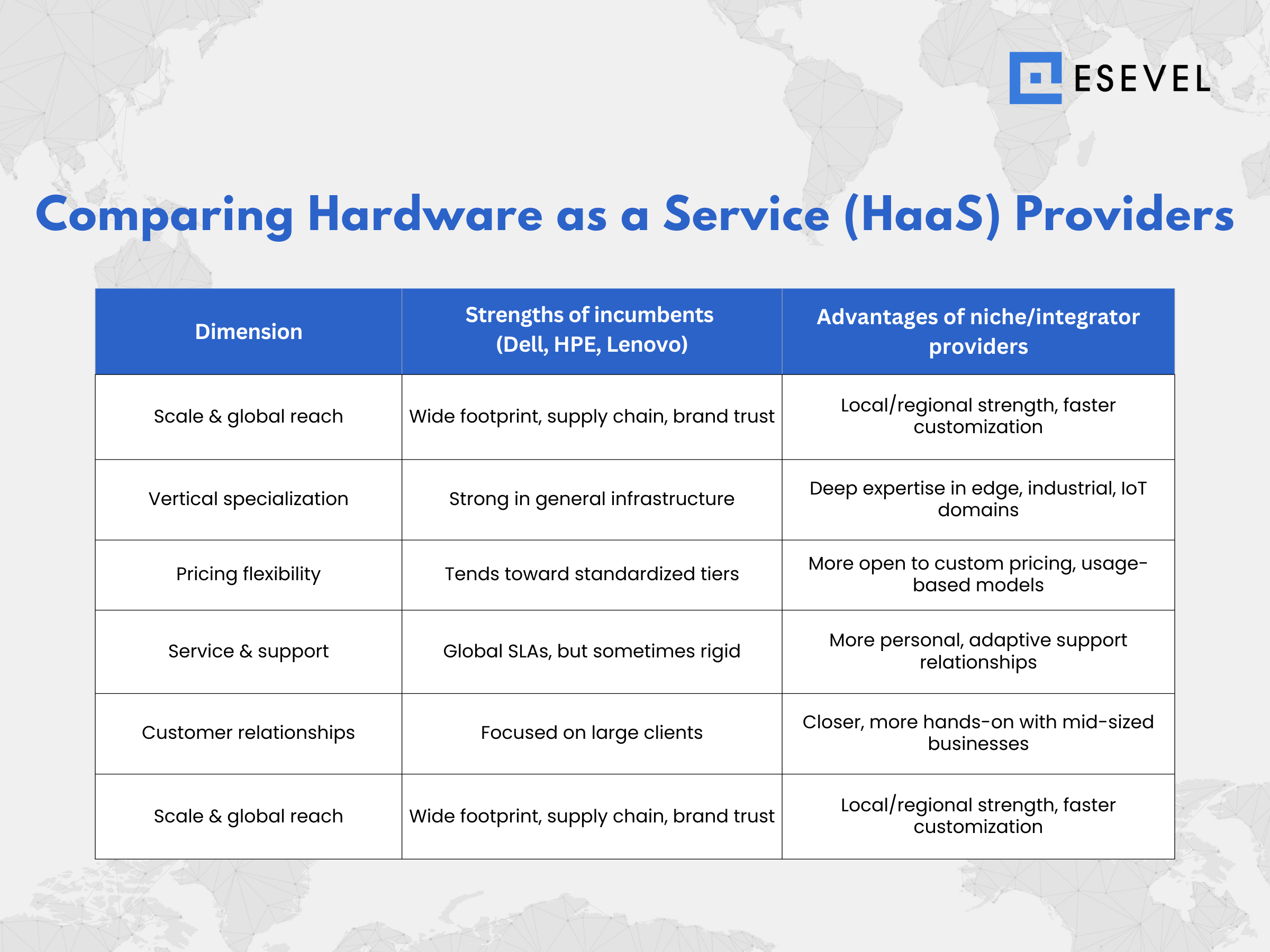
In practice, your best fit depends on which use case dominates your fleet:
- For enterprise infrastructure, incumbents typically offer stability and coverage
- For device fleets and endpoints, MSPs or regional HaaS firms may deliver more agility
- For edge, IoT, or specialized hardware, niche firms often provide better domain fit
How to select the right hardware as a service company
When evaluating, keep these criteria front and center:
Key evaluation criteria
- SLA terms & performance guarantees (uptime, repair/replacement windows)
- Refresh/upgrade policy (how often you get new hardware)
- Hardware quality & vendors used
- Support coverage/geography
- Exit/buyout clauses, termination terms
- Transparency in cost and hidden fees
- Data security, compliance, data wiping provisions
- Integration with your IT asset management and policies
Questions to ask prospective providers
- After 3 years, can we refresh hardware or buy it out?
- What happens if the provider fails to meet SLA commitments?
- Are there penalties, hidden usage charges, or overages?
- How do you handle data wiping and device returns?
- Can I mix HaaS-provisioned and owned hardware in one fleet?
- What is your coverage and support in my geographic regions?
Pitfalls to avoid
- Locking into overly rigid refresh cycles
- Hidden fees for support, logistics, or upgrades
- Insufficient exit rights or restrictive buyout terms
- Misaligned refresh cycles (hardware becomes obsolete before refresh)
- Overemphasis on low monthly cost without factoring all services
A pilot or proof-of-concept is strongly advised. Start small, test support responsiveness, assess total cost over time, and evaluate user satisfaction before rolling out widely.
Outlook and trends in the HaaS provider landscape
The hardware as a service market is still evolving. Here’s what’s ahead:
- Consolidation: we’ll see incumbents acquire niche providers to add vertical or regional strength
- Hybrid pricing models: usage-based, consumption + base, or hybrid subscription models will become more common
- Stronger tie-ins with IoT, AI, edge computing, and managed services: hardware will increasingly be a platform for analytics and support services
- Leasing and financing firms will play a critical role in enabling HaaS adoption by absorbing hardware risk
- Greater data-driven services and upselling: providers will monetize usage data, predictive maintenance, analytics, and add-ons
In short, hardware is shifting from a one-time sale to being a long-term service platform.
FAQs
Are HaaS and DaaS/device as a service the same?
They overlap—but DaaS typically focuses on desktops/PCs. HaaS is broader, spanning servers, networking, edge, and more.
Will large hardware vendors squeeze out niche HaaS firms?
Possibly in core markets, but niche providers with domain focus or geographic strength can still thrive.
What is a typical contract length or refresh cycle?
Often 2–5 years. Refresh cycles might be 3 years for devices, shorter for high-demand gear, sometimes even annually.
What happens at contract end?
You return hardware (or buy it), the provider wipes data securely, and replacement or renewal happens per agreement.
Can I mix HaaS with owned hardware?
Yes. A hybrid approach is common. Use HaaS where it adds value; retain ownership where it makes sense.
How do SLAs differ across providers?
They vary in response time, uptime guarantees, penalties, and geographic support. Read them carefully.
Do you provide servers as part of HaaS?
No. Esevel’s HaaS covers end-user hardware—primarily laptops and, on a limited basis, mobile phones. Server hardware and related services are not included.
Choosing a winner in your HaaS journey
Not all hardware as a service companies are created equal. The best ones combine trust, domain fit, flexibility, and transparent terms. As you evaluate providers:
- Prioritize clarity in refresh terms and exit rights
- Favor solid support SLAs and geographic presence
- Beware of hidden fees or restrictive policies
- Start with a small pilot before scaling
If your organization has distributed or hybrid teams, your ideal partner will be able to support devices, networking, and edge hardware globally. That’s where a company like Esevel becomes relevant: we can integrate HaaS offerings with device procurement, device tracking, security, and support into one stack—helping you manage your entire hardware lifecycle without the usual headaches.