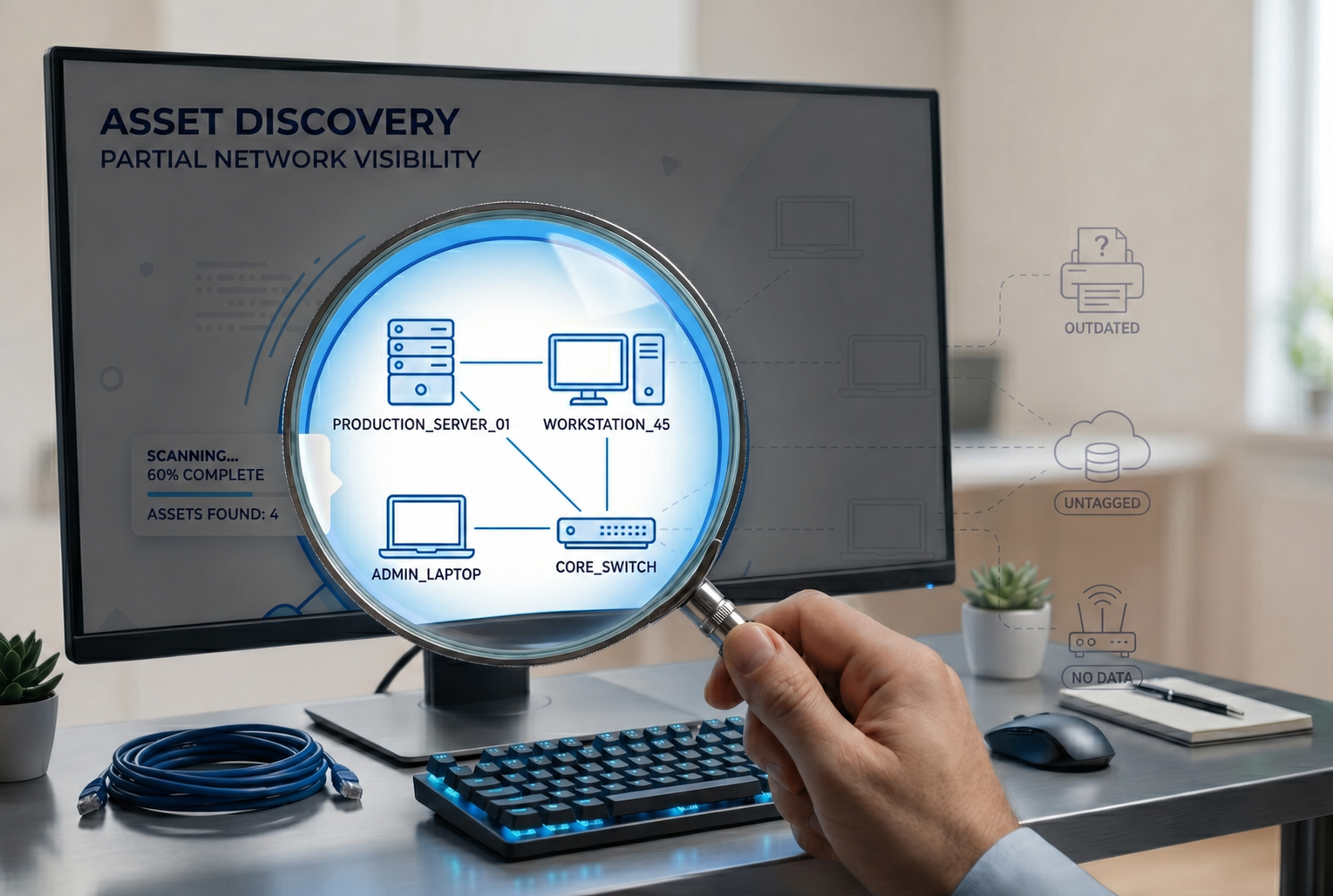
Most companies believe they have visibility into their IT assets because they use discovery tools and maintain asset records. In reality, what they see is often incomplete and fragmented, especially as infrastructure expands across teams, locations, and systems.
As organizations adopt remote and global work models, IT asset discovery becomes harder to maintain. Devices operate outside corporate networks, software usage changes rapidly, and asset records quickly become outdated.
This creates a gap between what exists in the environment and what is actually managed, which directly impacts operational efficiency and security as teams scale.
What is IT asset discovery
A clear view of an organization’s IT environment starts with identifying its devices, systems, and software. This process helps teams understand what assets exist, where they are located, and how they are being used. It also forms the foundation before any asset management or control can be effectively applied.
IT asset discovery definition
In simple terms, what is IT asset discovery? It is the process of detecting and recording IT assets within an environment, including hardware, software, and network-connected systems. This process is often part of broader IT asset discovery IT management, where discovery feeds into tracking and reporting systems.
What IT asset discovery includes
IT asset discovery generally covers several categories of assets within an organization:
- Devices such as laptops, desktops, and other endpoints
- Applications and software usage across systems
- Network-connected infrastructure such as servers and routers
- Shadow IT, including unmanaged or unauthorized tools and devices
While discovery provides an initial view of infrastructure, it only answers one question: what exists. Managing those assets requires a different set of processes and systems.
Why IT asset discovery is broken for modern teams
Traditional IT asset discovery was designed for centralized environments where devices operated within controlled networks. In these environments, discovery tools could scan networks and reliably detect assets. However, modern teams operate in distributed environments where these assumptions no longer hold.
Where the IT asset discovery process breaks
The IT asset discovery process becomes less reliable as infrastructure becomes more distributed. Several common issues appear:
- Devices operating outside corporate networks are not consistently detected
- Manual updates result in outdated or incomplete asset records
- Multiple tools create inconsistent or duplicate data
- Global teams rely on different vendors and processes across regions
These gaps reduce the accuracy of asset data and make it difficult to maintain a consistent view of infrastructure.
Why visibility does not equal control
Even when discovery tools successfully identify assets, they do not provide control over how those assets are used, maintained, or managed. Teams may know that a device exists, but they often lack clear ownership, usage context, or lifecycle status.
This creates situations where assets are visible in systems but are not properly managed in operations. As a result, discovery becomes a snapshot of infrastructure rather than a reliable source of truth.
Impact on operations
When discovery breaks down, teams lose confidence in their asset data. This affects onboarding, support, and security processes because decisions are based on incomplete or outdated information.
This is why many organizations rely heavily on tools to improve visibility, although tools alone do not fully solve the problem.
IT asset discovery tools and software
IT asset discovery tools are the most common approach used by organizations to identify and track infrastructure. These tools automate the process of detecting devices and systems, reducing the need for manual tracking.
Types of IT asset discovery tools
IT asset discovery tools use different methods to detect assets across environments, which affects how complete and reliable the results are.
- Network-based discovery tools scan the network to identify connected devices, making them effective in controlled environments but less reliable for remote devices.
- Agent-based discovery tools rely on software installed on devices, allowing more consistent tracking even outside corporate networks, but they require setup and maintenance.
- Cloud and SaaS discovery tools focus on identifying applications and usage in cloud environments, helping detect shadow IT but not covering physical devices.
Because each type covers different areas, companies often use a combination of these tools to improve overall visibility.
Best IT asset discovery tools
There are many IT asset discovery tools available, ranging from open source solutions to enterprise platforms. While they provide similar core capabilities such as detection and reporting, they differ in how they collect data, integrate with systems, and scale across environments.
Some commonly used IT asset discovery tools include:
- Lansweeper, which is widely used for network-based discovery and asset inventory across on-premise environments
- ServiceNow Discovery, which focuses on enterprise environments and integrates with IT service management workflows
- ManageEngine AssetExplorer, which combines asset discovery with inventory and basic management features
- Qualys AssetView, which provides cloud-based asset discovery with a focus on security and vulnerability visibility
- Device42, which supports discovery across hybrid environments, including data centers and cloud infrastructure
The best IT asset discovery tool depends on the environment, scale, and level of integration required. Organizations with centralized networks may rely more on network-based discovery, while distributed teams often require a combination of approaches.
Despite their usefulness, these tools primarily solve detection rather than management. They help identify what exists, but they do not ensure that assets are consistently tracked, maintained, or managed across their lifecycle.
The limitations of IT asset discovery tools
IT asset discovery tools provide visibility into infrastructure, but they do not ensure that assets are properly managed over time. They capture data at specific points, which means the information can quickly become outdated in dynamic environments.
Key limitations
Several limitations affect how effective these tools are in practice:
- Discovery is not continuous or reliable for remote or offline devices
- Ownership and accountability are not always clearly defined
- Discovery is not connected to onboarding or offboarding workflows
- Lifecycle stages such as repair, replacement, and recovery are not managed
Even when combined with IT discovery and asset management software, these tools still operate primarily as visibility systems rather than operational systems.
Why this matters
Discovery tools can show what exists, but they do not control how assets are used, maintained, or tracked over time. This creates a gap between visibility and control, which becomes more significant as organizations scale.
Traditional vs modern IT asset visibility
The way organizations approach IT asset visibility has changed as infrastructure has become more distributed and dynamic. Traditional discovery methods were built for centralized environments, while modern approaches are designed to handle assets that move across users, locations, and systems.
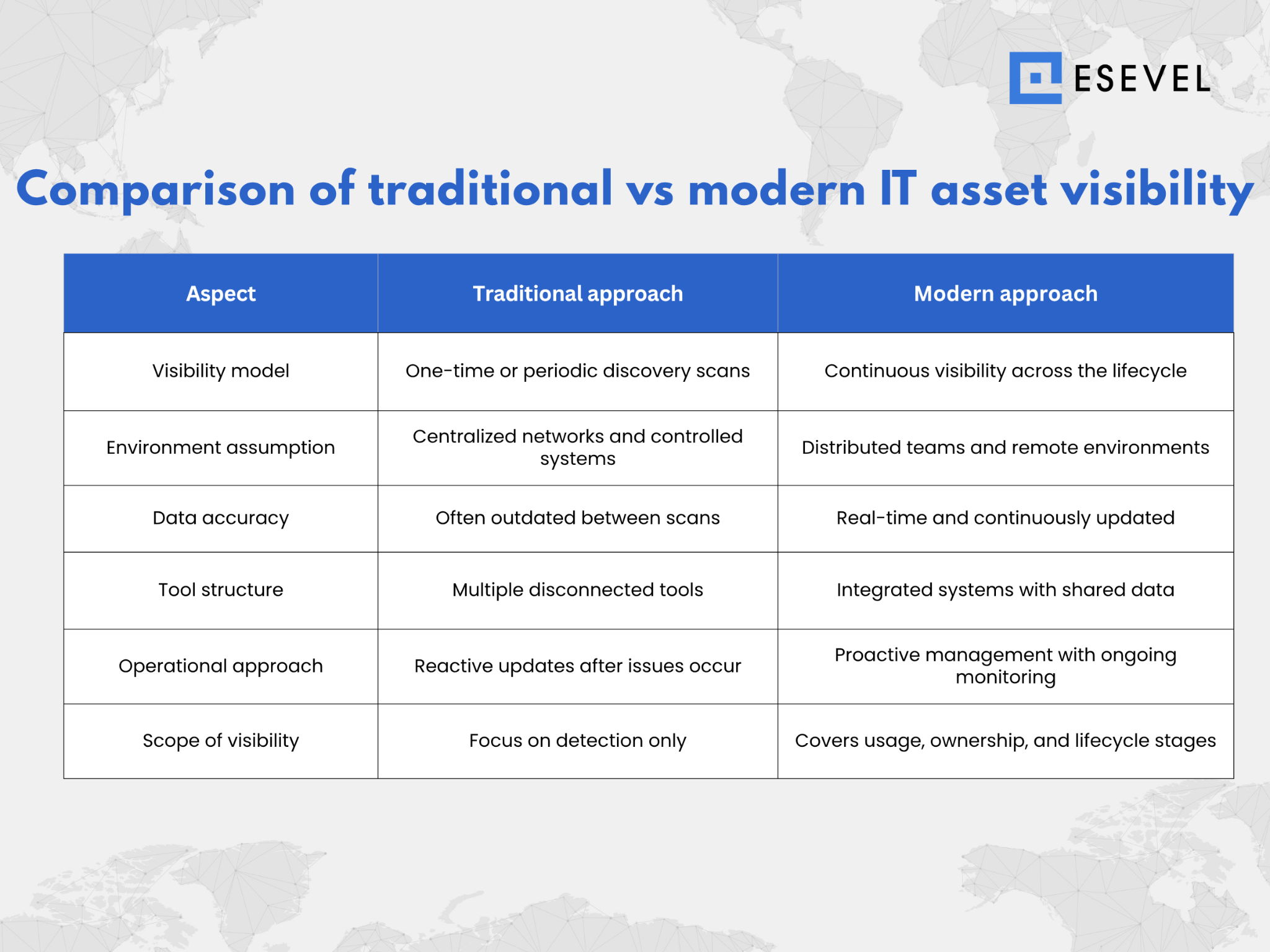
Traditional approaches rely on periodic discovery, which means asset data is only accurate at the time of the scan. As soon as devices move, change users, or go offline, that data quickly becomes outdated. This model worked when infrastructure was centralized, but it struggles to keep up with modern environments where assets are constantly changing.
Modern approaches focus on continuous visibility, where asset data is updated in real time and connected to operational workflows. Instead of treating discovery as a one-time activity, visibility becomes part of how infrastructure is managed every day. This allows teams to maintain a consistent view of assets across regions, reduce reliance on manual updates, and support operations at scale.
Rethinking IT asset discovery for distributed teams
Modern organizations need to rethink IT asset discovery as part of a broader system rather than a standalone function. Discovery alone cannot keep up with the complexity of distributed teams, where devices, users, and systems are constantly changing across locations.
A lifecycle-based approach
A lifecycle approach connects discovery with operational processes such as deployment, support, and recovery. This ensures that assets are not only identified, but also consistently managed throughout their use, reducing gaps between teams and systems.
Global infrastructure management
Managing infrastructure across regions requires more than visibility. Teams need consistent processes and centralized data to handle different vendors, timelines, and support requirements without losing control, especially as operations scale.
IT asset discovery service and solutions today
Organizations approach IT asset discovery in different ways depending on their needs and infrastructure complexity.
Types of solutions
There are several types of solutions available:
- Discovery-only tools that focus on identifying assets
- Combined platforms that include asset management features
- Managed services that handle infrastructure operations externally
Each IT asset discovery service or IT asset discovery solution offers different levels of functionality, but the right choice depends on how well it supports operational workflows.
Choosing the right approach
Selecting the right solution depends on whether the goal is visibility, control, or both. Discovery-only tools are useful for identifying assets, but they often need to be combined with additional systems to support tracking, maintenance, and operational workflows.
As infrastructure becomes more distributed, many companies start looking for solutions that connect discovery with lifecycle processes such as deployment, support, and recovery. Some providers, including Esevel, take this approach by combining visibility with operational execution, helping teams manage assets more consistently across regions without relying on disconnected tools.
FAQs
What is IT asset discovery
IT asset discovery is the process of identifying devices, systems, and software within an organization. It provides an initial view of infrastructure but does not manage assets over time.
What are IT asset discovery tools
IT asset discovery tools are software solutions that detect and track IT assets across networks and systems. They improve visibility but have limitations in managing asset lifecycles.
What is the IT asset discovery process
The IT asset discovery process involves scanning environments, identifying assets, and recording data into a system. It is typically the first step in asset management.
What is the best IT asset discovery tool
The best IT asset discovery tool depends on the environment, scale, and integration needs. Different tools are designed for different use cases.
How does IT asset discovery differ from asset management
IT asset discovery identifies assets, while asset management tracks and controls them throughout their lifecycle. Discovery provides visibility, while management ensures operational control.
Move beyond discovery to full IT lifecycle control
IT asset discovery is only the starting point, but it does not provide the control needed to manage infrastructure at scale. As organizations grow, relying only on discovery tools creates gaps in visibility, ownership, and operational consistency.
Lifecycle visibility connects discovery with real operations, enabling teams to manage assets from procurement to recovery without fragmentation. Esevel supports this by enabling consistent asset management across global teams, including Europe, the US, and APAC, while reducing reliance on disconnected systems.