Many companies rely on outsourced IT support to manage systems without building a large internal team. This model helps handle support requests, maintain infrastructure, and reduce operational workload. It works well when systems remain simple and growth is limited.
However, as businesses expand, IT operations become more complex. More users, devices, and applications increase the need for coordination. At this stage, traditional outsourcing often struggles to maintain visibility and consistency across operations.
This is where lifecycle driven IT becomes relevant. Instead of treating support, devices, and operations as separate tasks, lifecycle IT manages them as one connected system designed to scale.
What outsourced IT support means
Outsourced IT support refers to using external providers to manage IT operations. These providers handle technical support, system maintenance, and monitoring on behalf of the business.
Typical outsourced IT support services include:
- Help desk support for resolving user issues
- System monitoring and maintenance
- Device and infrastructure management
- Security updates and access control
This model focuses on resolving issues and maintaining systems through external providers. It is effective for handling day to day support needs, but it does not always provide full visibility across the entire IT environment.
What lifecycle driven IT means
Lifecycle driven IT is an approach that manages IT operations across the full lifecycle of devices and systems. It connects procurement, deployment, management, support, and offboarding into one coordinated process.
This model focuses on managing IT as a continuous system rather than isolated tasks. By linking each stage, businesses can maintain consistency, improve visibility, and reduce gaps across operations.
A lifecycle driven IT approach typically includes:
- Device procurement and delivery across regions
- Standardized provisioning and configuration before use
- Centralized device tracking and inventory visibility
- Ongoing monitoring and support coordination
- Repair, replacement, and hardware support
- Secure offboarding and device retrieval
By connecting these stages, lifecycle IT provides visibility and control across operations.
Key differences between outsourced IT support and lifecycle IT
| Aspect | Outsourced IT support | Lifecycle IT |
| Approach | Reactive issue resolution | Proactive lifecycle management |
| Structure | Separate services | Integrated system |
| Visibility | Limited across tools | Centralized across devices |
| Coordination | Vendor based | System driven |
| Scalability | Increases complexity | Designed to scale |
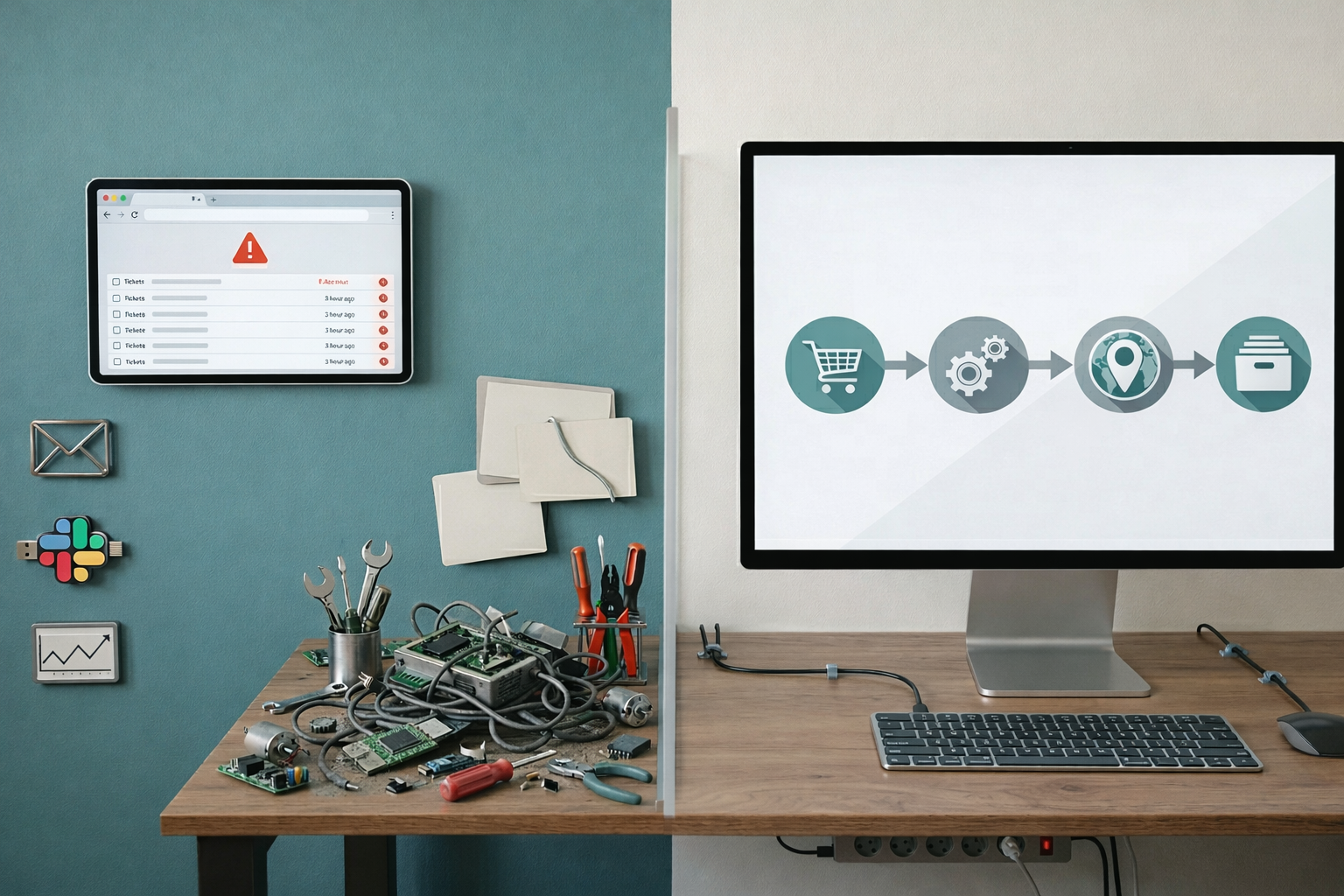
Outsourced IT support focuses on handling issues as they arise, while lifecycle IT focuses on managing operations across the entire system. This difference affects how businesses maintain visibility, coordinate processes, and scale their IT environment over time. As operations grow, these differences become more noticeable in daily workflows and system performance.
Why outsourced IT support struggles at scale
Outsourced IT support works well in smaller environments but becomes harder to manage as operations grow. As businesses expand, more users, devices, and systems increase dependencies, making coordination more complex and slowing response times.
Coordination becomes more complex
As teams grow, support must cover more users and systems. Coordinating requests across providers and locations increases complexity and slows response time.
Visibility across systems is limited
Outsourcing often relies on separate tools and providers. This limits visibility into device status, system performance, and asset tracking.
Vendor fragmentation increases
Businesses may rely on multiple providers for different regions or services. This creates inconsistent processes and communication gaps.
Operations become inconsistent
Different providers may follow different standards. This leads to uneven support experiences and makes it harder to maintain consistent IT operations.
These challenges show that outsourcing alone does not scale efficiently with growing operations.
Why lifecycle IT scales better
Lifecycle IT is designed to support growing operations by connecting all stages of IT into one coordinated system. Instead of managing support, devices, and infrastructure separately, lifecycle IT treats them as part of a continuous process. This structure allows businesses to scale without increasing operational complexity.
End to end visibility across devices and systems
Lifecycle IT provides centralized visibility across all devices and systems. IT teams can track device status, monitor performance, and understand how systems are used across the organization.
This visibility helps teams identify issues early, maintain accurate inventory records, and ensure that devices remain aligned with company standards. As the number of users and devices increases, centralized visibility becomes essential to maintain control.
Standardized workflows across the lifecycle
Lifecycle IT introduces consistent workflows for key stages such as provisioning, maintenance, support, and offboarding. Each device follows the same process from deployment to retirement.
Standardization reduces errors and improves efficiency. It also ensures that all devices meet the same configuration and security requirements, regardless of where employees are located.
Centralized control of IT operations
Lifecycle IT allows IT teams to manage policies, configurations, and system settings from a central system. This helps enforce consistent standards across devices and users.
Centralized control is important as teams expand across locations. It ensures that IT operations remain consistent and reduces the risk of unmanaged systems or configuration drift.
Coordinated support and system management
In a lifecycle model, support is not isolated from system management. Support teams have access to device data, system status, and lifecycle history, which helps them resolve issues more effectively.
This coordination reduces response time and improves the quality of support. It also ensures that support actions align with broader IT operations.
Better alignment with growth and operational needs
Lifecycle IT is designed to adapt as businesses grow. As new employees join and more devices are added, the same structured processes can be applied without rebuilding the system.
This allows organizations to scale operations while maintaining stability, visibility, and consistent performance across their IT environment.
These capabilities make lifecycle IT more suitable for growing teams. By managing IT as a connected system, businesses can scale operations without increasing complexity or losing control.
Operational impact comparison
The difference between outsourcing and lifecycle IT directly affects daily operations. These differences influence how quickly teams can onboard employees, resolve issues, and maintain system visibility. Over time, they also impact productivity and overall system reliability.
With outsourced IT support:
- Onboarding may slow due to coordination delays
- Device tracking can become inconsistent
- Support response may vary across providers
- System visibility remains limited
With lifecycle IT:
- Onboarding follows structured workflows
- Devices are tracked throughout their lifecycle
- Support is coordinated within one system
- Visibility is maintained across operations
These differences shape how efficiently teams can work and how reliably systems perform. A more structured approach helps reduce disruptions and improve consistency across operations.
When outsourced IT support still makes sense
Outsourced IT support remains a practical option in environments where IT operations are relatively simple and predictable. The model is built around handling support requests and maintaining systems, which can be sufficient when coordination needs are limited.
Small teams with limited operational complexity
Smaller organizations often operate with fewer users, devices, and applications. In these cases, IT demand is lower and easier to manage. Outsourced IT support can provide access to technical assistance without the cost of building an internal IT team.
Routine tasks such as troubleshooting, software installation, and basic maintenance can be handled effectively through external providers.
Single region or centralized operations
When employees, devices, and infrastructure are located in one region, coordination becomes simpler. There is less need to manage time zone differences, cross border logistics, or multiple vendors.
In this setup, outsourced IT support services can maintain consistent response times and service quality because operations remain within a controlled environment.
Stable and predictable IT environments
Organizations with stable systems and limited change can rely on outsourced IT support to maintain operations. For example, businesses with fixed applications and low device turnover may not require structured lifecycle management.
In these environments, IT tasks are often repetitive and do not require complex coordination across multiple stages.
Limited need for device lifecycle coordination
If a business does not frequently onboard or offboard employees, or does not manage large numbers of devices, the need for lifecycle management is reduced.
Outsourced technical support can handle isolated issues without requiring full visibility into device lifecycle processes.
In these situations, outsourced IT support provides a cost effective and straightforward way to maintain IT operations.
What growing teams actually need
As organizations expand, IT operations become more dynamic. More employees, devices, and systems increase the need for coordination, visibility, and structured processes.
Centralized visibility across devices and systems
Growing teams need a clear view of their IT environment. This includes knowing where devices are located, how they are performing, and whether they meet company standards.
Without centralized visibility, IT teams may struggle to track assets, monitor system health, and respond to issues effectively.
Structured device lifecycle management
As hiring increases, businesses must manage device provisioning and retrieval more frequently. Each stage, from procurement to offboarding, requires coordination.
A structured lifecycle approach ensures that:
- Devices are prepared before employees receive them
- Systems are configured consistently
- Devices are tracked throughout their use
- Data is secured when devices are retired
This reduces delays and improves operational consistency.
Consistent support across locations
As teams grow across locations, support must remain consistent. Employees should receive the same level of service regardless of where they are based.
This requires coordinated support processes, clear workflows, and access to system information that helps resolve issues efficiently.
Coordination between systems, devices, and support
Growing environments introduce dependencies between systems and devices. For example, user access, device configuration, and application setup must work together.
IT operations must connect these elements to avoid gaps. Without coordination, issues in one area can affect the entire workflow.
Ability to scale without increasing complexity
Growth should not require rebuilding IT processes. Teams need systems that can handle more users and devices without increasing manual effort.
Structured IT operations allow businesses to scale while maintaining performance, security, and reliability.
These requirements show that growing teams need more than basic support. They need a coordinated system that connects devices, support, and operations into one scalable model.
Frequently asked questions about outsourced IT support and lifecycle IT
What is outsourced IT support and how does it work
Outsourced IT support is a model where a company hires external providers to manage IT tasks such as troubleshooting, system maintenance, and monitoring. The provider handles support requests and infrastructure operations, usually through remote services, instead of the company managing IT internally.
What is lifecycle driven IT in simple terms
Lifecycle driven IT is an approach that manages the full lifecycle of devices and systems, from procurement and setup to support and offboarding. It connects these stages into one system to improve visibility, consistency, and operational control.
What is the difference between outsourced IT support and lifecycle IT
Outsourced IT support focuses on resolving issues through external providers, while lifecycle IT manages devices, systems, and support as a connected process. Lifecycle IT provides centralized visibility and structured workflows, which makes it more suitable for scaling operations.
Why does outsourced IT support struggle at scale
Outsourced IT support can struggle at scale because it relies on separate providers and tools. As systems grow, coordination becomes more complex, visibility decreases, and support consistency can vary across teams and locations.
Which is better for growing teams, outsourced IT or lifecycle IT
Lifecycle IT is generally better for growing teams because it provides structured processes, centralized visibility, and coordinated operations. These capabilities help maintain consistent performance as the number of users, devices, and systems increases.
Building IT operations that scale
Outsourced IT support works for basic needs, but it becomes harder to manage as operations grow. Businesses need a more structured way to manage devices, systems, and support together.
Lifecycle driven IT connects procurement, provisioning, tracking, support, and offboarding into one system. This helps teams maintain visibility and consistency as they scale.
Platforms such as Esevel combine software and IT operations into a single system. This allows businesses to manage device lifecycle, support, and system visibility across locations. Adopting a lifecycle approach helps organizations scale IT operations while keeping systems stable and manageable.