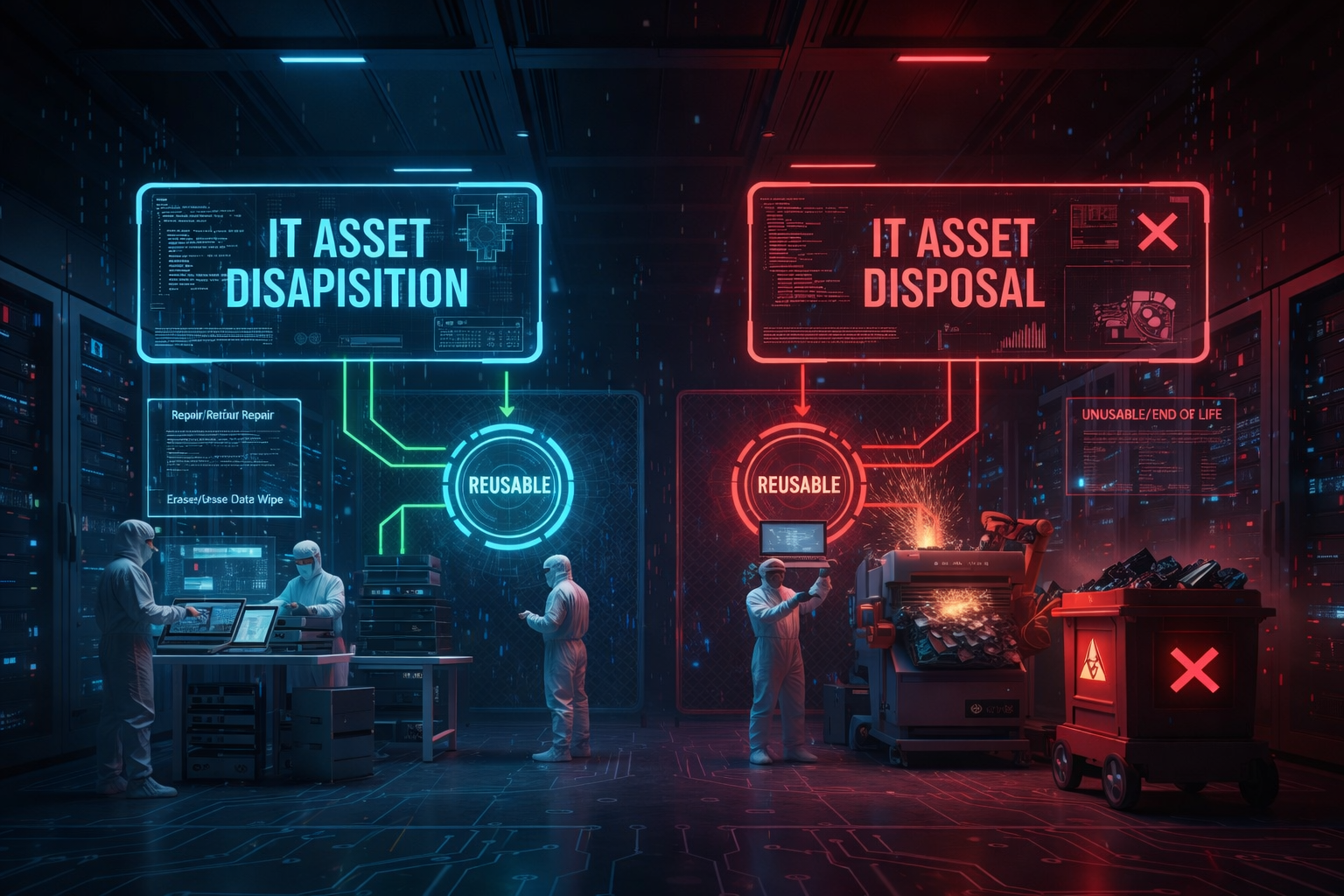
You’re planning to retire a fleet of company laptops. But suddenly you get stuck—should that process be called “disposition” or “disposal”? Which one offers value, which one ensures safety, and which one fits your compliance needs?
This confusion is common. Many treat the two terms as interchangeable, but they carry very different implications—especially for distributed teams, IT budgets, and data security.
In this post, I’ll explain what disposition vs disposal really mean in the IT world. We’ll compare them side by side, explore when each makes sense, and show you why a disposition-first mindset can protect your capital, reduce waste, and simplify audit trails. If you manage devices for a remote workforce, this distinction becomes more than semantics—it shapes your operations.
Let’s start by defining both.
Why understanding the difference matters
At first glance, disposition and disposal might sound like two ways of saying the same thing. In reality, they represent completely different mindsets about how organizations treat their IT assets—especially as those assets reach the end of their useful life.
Understanding this difference matters because it directly affects your strategy, value recovery, and data security.
When you treat every outdated laptop or server as something to simply discard, you’re missing opportunities to recover value, reduce environmental waste, and even strengthen compliance. On the other hand, viewing old equipment through the lens of IT asset disposition encourages your team to see potential—through refurbishment, redeployment, resale, or donation.
For startups and distributed teams, this isn’t just a cost-saving tactic—it’s a governance issue. A clear distinction between disposition vs disposal ensures your organization can:
- Retain control of sensitive data through secure processes.
- Recover residual value from functioning devices.
- Comply with environmental and e-waste regulations.
- Document every handoff for full auditability.
Platforms like Esevel help companies operationalize this mindset. Esevel automates how devices are classified, securely wiped, and either remarketed or recycled. For distributed companies that manage laptops across countries, such a system ensures consistency—no matter where the device lives or who uses it.
Now, let’s clarify the terminology so you can see how IT disposition and IT disposal play very different roles in your device lifecycle.
Defining IT disposition
IT asset disposition (ITAD) refers to the strategic and structured management of technology assets as they move through the end-of-life stage of their lifecycle. It’s not just about “getting rid” of hardware—it’s about maximizing its remaining value while ensuring data security and compliance.
Meaning and scope
In essence, IT disposition covers everything from assessment and refurbishment to redeployment and remarketing. It’s a lifecycle-oriented approach where devices are not immediately discarded but evaluated for possible reuse or resale.
Key activities under disposition
A proper disposition plan typically includes:
- Assessment: Evaluating the device’s condition, data sensitivity, and market value.
- Refurbishment: Repairing or upgrading components for extended use.
- Redeployment: Moving working assets to new employees or departments.
- Remarketing or resale: Selling devices to recover residual value.
- Recycling: As a final step, ensuring responsible recycling for devices beyond repair.
Goals of disposition
The main goals of IT disposition are to:
- Maximize value recovery from usable assets.
- Extend device lifecycles through reuse and redeployment.
- Reduce e-waste and environmental impact.
- Maintain data security through verified sanitization.
For example, Esevel helps organizations manage the disposition process by automating device evaluation and coordinating certified vendors for refurbishment, resale, or recycling—all while tracking certificates and compliance records in one dashboard.
Defining IT disposal
While disposition focuses on optimizing and extending an asset’s value, IT disposal is the final, irreversible step in an asset’s lifecycle — the point where the device is permanently removed, destroyed, or recycled. It’s about risk elimination, not recovery.
Disposal is necessary, but it’s also the costliest and least flexible option if used prematurely. Once a device enters the disposal stage, there’s no going back. That’s why understanding when and how to apply it is critical for companies managing hundreds or even thousands of distributed laptops.
Meaning and scope
In IT terms, disposal means the end-of-life removal or destruction of assets that are no longer usable, repairable, or safe to redeploy. It’s the stage where devices are either:
- Physically destroyed to ensure complete data removal, or
- Recycled to recover materials in compliance with e-waste regulations.
Unlike disposition, which seeks to extract remaining value, disposal is designed to eliminate risks — especially those tied to sensitive information or regulatory requirements.
Key activities under disposal
Common disposal activities include:
- Data destruction: Erasing or physically destroying storage media to prevent data recovery.
- Shredding or degaussing: Mechanically destroying drives or using magnetic fields to render them unreadable.
- Recycling: Separating components and materials for proper waste management.
- Decommissioning: Formally retiring assets from inventory and updating financial or compliance records.
Each of these steps must be documented and verified. Esevel simplifies this by automating chain-of-custody tracking, generating certificates of destruction, and integrating the information into your IT asset register — ensuring your disposal processes are always audit-ready.
Goals of disposal
The goals of IT disposal are more defensive than strategic, but they are essential for business continuity and compliance:
- Eliminate data security risks from outdated or compromised devices.
- Comply with data protection and environmental regulations.
- Clear obsolete assets to make room for new equipment.
- Prevent environmental harm through responsible recycling.
In other words, disposal is about finality and protection — ensuring that assets that cannot be safely reused or sold are handled securely and responsibly.
Esevel’s integrated IT management platform helps companies manage this stage efficiently by coordinating secure pickup, destruction, and certification across 88+ countries — all while maintaining a complete digital paper trail for compliance teams.
Key differences: Disposition vs disposal
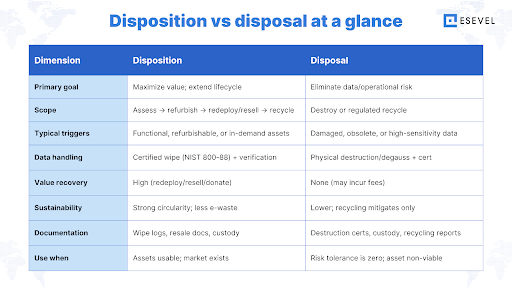
Now that we’ve defined both concepts, it’s time to look at how disposition vs disposal differ in practice. While the two share a connection — both deal with end-of-life assets — their objectives, scope, and impact diverge sharply. Understanding these differences helps companies choose the right strategy for each device and avoid unnecessary losses.
Scope and breadth
Disposition covers the entire range of end-of-life activities — from assessing and refurbishing to reselling, donating, or recycling. It’s a strategic lifecycle process aimed at extracting the maximum remaining value from an asset.
Disposal, in contrast, represents the final stage within disposition. It’s the point of no return, when an asset is destroyed or recycled because it no longer has any use or resale potential.
Think of disposition as the whole playbook, and disposal as one specific move — used only when there are no better options left.
Process and approach
The disposition process is proactive and planned. It starts early, with clear inventory tracking, condition assessment, and vendor coordination. This ensures that reusable devices find a second life and only the unrecoverable ones move to destruction.
The disposal process, however, is reactive. It’s usually triggered when a device fails, becomes obsolete, or poses a security risk. The goal is to remove it swiftly and securely, minimizing exposure and liability.
Platforms like Esevel streamline both processes by automating asset tagging, data sanitization, and certified vendor management. That means companies can handle reuse and destruction in a single workflow — without manual tracking or fragmented spreadsheets.
Outcomes and value recovery
Disposition aims for value recovery. Devices that are still functional can be refurbished, redeployed, or sold, reducing total cost of ownership. Even donation programs can create goodwill and potential tax benefits.
Disposal, by contrast, generates no direct financial return. It’s an expense — covering transport, destruction, and compliance documentation.
That said, disposal still contributes value indirectly by reducing risk. A clean, secure disposal record protects your organization from data breaches and audit failures.
Risk posture and data security
When it comes to data security, disposal carries zero tolerance for risk. Devices with sensitive or classified information must be wiped or destroyed beyond recovery.
Disposition also prioritizes data security, but it balances it with asset recovery. Certified data wiping tools and verification reports allow companies to safely redeploy or resell devices without compromising information.
Esevel integrates both options into its IT management platform. Every asset undergoes secure data sanitization before moving to either the resale or destruction stage, ensuring consistent global compliance.
Environmental and sustainability impact
Disposition supports circular economy principles. By extending device lifespans, reducing e-waste, and promoting reuse, it aligns with sustainability and ESG (Environmental, Social, and Governance) goals.
Disposal, on the other hand, is inherently less sustainable — especially when devices are shredded or incinerated. Recycling offsets this impact somewhat, but it’s still less environmentally friendly than refurbishment or reuse.
That’s why many forward-thinking companies adopt a “disposition-first, disposal-last” policy. Platforms like Esevel make it practical to implement this hybrid approach at scale, tracking every asset’s outcome across refurbishment, resale, or recycling.
When to use disposition vs when to use disposal
Knowing when to apply disposition or disposal depends on three key factors: the asset’s condition, its data sensitivity, and its market value. Misjudging this choice can either lead to lost value or unnecessary risk exposure. The best IT asset strategies blend both approaches — prioritizing disposition whenever possible, with disposal as the secure fallback.
Criteria for choosing between disposition and disposal
- Asset condition
- Disposition: Use when devices are still functional, repairable, or have components that can be reused.
- Disposal: Choose when hardware is damaged beyond repair, unsafe, or obsolete.
- Data sensitivity
- Disposition: Appropriate if data can be securely wiped and verified through certified tools.
- Disposal: Required for assets containing highly confidential, regulated, or personal data where even a minor risk is unacceptable.
- Resale market viability
- Disposition: Suitable if devices retain market value or can be remarketed after refurbishment.
- Disposal: Ideal when resale potential is negligible or when compliance costs outweigh possible returns.
Esevel’s platform simplifies this assessment by automatically categorizing assets based on age, usability, and sensitivity level — helping IT and finance teams decide which route offers the best balance between value recovery and security.
A batch of two-year-old laptops still performs well but no longer meets your company’s hardware standards.
- Recommended approach: Disposition. Wipe data securely, refurbish, and resell or donate the laptops.
- Result: Generates residual value while reducing e-waste and improving sustainability metrics.
Scenario 2: Irreparably damaged or compromised devices
A few laptops suffered liquid damage, and one’s hard drive failed completely.
- Recommended approach: Disposal. Physically destroy or recycle components to prevent any data recovery.
- Result: Eliminates data risk and ensures compliance with data protection regulations.
Scenario 3: Security-critical hardware
A finance director’s laptop stores payroll information and customer data subject to data privacy laws.
- Recommended approach: Disposal, after verifying complete data destruction.
- Result: Prioritizes security and prevents regulatory exposure.
Hybrid and cascading approaches
Many companies now follow a hybrid or cascading approach:
- Try disposition first — assess if assets can be refurbished, redeployed, or resold.
- Fallback to disposal — destroy or recycle only what can’t be safely reused.
This structured flow ensures maximum value recovery with minimal waste. Esevel’s global device lifecycle management system supports this model, integrating secure data wiping, logistics, and vendor certification — so companies can apply both disposition and disposal workflows seamlessly across multiple countries.
Benefits of adopting a disposition mindset
Adopting a disposition-first mindset changes how companies think about their IT assets. Instead of treating end-of-life equipment as a burden, it reframes it as an opportunity — to recover value, improve sustainability, and strengthen governance. This shift not only reduces costs but also aligns with broader business and environmental goals.
Here are some of the biggest advantages of prioritizing disposition over disposal.
Recover residual value
Every laptop, monitor, or peripheral has a second life if handled correctly. Through refurbishment, redeployment, or resale, companies can recover part of their initial investment. For startups and scale-ups managing tight budgets, this recovered value can offset future hardware expenses.
With Esevel, this process becomes effortless. The platform identifies which devices are still valuable, coordinates certified refurbishers or resellers, and automates financial reconciliation. You get both transparency and traceability — without the manual work.
More sustainable and less e-waste
Disposition supports sustainability by extending product lifecycles and reducing landfill waste. Each refurbished laptop means one less device manufactured — and one less unit contributing to e-waste.
When companies integrate disposition into their IT policies, they actively participate in the circular economy, where reuse, repair, and recovery take priority over disposal. Esevel’s partnerships with certified recyclers and refurbishers ensure that even retired assets contribute positively to environmental targets.
Flexibility and optionality
A disposition-first approach gives your business options. You can decide whether to redeploy devices to new hires, sell them, or donate them to partner organizations. This flexibility ensures that every asset is used to its fullest potential before any irreversible steps are taken.
By managing disposition and disposal in one platform, Esevel allows IT teams to pivot easily — from reuse to destruction — without losing visibility or control of the process.
Better alignment with ESG and circular economy goals
Investors, employees, and customers increasingly evaluate companies based on their Environmental, Social, and Governance (ESG) performance. A well-defined IT disposition policy shows measurable action toward these goals.
Disposition contributes to:
- Lower carbon footprint through extended device life.
- Ethical e-waste management through certified partners.
- Greater transparency in supply chain and reporting.
Esevel helps companies quantify these impacts by tracking the number of devices reused, recycled, or refurbished — data that feeds directly into ESG and sustainability reports.
Reduced total cost of ownership
Proper IT disposition lowers the total cost of ownership (TCO) for hardware assets. By recovering value and optimizing redeployment, companies delay new purchases and minimize replacement costs.
It also reduces hidden costs — like storage for unused assets or compliance risks from outdated equipment containing sensitive data. With Esevel’s automation, CFOs gain visibility into asset utilization and lifecycle costs, transforming what used to be a reactive IT function into a strategic business advantage.
Pitfalls and risks of treating everything as disposal
Many companies still default to disposal for all retired IT assets. On the surface, it seems simpler: destroy everything and eliminate risk. But this “one-size-fits-all” approach often backfires — leading to higher costs, wasted opportunities, and even compliance issues.
Let’s break down the common pitfalls of treating every asset as disposable.
Losing resale and reuse opportunities
By jumping straight to disposal, companies overlook the residual value in their hardware. Even devices a few years old can have resale potential in secondary markets or be redeployed internally after refurbishment.
This missed opportunity translates to direct financial loss. Instead of recovering part of your investment, you’re paying vendors to destroy devices that could have earned back some value. Esevel helps prevent this by evaluating each device’s condition before disposal, automatically recommending disposition-first actions when feasible.
Wasting resources and increasing e-waste
When devices that could have been reused or recycled are destroyed, it contributes to unnecessary e-waste and resource consumption. Manufacturing new devices consumes energy and rare materials, so every laptop that’s refurbished instead of replaced has a tangible environmental benefit.
By prioritizing disposition over destruction, organizations can significantly cut down on waste and support global sustainability targets. Esevel’s vendor ecosystem ensures retired assets are repaired, reused, or recycled through certified partners — reducing environmental impact without compromising security.
Missing documentation and audit gaps
Disposal-only approaches often lack proper tracking and documentation. Without a clear chain of custody or certificate of destruction, companies face audit risks and compliance challenges — especially under data protection and e-waste regulations.
A missing document might seem minor until an auditor or regulator asks for proof. Esevel addresses this by maintaining a digital paper trail for every device, from pickup to final disposition or disposal, ensuring accountability at every stage.
Data risk if disposal is done improperly
Even destruction isn’t foolproof if handled by uncertified vendors. Drives that aren’t completely shredded or degaussed can still contain recoverable information, exposing the company to data breaches or regulatory violations.
The assumption that “destroying everything” is safer only holds true if the process is verifiable and compliant. Esevel’s disposal partners follow strict security standards, providing verifiable destruction certificates so you can confidently close the loop on data risk.
Best practices and guidelines
Building a clear, structured framework for managing disposition vs disposal ensures consistency, compliance, and efficiency across your IT operations. These best practices help you make the right call for every asset — maximizing value when possible, and ensuring total security when disposal is necessary.
Establish a clear policy and governance framework
Start with an internal IT asset disposition policy that defines how assets are assessed, handled, and documented. The policy should outline:
- Who is responsible for approvals (IT, Finance, Compliance).
- When to use disposition versus disposal.
- Vendor certification requirements.
- Documentation standards (e.g., certificates of destruction or resale).
Having this policy in writing prevents ad-hoc decisions and supports consistency across teams and regions. Esevel helps companies enforce these rules through automated workflows that embed policy logic into every offboarding and asset management process.
Maintain accurate inventory and classification
The foundation of effective IT lifecycle management is knowing what you own and where it is. Keep a live inventory of all assets, including details like:
- Device make, model, and serial number.
- Purchase date and warranty status.
- Current condition and user assignment.
- Data sensitivity level.
This inventory enables your team to quickly distinguish candidates for disposition (usable, refurbishable) from those needing disposal (broken, noncompliant). Esevel’s platform automatically updates asset status as devices move through onboarding, active use, and end-of-life stages.
Choose vendors with dual capabilities
Work with partners who can handle both refurbishment and certified destruction. That ensures a seamless transition between reuse and disposal, depending on each device’s evaluation results.
Your vendor should provide:
- Secure logistics and chain-of-custody tracking.
- Certificates for data wiping, destruction, or recycling.
- Transparent reporting for compliance audits.
Esevel’s global vendor network meets these criteria, offering companies one point of contact for every stage — from data sanitization to recycling across 88+ countries.
Document every step of the process
Whether you’re reselling or destroying a laptop, documentation is key to proving compliance and accountability. Keep digital records for:
- Asset handoff and transport.
- Data wiping or destruction certificates.
- Resale or donation receipts.
- Final accounting and audit entries.
These records protect your business during financial or regulatory audits. Esevel automatically generates and stores this documentation, eliminating manual tracking and ensuring nothing falls through the cracks.
Build decision workflows and approvals
Formalize how decisions are made. Create simple workflows that guide employees and IT managers through the steps of evaluating, approving, and executing disposition or disposal actions.
For example:
- IT team identifies end-of-life devices.
- Finance verifies depreciation and potential resale value.
- Compliance reviews data handling procedures.
- Vendor executes and certifies the selected method.
Esevel’s approval workflows mirror this process digitally, ensuring transparency and accountability across all departments.
Ensure traceability and secure chain-of-custody
Every laptop, drive, or device should be trackable from pickup to final outcome. Use tamper-proof packaging, barcode tracking, and secure transport to maintain control.
A complete chain-of-custody prevents loss, theft, or data leakage during transit. Esevel’s integrated tracking ensures full visibility for every device — whether it’s being redeployed, refurbished, or destroyed — so your audit trail stays intact.
Illustrative examples and scenarios
Understanding how disposition vs disposal works in real life makes the difference tangible. Below are a few common business situations that show how the right choice can save money, protect data, and support sustainability goals.
Scenario A: Refurbish and resell instead of discard
A tech startup has 100 laptops that are three years old. They’re still in good working condition but no longer meet the performance requirements for developers. Traditionally, the company would have sent all these devices for disposal to “avoid the hassle.”
However, by applying a disposition-first approach, the IT team decides to:
- Securely wipe all drives using certified data sanitization software.
- Send the devices for minor refurbishment and quality checks.
- Partner with a certified reseller to remarket the laptops.
Outcome:
- The company recovers 30% of the original asset value through resale.
- E-waste is reduced significantly.
- All documentation — from data-wiping certificates to resale receipts — is digitally stored through Esevel for audit readiness.
This scenario highlights how choosing disposition over disposal supports both financial and sustainability objectives while maintaining compliance.
Scenario B: Disposal due to data sensitivity or damage
A financial services firm needs to retire devices used by its accounting team. Each laptop contains confidential financial reports and payroll data. Some units are damaged and cannot power on, making data wiping impossible.
In this case, the organization opts for secure disposal. Esevel coordinates the pickup and physical destruction of all devices, ensuring:
- Verified certificates of destruction.
- Chain-of-custody tracking from the office to the destruction site.
- Automatic updates in the company’s IT asset records.
Outcome:
- Zero data recovery risk.
- Full compliance with data protection regulations.
- Simplified reporting for the company’s auditors and compliance team.
This case shows that while disposal yields no financial return, it is crucial for eliminating risk and maintaining trust.
Scenario C: Hybrid trade-off
A global marketing firm manages thousands of laptops across multiple countries. Some devices are recent and still valuable; others are outdated or broken. Rather than using a single approach, the firm chooses a hybrid disposition-disposal model through Esevel.
Here’s how it works:
- Devices under three years old are wiped and redeployed to new hires.
- Those in fair condition are refurbished and sold.
- Nonfunctional units are responsibly recycled.
Outcome:
- The company reduces total hardware spending by reusing devices.
- It achieves sustainability reporting milestones for reduced e-waste.
- All asset movements are traceable, supporting ESG audits.
This approach demonstrates how a cascading strategy — reuse first, dispose last — allows organizations to extract the most from their IT assets while staying compliant worldwide.
Scenario D: Trade-off between cost and security
A startup finds itself with 50 laptops that each could resell for around $100. However, securely wiping and certifying them would cost $30 per device. Alternatively, certified destruction would cost $25.
After reviewing data sensitivity levels and cost implications, the startup decides:
- 30 laptops containing minimal internal data will be wiped and resold.
- 20 containing sensitive HR and financial data will be destroyed.
Outcome:
- Security is maintained where risk is high.
- Value is recovered where possible.
- The company saves on unnecessary destruction costs and minimizes waste.
This is a perfect example of why understanding disposition vs disposal is so important — the right decision depends on context, not convenience.
Rethinking your end-of-life strategy
If there’s one takeaway from this discussion, it’s that disposition vs disposal isn’t just a matter of wording — it’s a reflection of mindset. How your organization handles end-of-life IT assets says a lot about its approach to cost control, compliance, and sustainability.
A disposition-first strategy is not only smarter financially but also more responsible environmentally. It ensures you extract the maximum value from every asset, protect sensitive data, and maintain a clean audit trail — all while contributing to a more circular economy.
FAQs
What does “disposition vs disposal” mean in an IT asset context?
In IT asset management, disposition refers to the full process of managing end-of-life devices — including refurbishing, reselling, redeploying, or recycling. Disposal is the final act of eliminating an asset, usually through destruction or regulated recycling, when reuse isn’t possible.
Can an asset go through disposition and then disposal?
Yes. A device may first go through disposition steps like data wiping and evaluation. If it’s deemed unusable or too risky to resell, it moves to disposal for secure destruction or recycling.
How do I decide which method to apply?
Assess the asset’s condition, data sensitivity, and potential market value. Choose disposition for reusable, low-risk devices and disposal for those that are damaged, obsolete, or contain sensitive data.
Do disposition processes require more overhead?
Not necessarily. When managed manually, they can be complex — but platforms like Esevel automate classification, logistics, and documentation, reducing administrative burden while ensuring global compliance.