In recent years, startups and growing companies have felt squeezed by rising hardware costs, fast obsolescence, and mounting IT maintenance burdens. Investing large sums in laptops, servers, and networking gear feels risky when technology shifts so fast. Add to that the headaches of support, upgrades, and device security, and you have a messy IT landscape.
Many firms face unpredictable capital expenditures and struggle with upgrade cycles. What if there were a model that shifted that risk away from you? Enter hardware as a service (HaaS) — a subscription-based approach that hands off much of the burden of ownership, upgrades, and management.
In this post, we’ll walk you through how HaaS works, how it compares to other models, its benefits and trade-offs, how hardware vendors evolve, and how a forward-thinking company can evaluate adopting it. We’ll also link to where Esevel fits naturally in.
What is hardware as a service (HaaS) and how it works
Defining HaaS
Hardware as a service, or HaaS, is a model in which a company pays a monthly fee (or usage-based charge) to access hardware instead of buying it outright. In effect, clients “rent” the devices (laptops, servers, networking gear, etc.) on a subscription basis, while the provider retains ownership.
Because the provider handles the lifecycle — installation, maintenance, upgrades, replacements, and decommissioning — the end user enjoys access to the latest technologies without having to manage them directly.
Mechanics and lifecycle
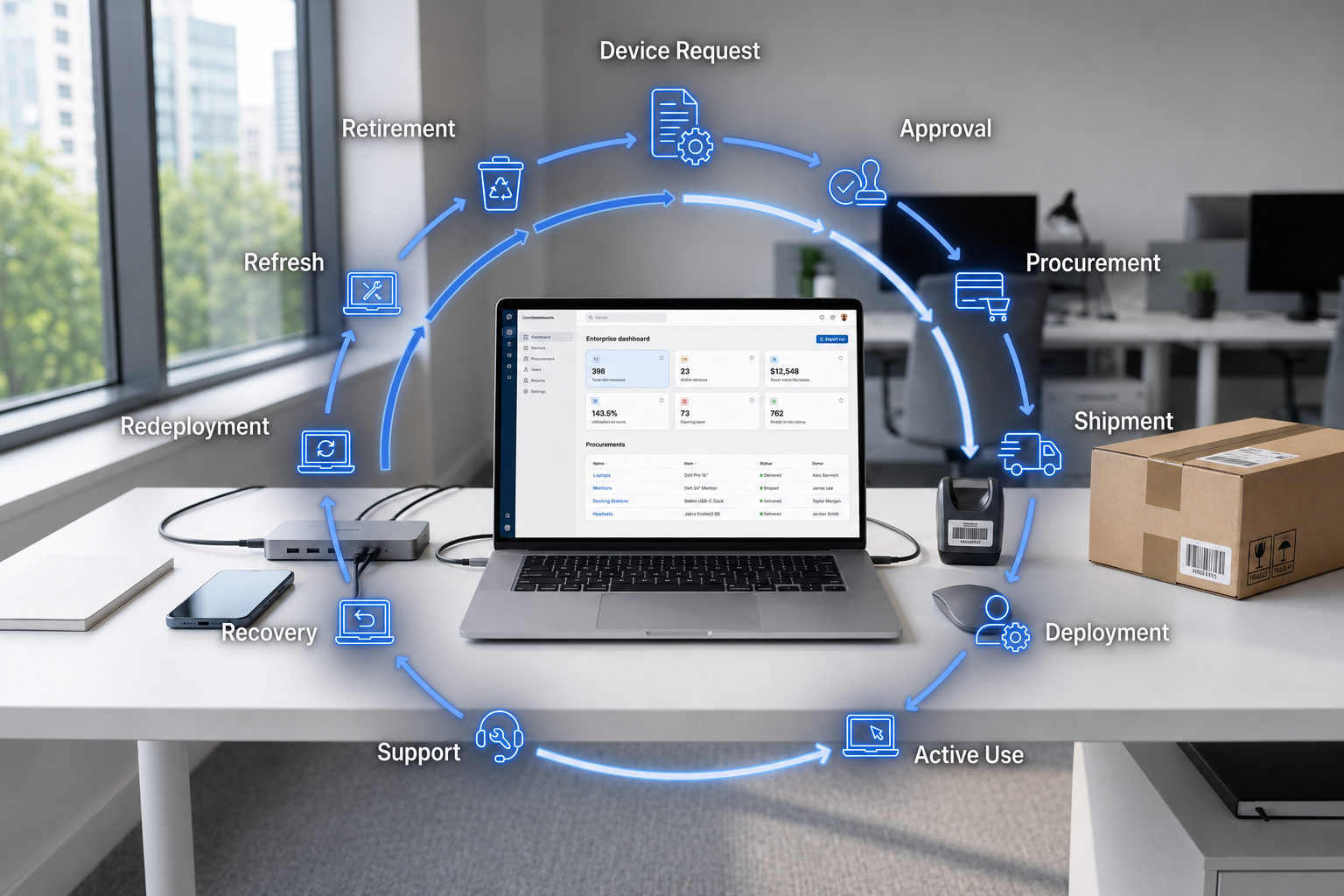
Here’s how a typical HaaS arrangement unfolds:
- Assessment & procurement: The provider helps you choose hardware that aligns with your use case. They purchase devices in bulk (or use existing inventory) and manage all logistics.
- Deployment & service agreement: The vendor delivers and installs hardware at your site or ships directly to remote employees. A service-level agreement (SLA) defines uptime, maintenance windows, warranties, repair response, and upgrade cycles.
- Ongoing support & upgrades: The provider monitors device performance, applies updates (firmware, security patches), repairs faulty units, and replaces end-of-life gear proactively.
- Decommissioning/replacement: When hardware reaches the end of its useful life, the provider handles disposal or refurbishment, wiping all data securely, and replacing it with new units.
In sum, you pay a monthly subscription, avoid upfront capital expenditure, and gain a hands-off hardware experience.
The provider (often a managed service provider, or MSP) assumes the full operational burden.
While servers are commonly included in some HaaS models, Esevel focuses exclusively on end-user devices such as laptops and select mobile phones.
HaaS versus other “as a service” or legacy models
To understand why HaaS is appealing, it helps to contrast it with adjacent models:
HaaS vs IaaS
- IaaS (Infrastructure as a Service) delivers compute, storage, and network resources virtually—typically via cloud providers.
- With HaaS, hardware is physically deployed to your environment (or remote users), and you pay for use rather than hosting in a data center.
- The two models can coexist: you might combine HaaS for endpoint devices with IaaS for servers.
HaaS vs PaaS
- PaaS revolves around offering a platform (runtime, middleware, database) for application development and deployment.
- HaaS is about delivering physical devices with service. The purpose and layers differ entirely.
HaaS vs DaaS/PCaaS
- DaaS (Desktop as a Service) virtualizes desktops in the cloud, delivering them remotely.
- PCaaS (Personal Computer as a Service) is more similar to HaaS: it bundles a PC with lifecycle services (imaging, support, replacements).
- PCaaS is often seen as a narrower variant under the broader banner of HaaS.
HaaS vs traditional leasing or capital purchase
- With capital purchase, you absorb large upfront cost, deal with depreciation, and own the hardware.
- With leasing, you rent hardware but still may carry maintenance responsibilities.
- With HaaS, it’s a subscription model where the provider handles upkeep. You shift from CapEx to OpEx.
In short: HaaS blends the flexibility of leasing with a more fully managed service relationship.
The benefits and advantages of HaaS
Why are forward-looking firms embracing HaaS? Here’s what stands out:
1. Shift CapEx to OpEx & predictable budgeting
Instead of paying a large capital sum upfront, you pays a monthly charge. It smooths cash flow and turns a large upfront capital expenditure into a regular operating expense. This predictability helps with forecasting and reduces surprises.
2. Access to modern hardware & easier refresh
You get access to the latest devices over time. As tech evolves, your equipment doesn’t become obsolete on your dime. Upgrade cycles become baked into your contract.
3. Reduced internal IT burden
Your IT team spends less time on repair, patching, and maintenance. The provider handles much of the heavy lifting. This frees internal resources for higher-value work.
4. Scalability & flexibility
You can scale up or down as needed, accommodating growth spurts or contract changes. No need to over-provision for peak demand.
5. Enhanced security & compliance
Because the provider controls the lifecycle, they ensure data security through encryption, secure wiping, firmware updates, and access controls. This helps you maintain regulatory compliance more easily.
6. Better cash flow and risk mitigation
You avoid the large upfront capital burden and can preserve liquidity. The risk of hardware failure or obsolescence shifts to the provider. That said, over long terms, the cumulative cost must be weighed.
These benefits of HaaS make it a compelling alternative, especially for growing firms that want to stay nimble.
Challenges, trade-offs, and risks to watch out for
No model is perfect. HaaS brings its own set of trade-offs and pitfalls.
Total cost over long term vs buying
Over long contract periods, the sum of monthly fees may exceed what outright purchase would’ve cost — especially if hardware depreciation is low. You need to run a cost analysis over 3–5 years.
Vendor lock-in and dependency
Once your devices, software, and processes are tied to a provider, shifting away may be costly or complex.
Contract complexity, SLAs, exit clauses
You’ll need to negotiate SLAs, response times, penalties, and exit or buyout terms. Poorly structured contracts can leave you exposed.
Logistics of return and data wiping
At contract end you must ensure safe return of hardware, full data erasure, and replacement if desired. That process requires careful planning.
For vendors: cash flow burden & hardware risk
The provider shoulders the upfront cost and carries risk of failure. They must finance hardware until it’s paid off via subscriptions.
Customization limits
Some providers offer standard configurations only. If your use case is specialized, off-the-shelf solutions may not suffice.
Data security exposure
Entrusting hardware to a third party adds risk. You must ensure encryption, multi-factor authentication, audits, and compliance are carefully addressed.
Real-world use cases and examples
Hardware as a service isn’t just theory. These are real ways companies deploy it:
- Office equipment and multifunction printers: Many firms lease copiers, printers, and scanning devices under HaaS. The provider maintains toner, repairs, and upgrades.
- Retail POS systems: Point-of-sale hardware in retail or restaurants often uses HaaS — providers ship the terminals, manage software, and replace failing units.
- Fleet and telemetry hardware: Connected sensors, GPS trackers, and telematics hardware are delivered under subscription, with constant upgrades.
- AV/conferencing systems: Video conferencing gear in meeting rooms is ideal for HaaS: you avoid large upfront cost and get better lifecycle support.
- Security & surveillance equipment: Cameras, access control systems, and sensors are increasingly offered via HaaS, where firmware updates, storage, and compliance matter.
- Case studies: Some major firms have adopted variant HaaS or DaaS models via offerings like Microsoft’s device-as-a-service or network hardware subscriptions.
On the vendor side, some hardware or deep tech firms are shifting from one-time sales to subscription models — turning their devices into recurring revenue engines.
How hardware vendors (and platforms) rethink business models under HaaS
If you build hardware, or you’re in a hybrid SaaS + hardware business, HaaS requires rethinking traditional economics:
Recurring revenue vs one-time sales
You trade large upfront margin for longer-term recurring margin. Success depends on retention and upselling.
Customer relationships evolve
You must provide strong customer relationships, not just deliver a product. Service, support, and SLAs become central to differentiation.
Financing and capital burden
You have to carry hardware until the subscription revenue fully recovers cost. That ties up capital and increases risk.
Data insights and additional services
Because you manage the hardware, you can collect usage and performance data. That can feed into upselling, predictive maintenance, or new services.
Risks and mitigation
You must manage hardware failure, obsolescence, and forecast demand. You may hedge with insurance, spare stock, and flexible buyout terms.
How to evaluate and adopt HaaS successfully
If you’re a startup or mid-sized business considering HaaS, here’s a pragmatic checklist:
Key criteria for selecting a HaaS provider
- Clear SLAs (response times, repair times, uptime guarantees)
- Terms for hardware refresh/upgrade
- Transparent cost model (what’s included, what’s extra)
- Data security & compliance standards (encryption, audits)
- Exit clauses and buyout options
- Logistics and coverage (shipping, spares, support in your regions)
- Integration with your IT asset management systems
- References and track record
Contract negotiation tips
- Ask for trial or pilot periods
- Ensure you have “escape routes” or buyout clauses
- Negotiate refresh intervals (e.g. every 3 years)
- Limit liability and define responsibilities clearly
- Include termination and data-wipe terms
Planning for refresh cycles and exit strategy
Even with a provider managing it, you need to plan how hardware will rotate. Ensure data is wiped, devices returned, and replacements ready with minimal downtime.
Integrate with existing IT asset management
You’ll want to treat HaaS devices like any other asset—track who has what, software installs, lifespan, warranty, compliance, etc.
Pilot proof-of-concept
Start small with one team or region. Measure performance, support, cost comparisons, user satisfaction. Use that to validate before rolling out company-wide.
The evolution ahead: HaaS in context and future trends
HaaS in the “Everything as a Service” trend
HaaS fits neatly into the broader shift toward XaaS (Everything as a Service). Just as SaaS, IaaS, and PaaS transformed software and infrastructure, HaaS is doing the same for physical hardware.
IoT, edge, robotics, and variant models
Expect growth in hardware-as-a-service for Internet of Things (IoT), robotics, industrial machinery (RaaS), or mobility (MaaS). Devices in the field will be supported via subscription and remote servicing.
Hybrid and usage-based pricing
In the future, HaaS contracts may evolve from fixed monthly fees toward usage-based pricing (pay for what you use) or hybrid models combining base + usage tiers.
Convergence of hardware + software value
Vendors will increasingly bundle hardware with software, analytics, and managed services, making hardware a platform for monetization.
Broader adoption in mid-sized businesses
What’s now niche may soon become standard among startups and mid-sized companies that prefer operational flexibility over capital investment.
FAQs
Is HaaS the same as leasing or renting?
No. Leasing often means paying to use hardware but handling maintenance yourself or paying extra. HaaS includes full lifecycle services—maintenance, upgrades, support—beyond simple rental.
When does HaaS make more sense financially?
When:
- You want to avoid a large upfront capital expenditure
- You prefer predictable operating expenses
- You expect frequent upgrades
- You have limited IT capacity to maintain hardware
- You value flexibility over owning assets
What happens at the end of a HaaS contract?
Typically, you return the hardware (or sometimes buy it out), and the provider wipes data, decommissions devices, and can replace or renew them under new terms.
Can I mix owned hardware and HaaS devices?
Yes. A hybrid approach is common. Use owned devices for stable, long-term use cases and HaaS for dynamic or high-rotation needs.
What are typical contract lengths and SLA terms?
Contracts tend to run 2–5 years. SLAs often guarantee response in hours or days, uptime percentages, repair or replacement windows, uptime warranties, and refresh schedules.
Are there security or compliance concerns?
Yes. You must ensure the provider supports data security, encryption, audits, secure wiping, and meets regulatory standards in your industry. Always review security clauses.
Do you provide servers as part of HaaS?
No. Esevel’s HaaS covers end-user hardware—primarily laptops and, on a limited basis, mobile phones. Server hardware and related services are not included.
Why leaders should care — A final take
The case for HaaS isn’t just financial, it’s strategic. With HaaS, your team gains flexibility, predictability, and peace of mind. You free yourself from large upfront costs, upgrade cycles, and maintenance burdens.
For a company like Esevel, which helps distributed teams manage devices, support, and security globally, HaaS fits naturally as a complementary offering. You could bundle HaaS into your stack—offering not just software and services, but the actual hardware on a subscription model. That deepens customer relationships, boosts recurring revenue, and differentiates your platform.If you’re running a startup or mid-sized firm with remote or hybrid employees, evaluating HaaS is not just smart — it may soon be essential. And when you do, Esevel is uniquely positioned to help you navigate hardware procurement, lifecycle management, global delivery, and security — so your hardware works for you, not against you.