Every tech stack evolves. Old laptops, servers, networking gear, and storage arrays eventually need retirement. But disposing of them casually — tossing into bins, recycling centers, or local dump — is risky. You may expose sensitive data, fail regulatory audits, or hurt your organization’s reputation.
That’s why IT asset disposal services (ITAD services) matter. A proper ITAD solution handles the full lifecycle of retiring hardware safely, securely, and sustainably. It’s more than just discarding; it’s about minimizing risk, recovering value, and doing right by the environment.
In this article, we’ll explain:
- What truly defines ITAD services
- What clients should expect from a high-quality provider
- The typical service workflow
- Benefits and value delivered
- How to pick and vet vendors
- Common pitfalls and real scenarios
- Answers to key questions
Let’s get into what makes a certified, responsible ITAD service stand apart from the rest.
What are IT Asset disposal services?
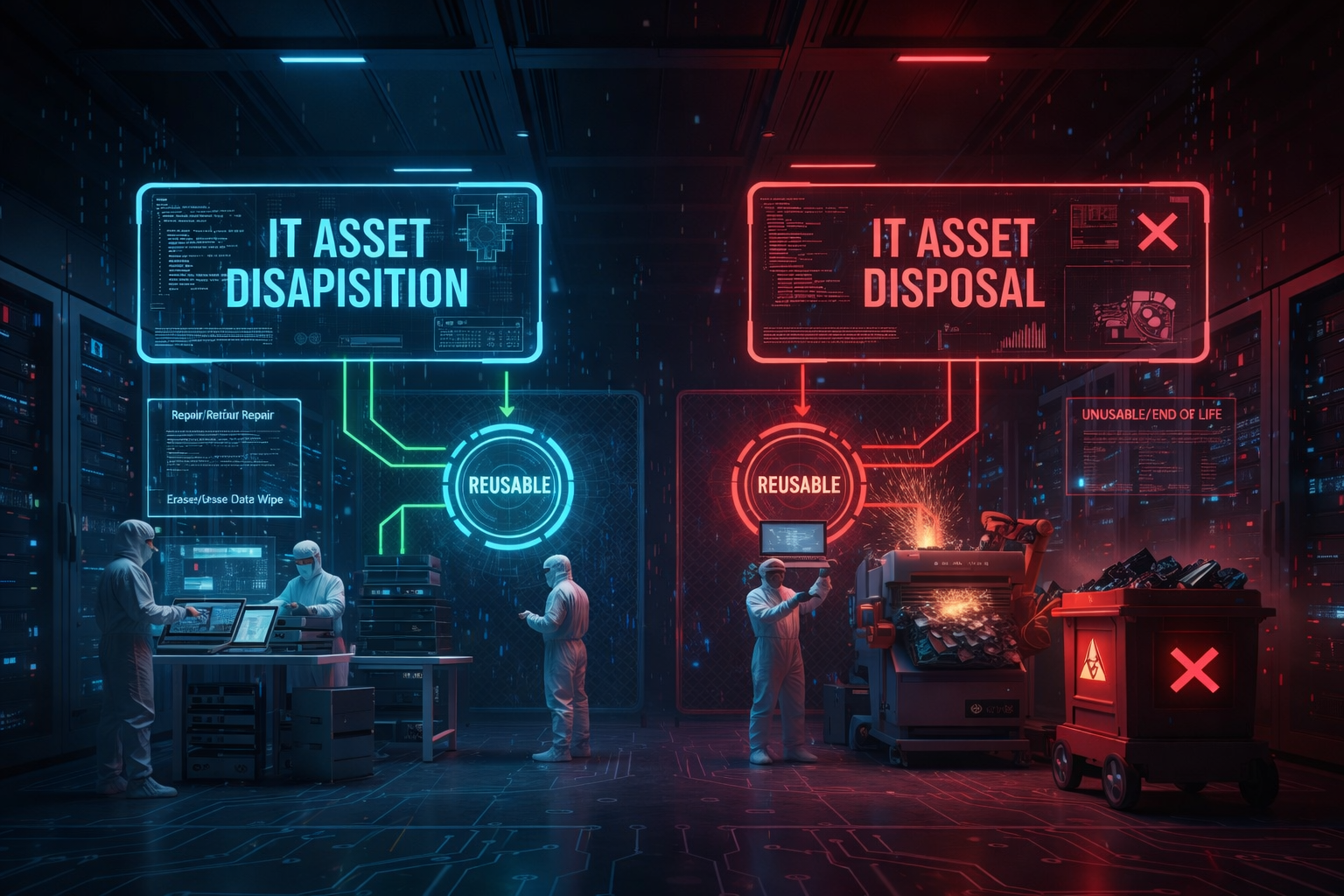
Definition: secure, structured, compliant retirement of tech assets
ITAD services offer a managed, structured, and certified way to dispose of hardware, media, and peripheral devices. These services ensure data security, meet regulatory requirements, and often recover residual value — all while disposing responsibly.
Differentiation from generic disposal/recycling
Generic recycling or waste disposal treats devices like trash. ITAD services, by contrast:
- Ensure secure data destruction
- Maintain chain-of-custody for every piece
- Offer certified data destruction with audit proofs
- Handle refurbishment/resale when feasible
- Commit to responsible recycling when reuse isn’t viable
A robust ITAD is integrated into asset management and the technology life cycle, not tacked on as an afterthought.
Scope: types of hardware, media, peripherals
ITAD services cover:
- End-user devices (laptops, desktops, tablets, phones)
- Data center equipment (servers, racks, switches)
- Storage arrays, backup media, tape libraries
- Networking devices (routers, firewalls)
- Peripherals and accessories
- Batteries, power units, and other components
Any device that stores or processes data must be in scope.
What clients should expect from ITAD services
A strong provider will offer the following capabilities and guarantees:
Secure data destruction/sanitization (various methods)
Methods include:
- Software wiping/overwriting
- Degaussing for magnetic media
- Physical destruction (shredding, crushing)
These must be verifiable and certified.
Chain-of-custody & tracking during transport
From the moment assets leave your premises to final disposal, the provider must track serial numbers, maintain logs, and photograph handlers — ensuring secure handoffs.
Refurbishment/resale/value recovery
Where possible, devices are refurbished or remarketed to recoup some cost, rather than shredded mindlessly.
Recycling/materials processing
For unsalvageable parts, they are recycled in compliance with e-waste laws and environmental best practices.
Certification & reporting/audit documentation
Providers should deliver certificates of destruction, audit logs, and compliance reports you can use for regulatory or internal review.
Environmental compliance (laws/regulations)
Providers should follow e-waste regulations in your jurisdiction, and policies such as those required under Basel, WEEE, or local laws.
Logistics & secure transportation
Providers must handle secure pickup, insured transport, appropriate packaging, and proper disposal of bulky or hazardous devices.
As one leading provider describes their model, their chain-of-custody is fully traceable from pick-up to final processing.
Typical service process/workflow
Here’s how most top-tier ITAD vendors execute their services:
Asset pickup/ingress/collection
Schedule secure pickup from client sites, label and scan devices on arrival.
Pre-assessment/inventory verification
Cross-check serial numbers, condition, data classification, and disposition plan.
Data sanitization/destruction
Use software or physical methods to wipe or destroy data in accordance with standards.
Sorting & decision (reuse, resale, recycle)
Classify which devices are viable for reuse, resale, or should be recycled.
Waste handling, recycling, disposal
Process e-waste components responsibly and dispose of irreparable parts.
Reporting, certification, documentation
Generate certificates, logs, chain-of-custody records, and compliance documentation.
Each of these steps must be transparent and auditable.
Benefits & value propositions
When you outsource to a proper ITAD services provider, you gain:
- Mitigation of data breach risk and compliance exposure
- Residual value recovery offsets disposal costs
- Fulfillment of environmental responsibility and ESG goals
- Operational simplicity — you don’t manage the disposal burden
- Reputation/brand protection from data leaks or scandals
These benefits make ITAD not just a cost center, but a risk-management and value-preservation arm.
Vendor selection criteria & certifications
What should you look for in a provider?
- Chain-of-custody & auditability
- Certifications: R2, e-Stewards, NAID AAA, ISO 14001, ISO 45001
- Proven experience and references
- Transparency in reporting and access to logs/certificates
- Secure transport & handling capabilities
- Insurance and liability coverage
Many top providers also hold ISO 45001 for worker safety.
Challenges & pitfalls to watch for
Even when outsourcing, several risks remain:
- Vendors claiming “wipe” without verification — weak sanitization
- Missing documentation or chain-of-custody gaps
- Vendors lacking proper certifications or legal compliance
- Logistics failures — lost, damaged, or mishandled assets
- Hidden fees, low value estimates, or surprise charges
- Difficulty disposing of mixed or hazardous assets like batteries, large storage arrays
You must vet carefully before trusting.
Illustrative examples/scenarios
Disposing of 200 laptop units
You hire a certified ITAD provider: they pick up the devices, inventory them, sanitize data, refurbish some, recycle others, and issue certificates for each unit.
Data center retirement
Shutting down racks of servers and storage systems. The ITAD service handles the physical removal, parts salvage, data destruction, and proper recycling.
Vendor certificate & chain logs scenario
You receive a certificate of destruction and full log showing each device’s path — when picked, sanitized, destroyed or passed for resale. This documentation supports audits and compliance.
Certified vs non-certified vendor outcome
A non-certified vendor might skip chain-of-custody steps, giving you minimal paperwork. If data breaches occur, you have no protection. A certified one gives you robust proof and legal cover.
FAQs
1. What is the difference between data wiping and physical destruction?
Wiping overwrites data so it cannot be recovered, while physical destruction (e.g. shredding) ensures media is irreparably broken.
2. Will I get proof/certificate that data is destroyed?
Yes. Certified ITAD services offer certified data destruction and formal certificates as proof for audits.
3. How much value can I expect to recover?
It depends on device age, model, condition, and market demand. Some recovery offsets costs; others yield marginal return.
4. Are all devices eligible for resale or recycling?
Not always. Devices with damaged hardware, or that are outdated or unrepairable, may only be recyclable or must be destroyed.
5. How are mixed media/high-risk devices (storage arrays, batteries) handled?
Special processes: battery disposal protocols, array decommissioning, safe removal of components, tailored sanitization for high-risk media.
Towards smarter ITAD services
Clients of quality it asset disposal services shouldn’t just expect shredding — they should expect secure, certified, sustainable, value-maximizing end-of-life management.
Going forward, key trends include:
- Stricter e-waste and privacy laws
- The rise of circular economy models for electronics
- Blockchain or traceability systems for better audit trails
- Integrated solutions combining ITAD with full asset management/life cycle suites
If your disposal process feels like a liability rather than an asset, it’s time to upgrade. Review your ITAD policies, define service-level requirements, and engage a vendor with proven certifications and transparency.
Esevel can help you with this alignment — building a trustworthy, secure, sustainable ITAD strategy that ensures retired assets never become risks.