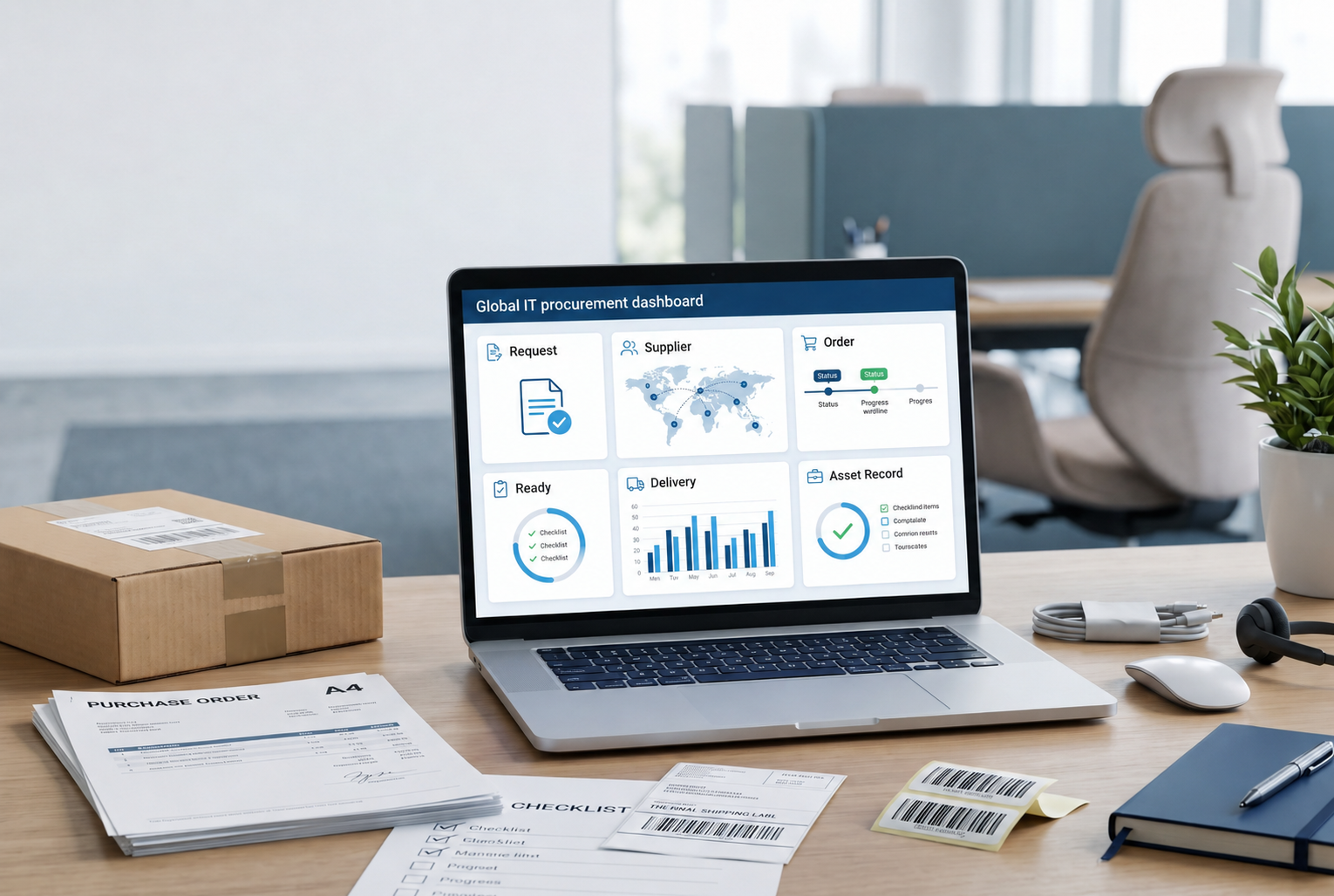
Outsourcing IT procurement means assigning technology sourcing, supplier coordination, purchasing, and delivery to an external provider while the company retains control over budgets, approvals, policies, and technology standards. The main benefits include greater procurement capacity, better supplier coordination, stronger visibility, and improved cost control.
Deloitte found that 74% of procurement teams in the technology, media, and telecommunications sector spend less than 30% of their time on strategic activities. This shows how much capacity can be lost to routine procurement work.
As companies grow across more countries, that workload becomes harder to manage. One laptop request can involve multiple suppliers, regional availability checks, delivery coordination, and asset handoffs. This guide looks at how outsourcing IT procurement can simplify that process without giving up control.
What do IT procurement services companies do?
IT procurement services companies manage technology sourcing, supplier evaluation, purchasing, order tracking, delivery coordination, and reporting.
They also validate technical specifications, device standards, warranties, security requirements, regional availability, and asset-record needs.
Companies can outsource one task, one device category, or the full process. Strategy, budgets, approvals, and final supplier decisions should remain under internal control.
What do end-to-end IT procurement services include?
End-to-end IT procurement services manage the complete process from identifying a technology need to delivering the device and transferring its information to the systems and teams responsible for ongoing management.
The service describes the work being outsourced, while the provider is the company responsible for delivering that work. In an end to end model, the provider carries out these services across each stage of the procurement process.
Step 1: Define the requirement
The process begins by documenting what the business or employee needs. This includes the device type, technical specifications, quantity, budget, delivery location, required date, accessories, and any security or compliance requirements.
A clear requirement reduces incorrect orders and gives suppliers enough information to provide accurate quotes.
Step 2: Source and evaluate suppliers
Once the requirements are clear, the provider takes over the sourcing and evaluation work included in the service. It identifies suitable suppliers and compares product availability, pricing, delivery times, warranty coverage, commercial terms, and supplier reliability.
For global orders, the provider should also review regional availability and country specific device specifications. If the preferred product is unavailable, it should suggest approved alternatives that still meet company standards.
Step 3: Approve and place the order
Once the preferred supplier and product are selected, the internal team reviews the purchase against its budget and approval rules. The provider can then coordinate the quote, purchase order, contract confirmation, and order placement.
The order should also be recorded with clear ownership, cost, supplier, expected delivery date, and approval history.
Step 4: Coordinate fulfillment
The provider monitors the order from supplier confirmation through final delivery. This includes shipment tracking, supplier follow-ups, address validation, customs coordination where required, and communication with the employee or office receiving the device.
The provider should also manage delays, failed deliveries, damaged products, and approved product substitutions.
Step 5: Complete the device and operational handoff
The process should not end when the device arrives. The provider should confirm receipt, capture the serial number and warranty, link the device to the correct employee or location, and coordinate setup or provisioning where included.
Responsibility for support, repair, replacement, recovery, and refresh should also be documented so procurement data remains connected to the device throughout its lifecycle.
What are the benefits of outsourcing IT procurement
Outsourcing IT procurement means using an external provider to manage part or all of the technology buying process. This can include sourcing devices, coordinating vendors, placing orders, managing delivery, preparing equipment, and updating asset records. The main benefit is not only saving time. It is creating a more consistent procurement process across teams and locations.
Reduce internal coordination work
Outsourcing IT procurement reduces the time IT, finance, and People Ops spend contacting vendors, comparing quotes, tracking orders, and resolving delivery issues. Internal teams can focus on device standards, security, budgets, and employee needs instead of managing every transaction.
Improve vendor and purchasing control
A procurement provider can help companies use approved vendors, device models, pricing rules, and purchasing workflows. This reduces inconsistent orders and gives teams a clearer view of suppliers, costs, warranties, and delivery performance.
Support global device procurement
Outsourcing IT procurement is especially useful for companies that hire across several countries. A provider can coordinate local sourcing, delivery, regional availability, warranty support, repairs, and replacement options without forcing internal teams to manage a separate vendor in every market.
Improve onboarding and device readiness
Procurement delays often become onboarding delays. Outsourcing IT procurement can connect hardware ordering with delivery, device setup, software installation, security settings, and employee assignment so new hires receive equipment that is ready for work.
Connect purchasing with asset records
A strong provider should create or update the asset record when the device is purchased. This gives IT clearer visibility into the device model, serial number, vendor, warranty, employee owner, location, and status from the start.
Support the full device lifecycle
The benefits of outsourcing IT procurement can continue after delivery. Providers may also support repairs, device recovery, redeployment, refresh planning, and secure retirement, which helps companies make better use of existing hardware before buying new devices.
Outsourcing IT procurement works best when the provider supports more than purchasing. The process should connect sourcing with employee readiness, asset visibility, support, and lifecycle management.
What risks come with IT procurement outsourcing?
The main risks are reduced visibility, provider dependency, unclear pricing, inconsistent standards, and weak handoffs. Each needs a defined control.
| Risk | How it affects procurement | Recommended control |
| Loss of visibility | Supplier and order status becomes unclear | Require shared reporting and exportable data |
| Provider dependency | Internal capability becomes difficult to restore | Document processes and exit support |
| Unclear pricing | Fees and exclusions are hard to assess | Require transparent pricing and inclusions |
| Weak supplier performance | Delays continue without action | Use scorecards and escalation reviews |
| Inconsistent standards | Unapproved products enter the environment | Maintain catalogs and substitution rules |
| Delivery failures | Devices arrive late, damaged, or incorrectly | Define tracking and replacement ownership |
| Incomplete data | Purchase or asset details are missing | Set required fields and validation |
| Provider lock-in | Switching becomes disruptive | Confirm data portability and transition terms |
Procurement Managers can reduce these risks by retaining approval authority, setting technology standards, requiring shared reporting, defining service levels, reviewing supplier performance, confirming data ownership, and documenting escalation and transition support.
What should outsourced IT procurement cover for global device operations?
Global device procurement should cover sourcing, delivery exceptions, employee readiness, asset handoff, and lifecycle planning. An order is complete only when the device is delivered, usable, assigned, and visible.
Global sourcing and delivery
The provider should support regional suppliers, local availability, approved alternatives, country-specific specifications, warranties, shipment tracking, customs where relevant, failed deliveries, replacements, and employee changes.
Based on Esevel’s operational data from January 2026 to August 2026, device setup lead times vary by market, ranging from 2–4 working days in several APAC countries to 7–9 working days across many European, Middle Eastern, and African markets. This is why global procurement planning needs to account for local availability and regional fulfillment conditions rather than applying one timeline to every country.
Employee device readiness
Procurement success should not be measured only by whether a supplier shipped or delivered the device. The correct device, specifications, accessories, setup requirements, employee assignment, and support contact must also be confirmed.
Based on Esevel’s experience supporting device procurement for distributed teams, a common operational gap appears when Procurement, IT, and People Ops define order completion differently. A better approach is to use one shared checkpoint: an order is complete only when the device is delivered, ready to use, assigned to the correct employee, and visible in the company’s asset records.
Procurement success should therefore be measured against four tests:
- Delivered: The device reached the correct employee or office.
- Usable: It is configured or ready for the employee’s role.
- Assigned: Ownership is linked to the correct employee.
- Visible: Purchase, shipment, warranty, location, and asset data are available.
Procurement-to-lifecycle handoff
Supplier details, serial number, employee, location, warranty, status, and support ownership should be recorded during procurement. Purchasing should connect with repair, recovery, redeployment, refresh, and secure end-of-life handling.
Check recovered inventory before approving new purchases so available devices inform future demand.
How should Procurement Managers evaluate outsourcing partners?
Procurement Managers should evaluate providers based on their ability to support sourcing, global fulfillment, reporting, device readiness, and lifecycle operations. Pricing and supplier access matter, but they are not enough if the provider cannot manage delivery issues or maintain procurement visibility.
Key questions to ask include:
- Can the provider source the required technology categories and specifications?
- Can it validate product standards, warranties, and approved alternatives?
- Does it have verified supplier and delivery coverage in the required countries?
- Can it manage local sourcing, cross-border delivery, and customs where needed?
- Are request, approval, quote, order, and shipment statuses visible?
- Can procurement data be accessed and exported?
- Can the provider create asset records and support repair, recovery, and refresh?
- Are pricing, service levels, responsibilities, escalation, and data ownership clear?
Signs of an end-to-end IT procurement partner
An end-to-end partner should do more than source products and place orders. Look for a provider that can:
- Coordinate sourcing, ordering, fulfillment, and delivery exceptions
- Confirm that devices are delivered and ready for employee use
- Connect purchase details with employee and asset records
- Support procurement across the required countries
- Provide visibility into requests, orders, shipments, and delivery
- Coordinate repair, replacement, recovery, redeployment, and refresh
- Give the company access to exportable procurement data
A provider that only places orders and reports transactions may be suitable for basic purchasing support. However, it may not provide the operational support required for distributed teams or global device lifecycle management.
Provider red flags: Hidden fees, vague service levels, limited reporting, no exportable data, uncontrolled product substitutions, weak escalation procedures, and no transition or exit support.
What are the best practices for outsourcing IT procurement?
Treat outsourcing as an operating-model change, not only a contract.
- Define objectives and success measures: Document the problem, categories, countries, volume, and required results.
- Map the current process: Record request channels, approvals, suppliers, systems, handoffs, delays, and performance.
- Standardize requirements: Set approved products, specifications, security requirements, warranties, regional alternatives, and documentation.
- Define roles and governance: Assign the procurement owner, approval authority, provider duties, escalation, and data ownership.
- Start with a controlled scope: Pilot one category, region, business unit, or hiring workflow.
- Validate the workflow: Test order accuracy, delivery tracking, exception handling, asset records, employee readiness, and reporting.
- Expand in phases: Add regions, categories, volume, and lifecycle services after validation.
- Review performance: Measure service levels, supplier performance, delivery success, costs, asset-data accuracy, recovery, and reuse.
Frequently asked questions about outsourcing IT procurement
What is outsourcing IT procurement?
Outsourcing IT procurement is external management of selected or complete technology sourcing, purchasing, supplier coordination, delivery, and procurement operations. Companies can outsource one task, category, country group, or end-to-end workflow while retaining approvals.
What do IT procurement services include?
Services can include requirements, sourcing, supplier evaluation, purchase administration, tracking, delivery coordination, reporting, warranties, asset-record creation, and optional repair, recovery, refresh, and disposal support.
What are end-to-end procurement services?
End-to-end services manage requirements, sourcing, approval, ordering, fulfillment, and operational handoff. Scope may extend to employee assignment, asset tracking, support ownership, recovery, and refresh planning.
When should a company outsource IT procurement?
A company should consider outsourcing when capacity is limited, purchase volume is growing, operations span countries, suppliers are fragmented, delivery problems affect work, or visibility is weak.
How can outsourcing create more procurement control?
Outsourcing creates more control when execution moves to a provider but governance remains internal. Success requires defined standards, transparent accountability, and connected procurement and asset information.
Mature IT procurement links sourcing, ordering, delivery, assignment, tracking, recovery, and refresh. Esevel supports global device procurement and lifecycle operations through one platform and service model.
Review whether the current process gives the team visibility from the first request through device recovery.

Maytiska Omar Maytiska is an experienced content writer and blog specialist with 4+ years of expertise in creating engaging, SEO-driven content. She focuses on IT and digital topics, turning complex ideas into clear, reader-friendly insights. Her work helps position Esevel as a trusted voice in the digital space.