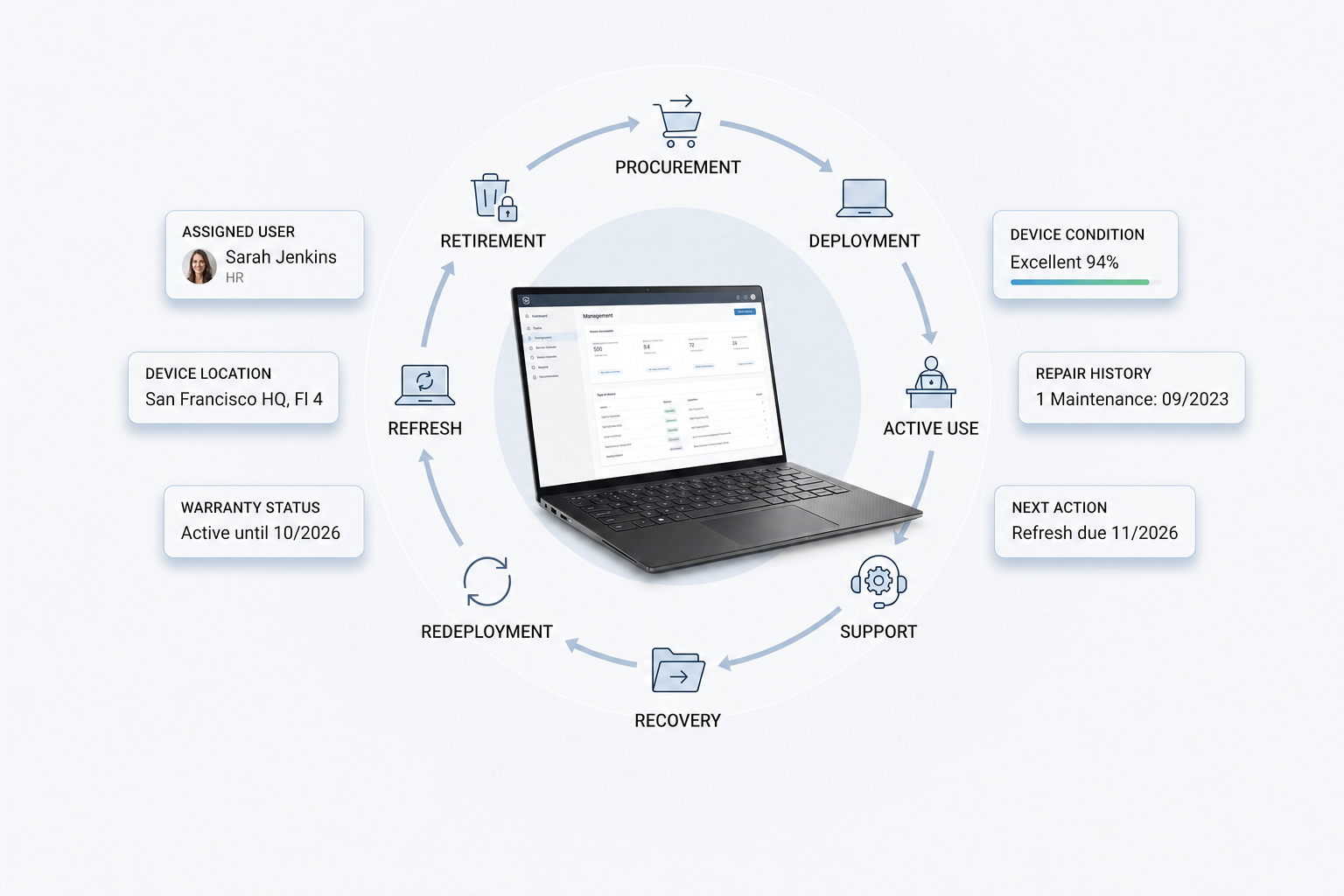
The best device lifecycle management tools in 2026 help IT teams manage devices from acquisition and deployment through support, recovery, reuse, and retirement. However, each platform covers a different part of that lifecycle.
For enterprise IT teams, the key difference is how much responsibility each provider actually takes on. Some manage physical device operations across regions, while others focus more on asset visibility, endpoint security, configuration, or remote management. Esevel brings direct operational experience to this comparison, supporting enterprise IT operations across six regions with coverage spanning 201 countries.
This guide compares the leading options across lifecycle scope, global operations, support and repairs, retrieval and disposal, and automation. The goal is to help IT teams identify which platform fits the lifecycle stages they want to manage externally and which responsibilities should remain in house.
Best device lifecycle management tools at a glance
After reviewing the leading options, we selected 10 device lifecycle management tools that stand out for enterprise IT teams. See how they compare below.
| Tool | Lifecycle Scope | Global Operations | Avg. Order to Delivery | IT Hardware Support |
|---|---|---|---|---|
| Esevel | – Procurement – Storage – Deployment – MDM – Tracking – Retrieval – Wiping – Redeployment – Disposal | 120+ countries | 6-8 business days | 24/5 |
| Workwize | – Procurement – Deployment – Retrieval – Disposal | 120+ countries | 7-14 days | Yes |
| Deel IT | – Procurement – Configuration – Deployment – Recovery | 130+ countries | 10 days | 24/7 |
| Rayda | – Procurement – Configuration – Deployment – Tracking – Maintenance – Retrieval – Storage – Redeployment – Recycling – Disposal | 170+ countries | Up to 8 days | 24/7 |
| ZenAdmin | – Procurement – Bulk order automation – Zero touch deployment – Inventory management – Asset tracking – Global sourcing – Spend management – Bulk ordering – Disposal | 150+ countries, | 5-7 days | 24/7 |
| Rippling IT | – Procurement – Configuration – Zero touch deployment – Device management – Tracking – Offboarding – Retrieval – Reassignment – Buyback – Secure disposal | 40 to 130 countries | shipments arrive within 3–5 business days | 24/7 |
| Oomnitza | – Procurement Deployment – Refresh – Disposition – Tracking – Maintenance – Onboarding & offboarding – Retirement | No published country coverage figure found | No direct hardware repair/helpdesk service verified | Not publicly stated |
| Fleet | – Enrollment and zero touch deployment device inventory – Configuration – Software management – Patching – Security and Compliance – Vulnerability management – Remote management – Refresh/ replacement lifecycle visibility | 90+ countries | Delivery timeframe not publicly disclosed | 24/7 |
| Hexnode UEM | – Provisioning and zero touch enrollment – Configuration – Device monitoring – Security and compliance – App and patch management – Remote troubleshooting – Device recovery – Retirement | 130+ countries | No published delivery timeframe found | 24/7 |
| Ivanti Neurons | – Procurement Purchase order management – Tracking Inventory and stock management – Deployment Disposal | Global presence in 23 nations | No official average order to delivery time published | 24/7 |
The table gives you the broad categories. The methodology below explains what we looked for within each one.
How we evaluated device lifecycle management tools
We evaluated each platform across six areas:
- Lifecycle coverage: Acquisition through retirement
- Procurement and deployment: Sourcing, configuration, and delivery
- Device visibility: Ownership, status, location, and inventory
- Support and repair: Troubleshooting, repair, and replacement
- Retrieval and disposal: Recovery, reuse, wiping, and retirement
- Automation and integrations: Connections with IT and employee workflows
Esevel publishes this comparison and is included because it provides device lifecycle management services. Competitor information is based on publicly available product information reviewed in August 2026.
10 best device lifecycle management tools in 2026
Device lifecycle management tools differ in scope, from full physical lifecycle support to asset visibility, endpoint management, and automation. The 10 tools below help enterprise IT teams compare which platform best fits the lifecycle stages they want to manage.
1. Esevel
Esevel supports enterprise device lifecycle management and global IT operations across 120+ countries, covering procurement, deployment, tracking, retrieval, secure wiping, and redeployment. It also provides hardware repairs and ongoing IT support for distributed teams across regions.
Key features
• Global device procurement and deployment
• Real time tracking and lifecycle visibility
• Secure retrieval, wiping, and redeployment
Pros
• Covers the physical device lifecycle through one provider
• Combines device operations with IT and hardware support
• Uses standardized device configurations across regions
Cons
• Less suitable for companies operating in fewer than three countries
2. Workwize
Workwize provides global hardware lifecycle management across 120+ countries, covering procurement, deployment, management, retrieval, and disposal. Its platform also automates hardware workflows and connects with HRIS and other IT systems.
Key features
• Global hardware procurement and delivery
• Automated onboarding and offboarding workflows
• HRIS and IT system integrations
Pros
• Strong coverage for global hardware operations
• Reduces manual onboarding and offboarding tasks
• Centralizes multiple hardware lifecycle stages
Cons
• Not the best fit for fully remote companies with fewer than 150 employees
3. Deel IT
Deel IT manages devices across 130+ countries, including procurement, deployment, repair, recovery, and ongoing support. Its device workflows connect closely with employee onboarding and offboarding, making hardware management part of the wider employee lifecycle.
Key features
• Global device procurement and deployment
• Device repair and recovery
• Employee lifecycle workflow automation
Pros
• Broad international coverage
• Connects HR events with device actions
• Includes 24/7 global support
Cons
• Companies that do not use the broader Deel ecosystem may prefer a more standalone device platform
4. Rayda
Rayda manages procurement, deployment, tracking, retrieval, storage, and secure wiping across 170+ countries. It focuses heavily on global device logistics and states that devices can typically reach employees within 2 to 8 days.
Key features
• Global device procurement
• Device tracking and retrieval
• Storage and secure data wiping
Pros
• Very broad stated country coverage
• Covers multiple physical lifecycle stages
• Supports relatively fast global deployment
Cons
• Its focus is more on device operations than deep endpoint security and policy management
5. ZenAdmin
ZenAdmin combines device lifecycle management with SaaS management, identity management, and IT support. Its device capabilities cover procurement, tracking, deployment, maintenance, and secure retirement across multiple operating systems.
Key features
• Multi vendor hardware procurement
• Real time asset tracking
• SaaS and identity management
Pros
• Combines several IT operations in one platform
• Supports hardware and software management
• Includes ongoing IT support
Cons
• The broader IT management scope may be unnecessary for companies that only need device logistics
6. Rippling IT
Rippling IT connects device management directly with employee data and HR workflows. Companies can order, configure, ship, retrieve, store, reassign, and resell devices while automating actions when employees join, move roles, or leave.
Key features
• Automated device onboarding and offboarding
• Cross OS device management
• Retrieval, storage, reassignment, and resale
Pros
• Strong connection between HR and IT workflows
• Automates device actions based on employee events
• Combines physical lifecycle tasks with device management
Cons
• The strongest value comes from using the wider Rippling platform rather than device management alone
7. Oomnitza
Oomnitza focuses on hardware asset governance from procurement through disposition. It maintains lifecycle, ownership, location, financial, and chain of custody information while helping teams automate changes as assets move between lifecycle stages.
Key features
• Hardware lifecycle tracking
• Ownership and chain of custody records
• Automated lifecycle workflows
Pros
• Strong asset visibility and governance
• Useful for audit and compliance requirements
• Connects operational and financial asset information
Cons
• Physical sourcing, shipping, retrieval, and storage generally require separate providers
8. Fleet
Fleet manages endpoints from enrollment through configuration, monitoring, maintenance, and offboarding. It uses an API first and GitOps friendly approach, making it particularly useful for technical IT teams that want to automate device configuration and security across operating systems.
Key features
• Multi platform device management
• GitOps based configuration management
• Endpoint visibility and automated remediation
Pros
• Strong automation capabilities
• Open source foundation and API first approach
• Supports multiple operating systems
Cons
• Does not replace physical procurement, delivery, retrieval, or warehousing services
9. Hexnode UEM
Hexnode UEM provides centralized management for corporate endpoints throughout the enrolled device lifecycle. IT teams can automate enrollment, apply configurations and security policies, manage applications, remotely troubleshoot devices, and wipe or redeploy supported endpoints.
Key features
• Zero touch device enrollment
• Application and security policy management
• Remote management, wiping, and redeployment
Pros
• Supports multiple device types and operating systems
• Strong endpoint configuration and security controls
• Supports remote lifecycle actions
Cons
• Physical procurement, shipping, storage, and retrieval sit outside its main UEM model
10. Ivanti Neurons
Ivanti Neurons combines IT asset discovery, lifecycle visibility, and automation. It continuously discovers and normalizes asset data, then maintains information such as ownership, financial details, and lifecycle status from acquisition through retirement.
Key features
• Continuous IT asset discovery
• Centralized asset system of record
• Lifecycle and workflow automation
Pros
• Strong asset discovery and inventory visibility
• Connects asset data with IT and security workflows
• Supports governance across the asset lifecycle
Cons
• Physical procurement, global delivery, retrieval, and storage require separate operational services
What should you look for in a device lifecycle management vendor?
Do not ask only whether a vendor “supports the device lifecycle.” Ask which stages it executes directly and which stages your internal IT team will still need to manage.
Check these seven areas:
- End to end lifecycle coverage: Where does responsibility begin and end?
- Country coverage: Can devices be sourced, delivered, repaired, and recovered where your employees work?
- Configuration and MDM integration: Can devices arrive ready to use and connect with your existing management stack?
- Asset visibility: Can IT see ownership, location, status, warranty, and lifecycle history?
- Repair and replacement: What happens when hardware fails?
- Offboarding and recovery: Who contacts the employee, arranges retrieval, wipes the device, and prepares it for reuse?
- Retirement and disposal: Is end of life handling secure, documented, and appropriate for each region?
Start with lifecycle scope, then compare which stages each vendor executes directly.
Which device lifecycle management tool should you choose?
There is no single device lifecycle management tool that fits every IT environment. The right choice depends on which lifecycle stages you want the provider to manage and which tasks your internal team already handles.
Choose Esevel if you need procurement, deployment, tracking, IT support, retrieval, wiping, redeployment, and disposal across countries through one provider.
Consider Workwize, Deel IT, or Rayda if global hardware procurement, delivery, recovery, and other physical device operations are the main priority.
Choose ZenAdmin if you want device lifecycle management alongside SaaS, identity, and broader IT management. Rippling IT is a stronger fit when device workflows need to connect closely with employee onboarding, offboarding, and HR processes.
Consider Oomnitza or Ivanti Neurons when asset visibility, governance, inventory data, and lifecycle records matter more than physical device logistics.
Choose Fleet or Hexnode UEM when endpoint configuration, security, patching, monitoring, and remote management are the main requirements and procurement or physical logistics are already covered.
The best choice depends on how much of the device lifecycle you want the provider to execute directly, from procurement and deployment through support, recovery, and retirement.
Frequently asked questions about device lifecycle management tools
What is device lifecycle management?
Device lifecycle management is the process of managing a business device from acquisition through deployment, active use, support, recovery, reuse, and eventual retirement. It connects the physical asset, employee assignment, security, maintenance, and end of life process.
What is the difference between device lifecycle management and MDM?
Device lifecycle management covers the broader operational journey of a device, including procurement, delivery, support, retrieval, and disposal. MDM focuses mainly on managing the enrolled endpoint through configuration, applications, policies, security controls, and remote actions.
What features should a device lifecycle management tool have?
A strong device lifecycle management tool should provide lifecycle visibility, asset tracking, deployment workflows, support or repair processes, retrieval controls, secure retirement, integrations, and clear ownership of each lifecycle stage. Global teams should also assess local delivery and recovery coverage.
These questions bring the comparison back to the most important buying decision: how much of the lifecycle you actually want a vendor to own.
Choose a tool that manages the lifecycle you actually have
The best device lifecycle management tool is not the one with the longest feature list. It is the one that covers the lifecycle stages your IT team needs help managing while fitting the systems and processes you already use.
For enterprise and distributed teams, Esevel connects procurement, deployment, tracking, IT support, recovery, and redeployment through one global operating model. The right choice ultimately depends on how much of the device lifecycle you want to keep in house and how much you want a provider to manage.

Maytiska Omar Maytiska is an experienced content writer and blog specialist with 4+ years of expertise in creating engaging, SEO-driven content. She focuses on IT and digital topics, turning complex ideas into clear, reader-friendly insights. Her work helps position Esevel as a trusted voice in the digital space.