Finance IT asset management is the process of maintaining trustworthy information about technology assets, their owners, locations, software, management status, lifecycle state, and relevant risk across a financial services organization.
A useful ITAM solution should do more than list laptops and servers. It should provide reliable asset visibility, traceable ownership and history, integration with existing systems, and enough lifecycle context to know what should happen next. Financial institutions may need this visibility across offices, branches, subsidiaries, countries, remote teams, contractors, and third-party environments.
The right approach depends on the problem to solve. Start with visibility, then evaluate risk and traceability, integrations, cost, and lifecycle execution. The best platform is not necessarily the one with the most features.
What is finance IT asset management?
Finance IT asset management, or finance ITAM, combines inventory with ownership, assignment, location, software information, management state, lifecycle history, and relevant risk context. It gives IT, security, audit, procurement, and finance teams a more trustworthy view of the technology estate.
A hardware register alone cannot show whether an asset is still managed, who is accountable for it, or whether its lifecycle record is current.
FFIEC interagency guidance recommends inventorying information systems and components that require authentication and access controls, including hardware, operating systems, applications, infrastructure devices, APIs, data, and systems provided by third parties such as cloud providers.
For financial services teams, the same asset record may support IT support, audit work, procurement, cost allocation, and eventual recovery. That makes ownership and lifecycle context more useful than a standalone hardware register. A broader IT asset management framework can provide the general lifecycle background.
What should finance IT asset management include?
A practical finance ITAM model should connect three layers: asset visibility, risk and technology context, and lifecycle operations.
| ITAM layer | Main question | Typical information |
| Asset visibility | What is it, where is it, and who is accountable? | Asset ID, serial number, user, location, ownership |
| Risk and technology context | What state is it in? | OS, software, management state, compliance or patch status |
| Lifecycle operations | What is happening next? | Deployment, repair, replacement, retrieval, retirement |
Asset visibility is the foundation. Records should identify the asset, assigned user, site, country, ownership, and lifecycle status.
Risk context can include operating system, installed software, MDM or UEM state, asset age, and support status. The ITAM platform does not have to generate every signal itself; it may receive them from other systems.
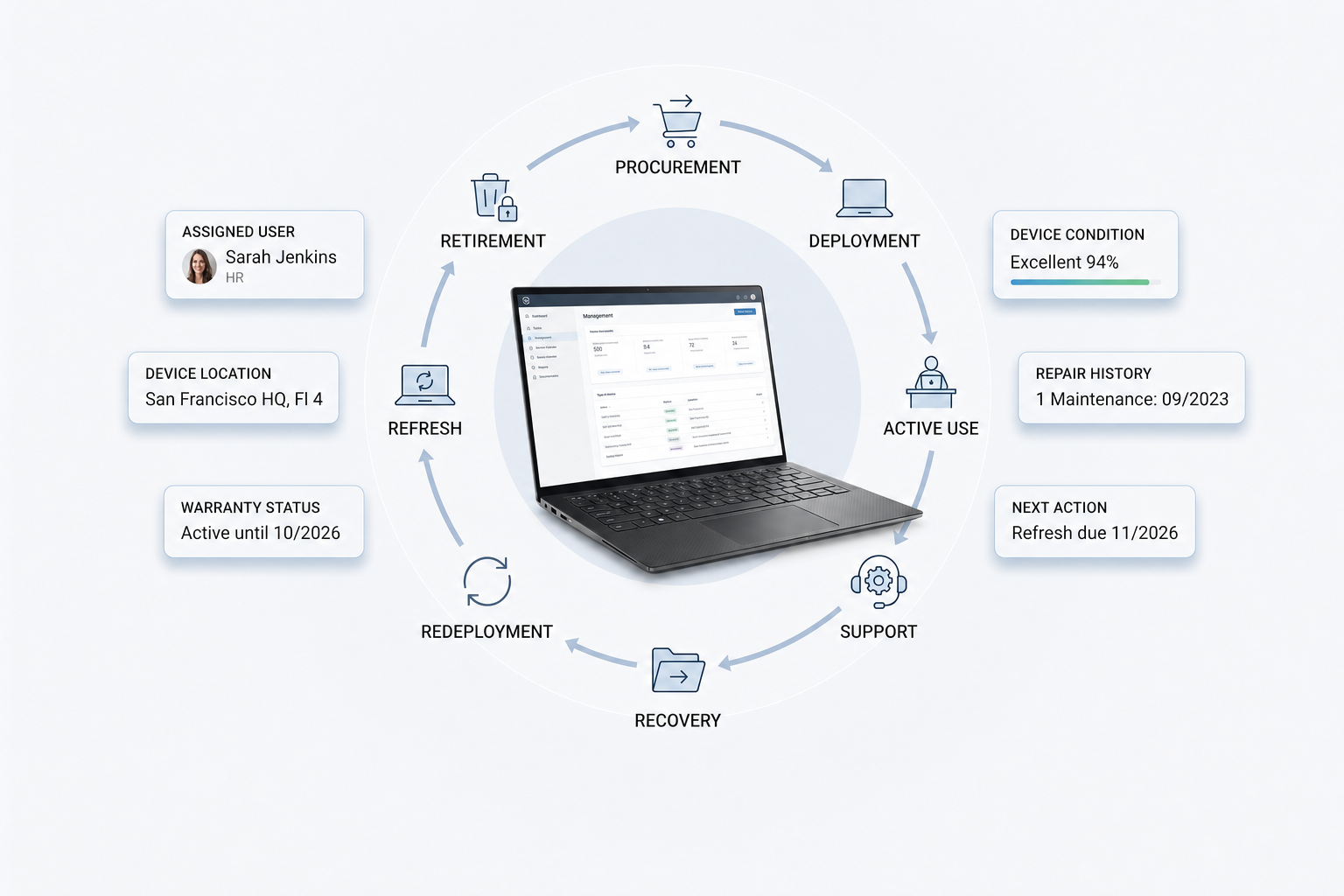
Operational context connects records to real events. A laptop should not remain listed as assigned when it is under repair, awaiting recovery, transferred, or retired.
This visibility remains difficult. Flexera’s 2026 State of ITAM Report, based on 512 ITAM professionals, found that only 36% of organizations reported complete visibility into their IT assets and impact on business outcomes. Maintaining an accurate inventory was also the top SAM-focused responsibility, cited by 78% of respondents.
How is finance ITAM different from basic asset tracking?
Basic asset tracking answers what the organization owns, where it is, and who has it. Finance ITAM adds lifecycle history, software visibility, management state, cost information, audit history, integrations, and workflow events.
In short, asset tracking records where technology is. ITAM connects that record with ownership, governance, risk context, and the processes that change its state.
How do you choose an IT asset management solution for financial services?
Financial services companies should choose ITAM around the information and actions their teams need, rather than starting with a vendor shortlist.
1. Define the visibility problem
Identify the gaps first: unknown assets, missing users, incorrect locations, duplicate records, stale devices, weak software visibility, or conflicting databases.
Also decide whether SaaS and cloud assets belong in scope. NIST CSF 2.0 calls for maintained inventories of hardware as well as software, services, systems, and supplier-provided services.
2. Define the asset scope
Document what the solution must manage, such as laptops, desktops, phones, shared workstations, servers, networking equipment, software, SaaS, and cloud resources.
Then define the footprint: locations, countries, subsidiaries, remote users, contractors, and relevant third-party environments. Scope affects discovery, data models, integrations, permissions, and cost.
3. Define risk, governance, and audit requirements
Decide what must be traceable. Common requirements include role-based access, ownership history, change records, asset audit trails, reporting, data retention, and a controlled status taxonomy.
Third-party technology also matters. Federal Reserve interagency guidance says banking organizations should review whether third parties maintain timely and accurate inventories of their technology and contractors. This applies to device partners too: ask how they keep serial-level records accurate and which certifications they hold.
Keep this evaluation focused on ITAM requirements. The platform should support the organization’s governance model without turning the selection process into a broader cybersecurity or regulatory program.
4. Evaluate discovery, data quality, and integrations
Check how assets enter the system and stay current. Useful capabilities include automated discovery, imports, normalization, duplicate reconciliation, stale-record identification, and synchronization.
ITAM may need data from ITSM, MDM/UEM, identity, HRIS, security, procurement, and finance systems. For each important field, confirm its owner, sync frequency, conflict rules, and whether the advertised integration is ready to use or only an API.
5. Compare total cost
Do not compare platforms on subscription price alone. ITAM total cost can include licensing, implementation, migration, integrations, administration, training, added modules, and supporting operations.
IAITAM’s 2025 practitioner survey found that 64% of respondents could not track ITAM savings as a percentage of their total IT budget. A clear pre-purchase cost model helps avoid the same measurement gap.
6. Evaluate scale and operational fit
Test what happens after ITAM identifies an action. If a laptop needs repair, who arranges it? If an employee leaves, who retrieves the device? If hardware moves country, who executes the transfer and updates the record?
For global financial services companies, ITAM may need to work alongside an operational layer for physical device activity.
What features should an effective IT asset tracking system have?
An effective IT asset tracking system should keep records accurate and make them actionable. Look for:
- Automated discovery: Finds assets missing from manual records.
- Ownership and location: Connects assets to users, sites, and accountable teams.
- Lifecycle history: Preserves assignment, repair, recovery, and retirement events.
- Reconciliation: Resolves duplicate or conflicting records.
- Audit trails: Records changes for traceability.
- Role-based access: Controls who can view or modify information.
- Integrations: Connects endpoint, HR, ITSM, procurement, and finance data.
- Workflow support: Records or triggers actions after status changes.
NIST’s CSF 2.0 implementation examples recommend continuously monitoring for new hardware. They also recommend updating inventories when systems, hardware, software, and services move or change.
What types of ITAM solutions should financial services companies evaluate?
There is no universally best ITAM platform. Different approaches fit different operational problems.
| Main requirement | Approach | Representative example | What to verify |
| ITSM and CMDB workflows | ITSM-native ITAM | ServiceNow | Asset depth, CMDB model |
| Unknown technology | Discovery-first | Lansweeper | Discovery, normalization, reconciliation |
| Software and SaaS governance | SAM-focused ITAM | Flexera | License depth, SaaS coverage |
| Endpoint synchronization | Endpoint-integrated ITAM | Ivanti | Endpoint coverage, lifecycle data |
| Flexible workflows | Asset database | Jira Assets | Governance, discovery, automation |
| Physical device lifecycle execution | Device lifecycle management | Esevel | Procurement, deployment, support, retrieval, certifications, and asset-data handoff |
These are representative examples, not rankings. ServiceNow connects ITAM with CMDB and service workflows; Lansweeper emphasizes discovery and reconciliation; Flexera covers ITAM, software, SaaS, and cloud; Ivanti connects asset data with endpoint and service management; and Jira Service Management Assets uses a flexible object model connected to Jira work.
When comparing categories, confirm current product capabilities directly with each vendor. Packaging, integrations, and included modules change, and an architecture that suits one financial institution may create unnecessary complexity for another.
Dedicated IT asset management solutions comparisons can cover vendor-level evaluation separately without turning this guide into a software ranking.
How should finance companies compare ITAM costs?
Enterprise ITAM cost should be evaluated as total cost of ownership rather than a headline license price.
| Cost area | Questions to ask |
| Platform | Assets, users, modules, or another pricing model? |
| Implementation | What setup, migration, and data cleanup are required? |
| Integrations | Are connectors included or custom? |
| Administration | What expertise, training, and reconciliation remain? |
| Scaling | What changes as assets, countries, or modules increase? |
| Operational gaps | Which lifecycle tasks remain outside the platform? |
A cheaper subscription can become more expensive if it requires substantial integration work or manual administration. Tie cost to measurable outcomes such as fewer unknown assets, better reconciliation, improved software utilization, or reduced manual work.
Software governance can also create material costs. Flexera’s 2026 survey found that 48% of organizations had been audited in the previous year, while 44% reported spending more than $1 million on software audits over the prior three years. These figures are cross-industry, but they reinforce why license visibility, ownership, and audit history belong in the cost discussion.
How should finance IT asset management systems work together?
One asset can appear in several systems for legitimate reasons. HRIS knows the employee, identity systems know account state, MDM/UEM knows endpoint configuration, ITSM records support history, procurement knows the order, and finance holds cost information.
ITAM can maintain ownership and lifecycle context without owning every field. The rule should be: every important field has one authoritative owner.
Use consistent identifiers such as serial numbers, asset IDs, employee IDs, and device identifiers. Define synchronization frequency, conflict-resolution rules, and responsibility for correcting inaccurate records.
FFIEC’s Architecture, Infrastructure, and Operations guidance also emphasizes the interconnectedness of financial institutions’ technology assets, processes, and third-party service providers.
What happens when ITAM identifies a physical device action?
ITAM can act as the system of record without executing every physical workflow. It may identify that a device needs repair, replacement, retrieval, redeployment, or retirement, but someone still needs to perform that work.
The key rule is simple: the asset record should change when the physical asset changes.
Esevel is one example of an operational layer that can complement ITAM, MDM/UEM, and ITSM across 120+ countries by connecting device tracking and management with procurement, deployment, hardware support, retrieval, and redeployment.
Luno provides a relevant financial-services example. The global cryptocurrency fintech used Esevel to coordinate procurement and device operations across multiple countries. Its published case study reports 75% faster onboarding and more than 20 hours saved per month, with onboarding reduced from two weeks to three days.
That outcome should not be attributed to ITAM software alone. It illustrates why asset visibility is more useful when the organization can execute the physical action behind the record.
How do you keep financial data safe when devices move or leave?
When laptops are transferred, repaired, retrieved, or reassigned, IT should track both the physical device and the security action taken. Offboarding should include device retrieval and confirmation that sensitive company data has been removed before the hardware is stored, redeployed, or retired.
Depending on the device and management setup, wiping may involve a factory reset, an MDM-verified remote wipe, or a manual secure wipe. The completed action should be recorded against the asset so IT has a clear history of what happened.
If a third party handles devices, ask how it maintains accurate serial-level records, how wipe completion is verified, and which security certifications it holds. Esevel is ISO 27001 certified and GDPR compliant, providing additional assurance for device lifecycle operations.
Which finance IT asset management approach is right for your organization?
Use the biggest problem as the decision point.
If unknown assets are the issue, prioritize discovery and reconciliation. If ITSM and CMDB dominate the environment, consider ITSM-native ITAM. If software licensing is the priority, focus on SAM and SaaS visibility.
For fragmented endpoint information, prioritize MDM/UEM synchronization. For poor data quality, focus on field ownership, reconciliation, and governance. For global physical workflows, combine the ITAM system of record with operational device support.
The decision path is:
Visibility → Risk and traceability → Integration → Lifecycle execution
Choose finance ITAM around the problem you need to solve
Effective finance IT asset management starts with trustworthy visibility, then adds traceability, integrations, governance, and operational action.
There is no single best platform for every organization. Choose the architecture around the asset estate, existing stack, geographic footprint, governance requirements, internal capacity, and physical workflows IT actually needs to manage.
FAQs
What is finance IT asset management?
Finance IT asset management maintains accurate information about technology assets, including ownership, location, software, lifecycle state, management status, and relevant risk context across a financial services organization.
What features should an IT asset tracking system have?
Useful capabilities include automated discovery, central records, ownership and location tracking, reconciliation, lifecycle history, audit trails, role-based access, integrations, and workflow support.
What is the best IT asset management solution for financial services?
There is no universal best platform. The right approach depends on discovery needs, software governance, integrations, risk requirements, geographic footprint, existing technology stack, and operational workflows.
How much does IT asset management software cost?
Total cost can include licensing, implementation, migration, integrations, administration, training, modules, scaling, and operational work outside the platform. Enterprise buyers should compare total cost rather than subscription price alone.
Can one ITAM platform manage every part of the asset lifecycle?
Some platforms cover multiple lifecycle functions, but organizations should separately verify endpoint controls, asset governance, service management, and physical execution such as procurement, repair, retrieval, and redeployment.

Maytiska Omar Maytiska is an experienced content writer and blog specialist with 4+ years of expertise in creating engaging, SEO-driven content. She focuses on IT and digital topics, turning complex ideas into clear, reader-friendly insights. Her work helps position Esevel as a trusted voice in the digital space.