IT hardware maintenance is usually ignored until performance drops or a device stops working. Laptops slow down, server components fail, and unpatched firmware quietly increases security exposure.
In distributed environments, even small hardware issues can escalate into onboarding delays, lost productivity, and complex support coordination across regions.
A structured IT hardware maintenance strategy shifts the focus from reactive repairs to preventive control, ensuring devices remain secure, compliant, and operational wherever your teams work.
What IT Hardware Maintenance Really Covers
IT hardware maintenance refers to the structured processes that keep physical IT assets reliable, secure, and compliant throughout their lifecycle. It applies to endpoints such as laptops and desktops, infrastructure components such as servers and switches, and equipment operating inside data centers.
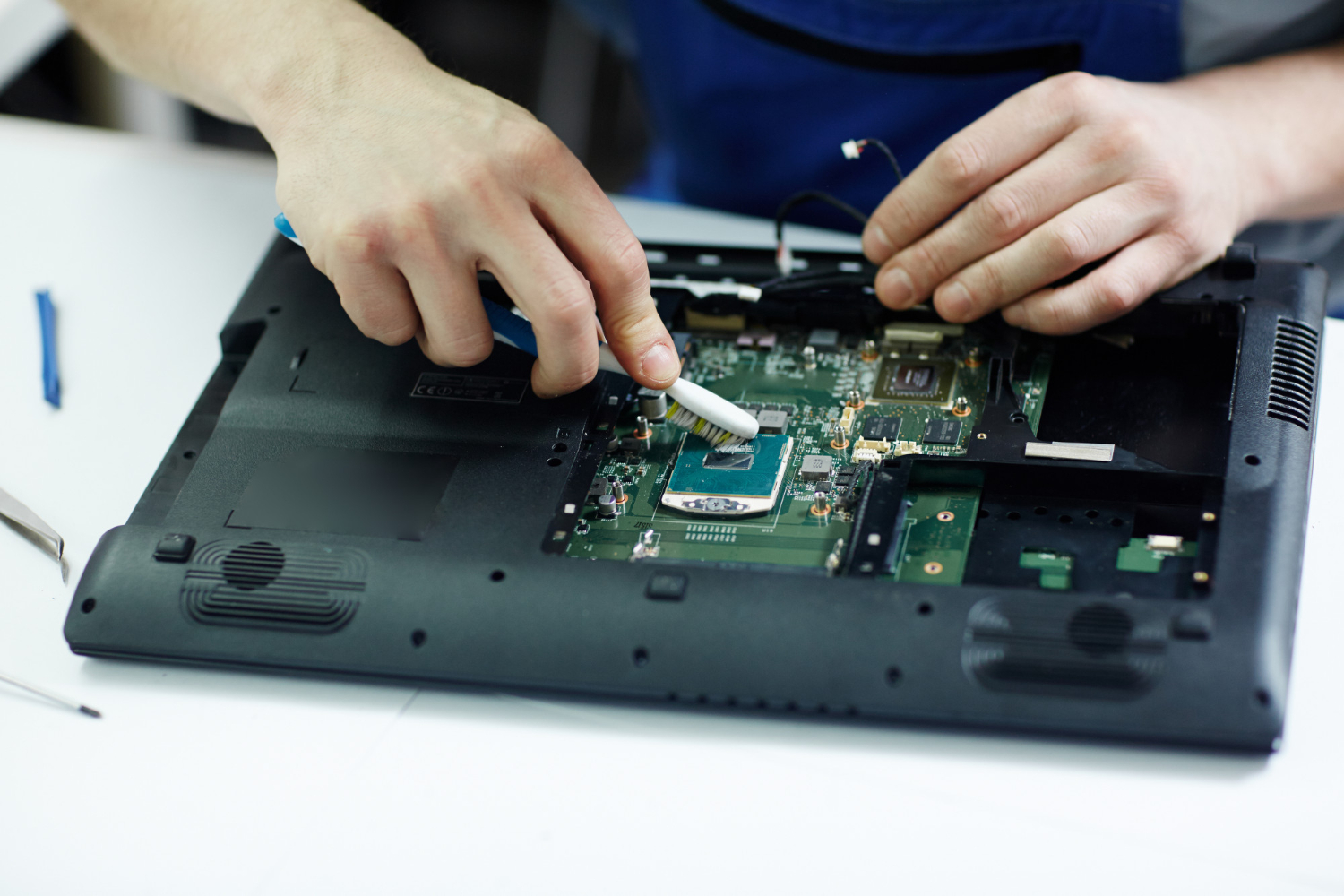
Maintenance services in information technology environments play a crucial role in sustaining uptime and protecting data. Hardware failure is rarely sudden without warning. Batteries lose capacity over charge cycles. SSDs expose wear indicators. Fans accumulate dust and reduce cooling efficiency. Firmware vulnerabilities are published long before they are exploited. A disciplined approach turns these signals into planned actions instead of emergency incidents.
A comprehensive program typically covers a range of services:
- Preventive diagnostics for endpoints and servers
- Firmware and BIOS updates aligned with vendor advisories
- Disk health validation using SMART indicators
- Battery cycle tracking and scheduled replacement planning
- Thermal inspection and internal cleaning
- Hardware support escalation and part replacement
- Asset documentation and lifecycle tracking
- Secure decommissioning and data wipe procedures
These activities may be delivered internally or through a third party maintenance provider. In either case, the service includes maintenance services that define scope, responsibilities, response times, and technical support channels.
Preventive Versus Reactive Maintenance
Organizations often underestimate the cost of reactive support. When a device fails unexpectedly, the impact includes lost productivity, emergency procurement, and unplanned shipping across regions. In distributed teams, this delay can stretch across time zones and customs processes.
Preventive IT hardware maintenance focuses on intervention before failure. Instead of waiting for a laptop battery to drop below acceptable performance, IT teams monitor health indicators and replace components during planned refresh cycles. Instead of reacting to a storage crash, disk wear metrics are reviewed regularly.
Reactive maintenance usually involves:
- Unscheduled troubleshooting
- Ad hoc part replacement
- Emergency device shipping
- Temporary device loan arrangements
Preventive maintenance emphasizes:
- Documented inspection intervals
- Predictable component replacement cycles
- Firmware and patch management routines
- Structured maintenance and support workflows
Over time, preventive programs reduce downtime volatility and simplify hardware support coordination across regions.
Core Components of an Effective IT Hardware Maintenance Strategy
An effective IT hardware maintenance framework is built on clear ownership, documentation, and measurable checkpoints. It is not limited to physical inspection. It integrates security, compliance, and lifecycle governance.
For companies with distributed teams, maintenance must connect with IT Asset Management visibility and endpoint control. Devices should remain traceable from procurement and onboarding through refresh and retirement. Without this structure, maintenance efforts become inconsistent as the device fleet grows.
1. Asset Visibility and Inventory Accuracy
Maintenance begins with accurate asset visibility. IT teams need reliable records before they can enforce maintenance schedules, security policies, or refresh timelines. When inventory data is incomplete, devices can fall outside governance or remain in employee possession after offboarding.
Asset records should capture key operational details:
- Device model and serial number
- Warranty status and service coverage
- Assigned employee and location
- Purchase date and refresh timeline
- Encryption and security status
Accurate inventory supports both IT and HR workflows. IT teams use it to manage maintenance and refresh planning, while HR relies on the same records during onboarding and offboarding to maintain accountability for company devices.
2. Firmware and Patch Management
Firmware maintenance is an important part of hardware governance. Many hardware vulnerabilities originate from outdated BIOS versions, device controllers, or vendor firmware components. When updates are delayed, devices may remain exposed to stability issues or known security risks.
IT teams typically review vendor advisories, validate firmware compatibility, and deploy updates through controlled processes. Patch management should cover the full device stack including operating system updates, security patches, and firmware updates.
For distributed teams, Unified Endpoint Management platforms help enforce update policies across remote devices. This allows administrators to maintain consistent device configuration and track update status across the entire fleet.
3. Environmental and Physical Health Monitoring
Hardware reliability is strongly influenced by environmental conditions and physical wear. Even properly configured devices can degrade if operating conditions are not monitored.
For employee endpoints, routine checks typically include:
- Battery cycle count monitoring
- Inspection of keyboards and device ports
- Cooling performance checks
For servers or infrastructure equipment:
- Temperature and airflow validation
- Power supply redundancy testing
- Disk array health monitoring
These checks help IT teams detect early signs of hardware stress before they lead to device failure or performance degradation.
4. Structured Maintenance Contracts
Maintenance contracts define how hardware support is delivered when issues occur. Whether using OEM services or third party maintenance providers, organizations should establish clear service expectations.
These agreements usually define response times, replacement part availability, escalation procedures, geographic coverage, and technical support access hours.
For companies with distributed teams, structured maintenance agreements are particularly important. Hardware incidents may require coordination across regions, local repair partners, and logistics providers. Clear support coverage helps ensure that device failures can be resolved quickly without disrupting employee productivity.
The IT Hardware Maintenance Lifecycle
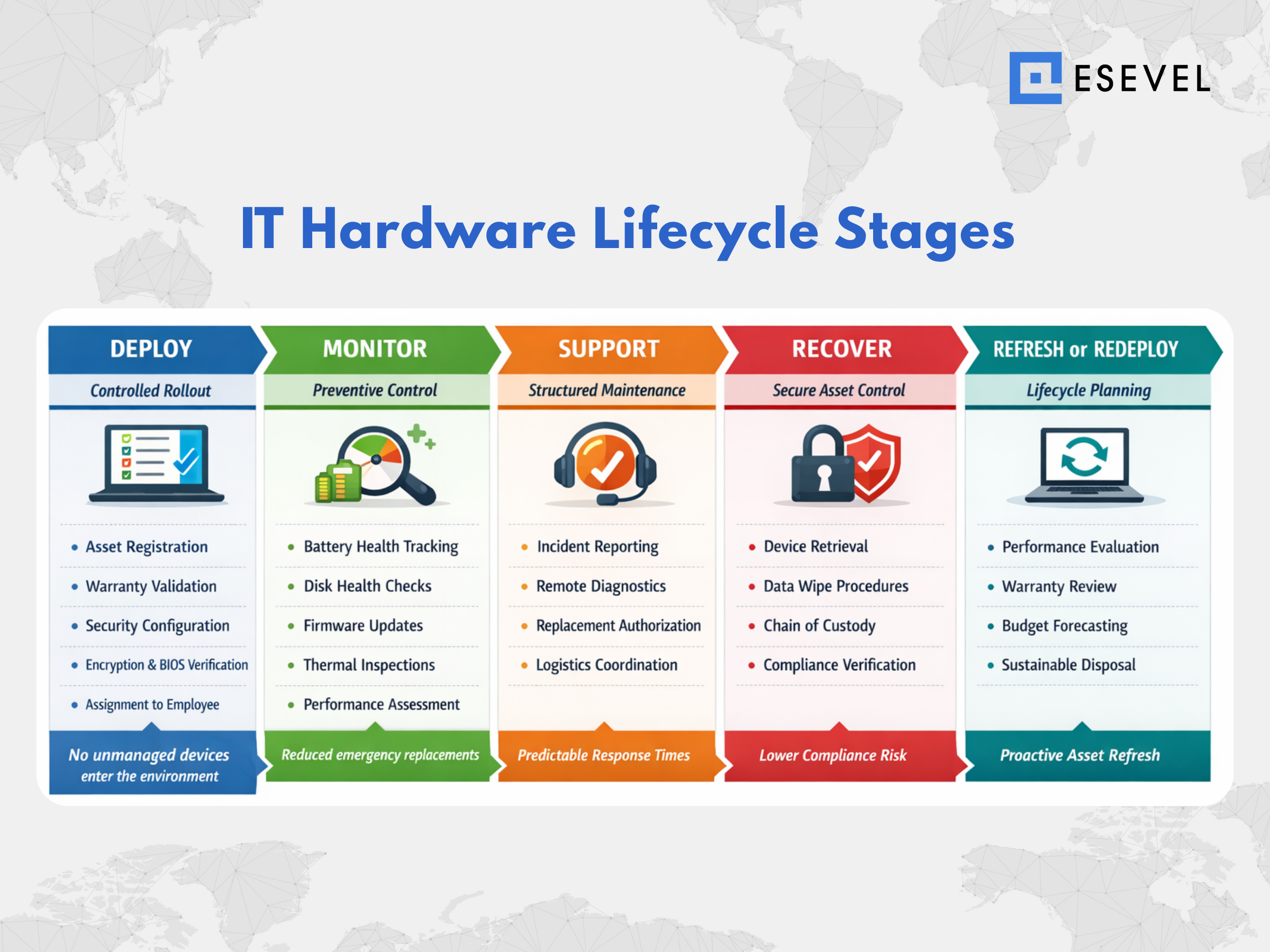
IT hardware maintenance is most effective when structured as a lifecycle rather than isolated repair events. Each stage builds on the previous one, ensuring that deployment, monitoring, support, and recovery operate as a unified process.
Below is a visual representation of the IT hardware maintenance lifecycle.
IT Hardware Maintenance in Distributed Teams
When devices are dispersed across regions, maintenance intersects with logistics and procurement. Replacement hardware cannot always be delivered overnight. Customs processes and local vendor limitations create friction.
IT hardware maintenance for distributed teams should include:
- Regional device staging strategies
- Standardized device models
- Centralized maintenance contract governance
- Local execution of support services
- Defined recovery workflows
A centralized lifecycle framework eliminates the need for fragmented local procurement decisions. Instead of reacting to each hardware incident independently, organizations operate under a unified structure.
This approach allows global teams to scale without downtime driven by inconsistent hardware support
Frequently Asked Questions
1. What does IT hardware maintenance include?
IT hardware maintenance includes preventive inspections, firmware updates, hardware support coordination, secure disposal procedures, and lifecycle documentation under a defined maintenance contract.
2. Why is preventive maintenance important?
Preventive maintenance reduces unplanned downtime and protects security posture. Early detection of battery degradation, disk wear, or firmware vulnerabilities prevents reactive incidents.
3. What is the difference between OEM services and third party maintenance?
OEM services are delivered by manufacturers and provide certified hardware support. Third party maintenance offers multi vendor coverage and flexible maintenance and support structures.
4. How does IT hardware maintenance reduce procurement delays?
Structured lifecycle planning ensures replacement devices are staged regionally and covered under centralized support services. This prevents fragmented local purchasing during emergencies.
5. Does IT hardware maintenance apply to data centers?
Yes. Data centers require structured maintenance and support including environmental checks, redundancy validation, and firmware oversight.
Operational Control Without Procurement Friction
IT hardware maintenance is not just about fixing devices. It determines how efficiently organizations operate across borders. Without structure, downtime increases, procurement becomes inconsistent, and hardware support grows reactive.
A lifecycle based approach integrates deployment, monitoring, support, recovery, and refresh under one governance model. Devices remain visible. Maintenance services are standardized. Support services align with hiring and offboarding cycles.
For companies managing global teams, the objective is operational stability without added complexity. Structured IT hardware maintenance enables distributed growth while reducing downtime and eliminating the friction of fragmented local procurement.