IT procurement services help companies source, buy, deliver, and coordinate technology through an external or managed provider. For global teams, the right service should cover more than purchasing. It should help manage suppliers, delivery, device readiness, asset handoff, and ongoing support.
This becomes more important as employees spread across countries and regions. IT teams may need to coordinate different suppliers, device models, delivery timelines, warranties, and local availability while still maintaining company standards.
The right provider can reduce that operational work. This guide explains what IT procurement services should include, when companies need them, how different provider models compare, and what to check before choosing one.
What are IT procurement services?
IT procurement services help companies source, purchase, and coordinate the technology needed by employees and business teams. They may cover laptops, desktops, monitors, accessories, software, suppliers, delivery, and related IT services.
A provider can take responsibility for parts of the procurement workload that would otherwise sit across IT, finance, HR, and operations. The exact scope varies, which is why companies should look beyond the term “procurement” and check what the provider actually handles.
That service scope becomes clearer when procurement is broken into the activities behind each purchase.
What IT procurement services include
IT procurement services can cover everything from finding an approved laptop to coordinating what happens when the device reaches an employee. Companies should check which of these services are included before selecting a provider.
Hardware and device sourcing
Hardware sourcing covers laptops, desktops, monitors, accessories, and other employee devices. A provider may help find approved models, check regional availability, collect quotes, and source alternatives when preferred equipment is unavailable.
For distributed teams, this can also reduce the need for IT staff to search for a different supplier each time an employee joins in a new location.
Software and license coordination
Some IT procurement services also include software licenses, subscriptions, and related vendor coordination. This can help companies keep software purchases aligned with user requirements, budgets, and approved tools.
The provider should also make it clear whether it only supports physical devices or can coordinate both hardware and software procurement.
Vendor and supplier management
Vendor management includes sourcing suppliers, comparing quotes, coordinating communication, reviewing availability, and maintaining purchasing standards.
This becomes useful when a company would otherwise need to manage several local vendors separately. A provider can act as a central point of coordination while purchases still happen through appropriate regional suppliers.
Delivery and logistics coordination
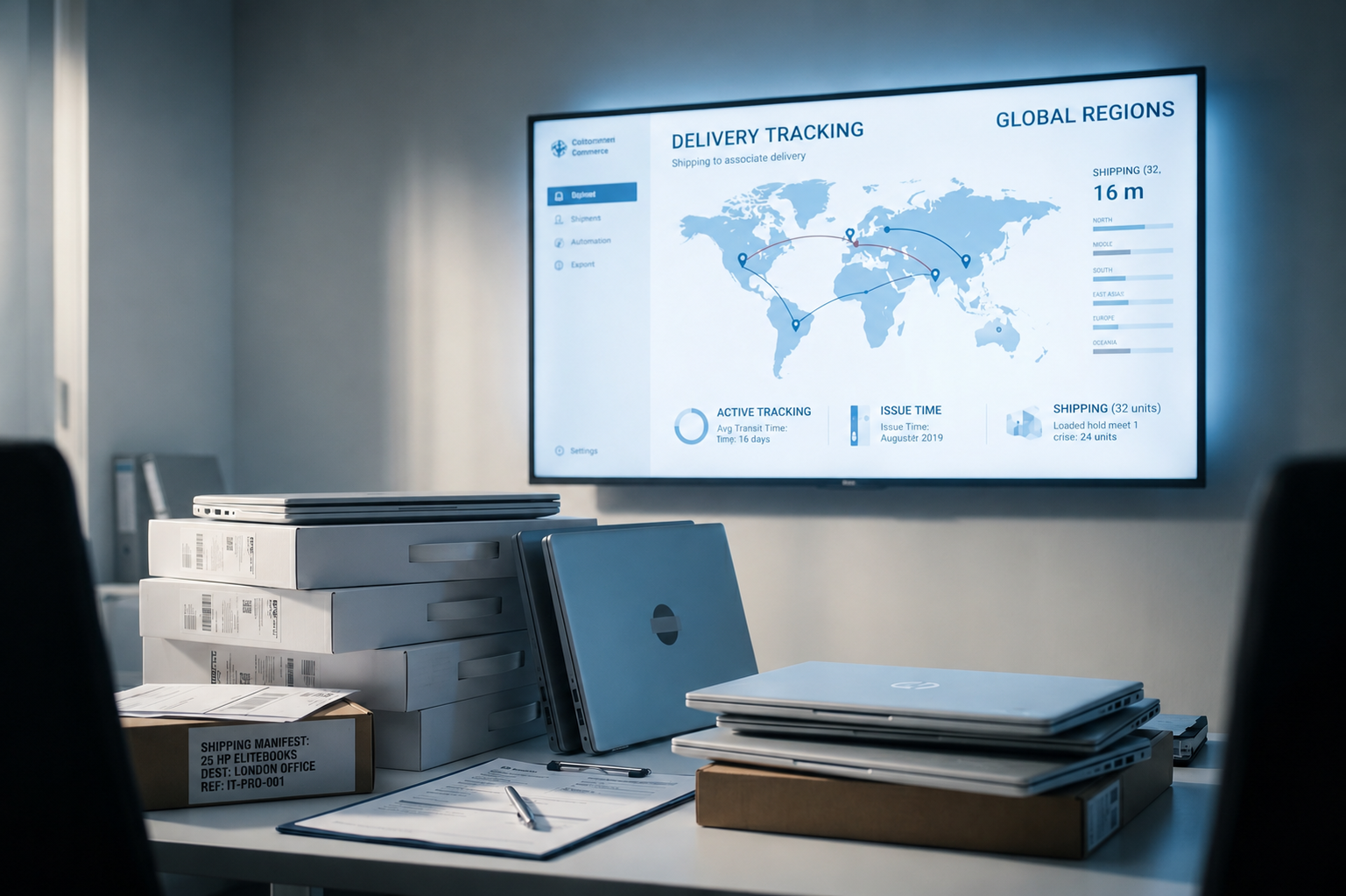
Buying the device is only part of the process. Someone still needs to confirm employee details, coordinate shipping, track orders, and respond when delivery does not go as planned.
A stronger IT procurement service should provide clear order status and help manage delivery issues instead of leaving IT teams to contact multiple couriers or vendors themselves.
Device setup and asset handoff
Procurement should also connect the purchase with the team responsible for the device after delivery.
This may include coordinating required setup, recording the serial number and warranty details, assigning the device to an employee, and updating its location and status. A clear handoff helps prevent gaps between purchasing and inventory management.
Repair, replacement, and lifecycle support
Some providers stop once the order arrives. Others support what happens later, including repair, replacement, recovery, redeployment, and refresh planning.
Companies should decide how much post purchase support they need before choosing a service model. That makes service scope one of the most useful ways to compare providers.
IT procurement service scope comparison
Two providers may both offer IT procurement services while handling very different parts of the process. Reviewing the scope by service area makes those differences easier to see.
| Service area | What it covers | Why it matters |
|---|---|---|
| Device sourcing | Approved laptops, monitors, accessories, and regional availability | Helps teams avoid urgent or inconsistent buying |
| Vendor coordination | Quotes, supplier communication, warranty terms, and alternatives | Reduces manual follow up and supplier fragmentation |
| Delivery logistics | Shipment tracking, employee address checks, and delivery exceptions | Helps devices reach employees when they need them |
| Device readiness | Setup coordination, security requirements, and required accessories | Helps employees receive equipment that is ready for work |
| Asset handoff | Serial number, warranty, owner, location, and status | Connects procurement records with device inventory |
| Lifecycle support | Repair, replacement, recovery, redeployment, and refresh | Extends procurement support beyond the initial delivery |
The right scope depends on how much work the company wants to keep internally. A business with a strong procurement team may only need sourcing support, while a distributed IT team may need a provider that handles much more of the device journey.
Knowing when those extra services become necessary can help companies decide whether their current procurement model still works.
When companies need IT procurement services
Not every company needs the same level of procurement support. The need usually becomes clearer as purchasing volume, employee locations, and vendor complexity increase.
Common signs include:
- Employees are being hired across multiple countries
- IT spends too much time requesting quotes and chasing suppliers
- Device delivery delays affect employee onboarding
- Different teams buy different device models from different vendors
- Procurement records do not connect with asset inventory
- IT has limited visibility into order and delivery status
- Repair and replacement processes differ by location
- Employees depend on IT to solve delivery issues manually
These problems often appear gradually. A process that works with one office and a few suppliers may become much harder to control once devices need to reach employees across several regions.
An IT procurement service provider can take over selected parts of this workload, but companies still need to understand how the provider manages the process.
IT procurement services process
IT procurement works best when it follows a structured process. Without clear steps, teams often face delays, duplicate purchases, poor vendor choices, and limited visibility.
The IT services procurement process should connect business needs with IT standards, budget rules, and delivery requirements.
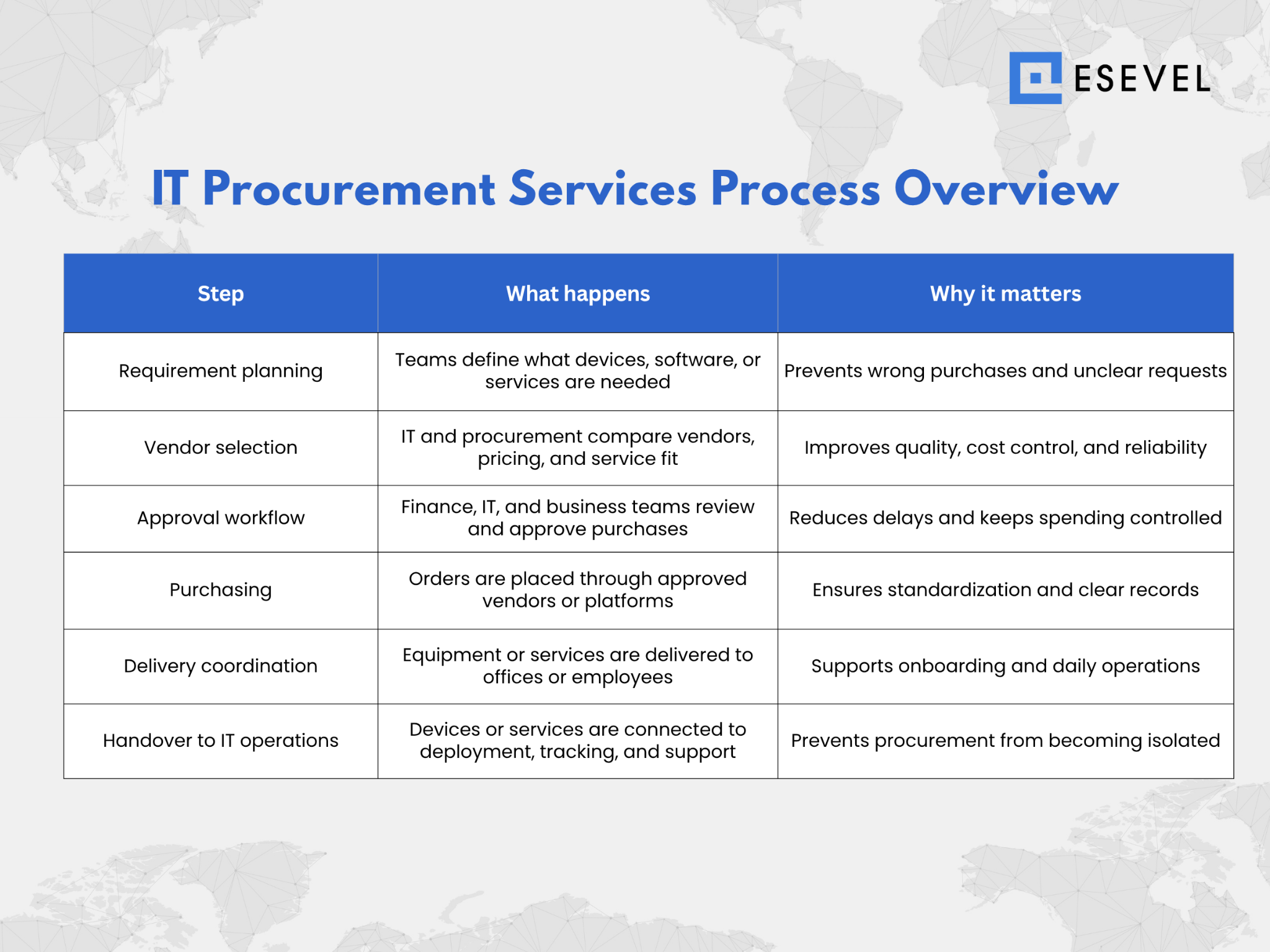
This process becomes more complex as teams scale. A company hiring in one city may handle procurement manually. A company hiring across several countries needs stronger coordination, vendor coverage, and visibility.
The real challenge is not placing an order. The challenge is making sure every purchase is usable, tracked, and supported after it arrives.
How to evaluate IT procurement service providers
Provider evaluation should go beyond product catalogs and device prices. Companies should look at what happens before, during, and after each order.
Check service scope and exclusions
Start by asking exactly what the provider manages.
Does it only source and purchase devices? Does it coordinate shipping? Can it support setup, asset recording, replacement, repair, recovery, or redeployment?
Also ask what is not included. Clear exclusions make it easier to understand which tasks will still remain with internal IT, HR, finance, or operations teams.
Review supplier and country coverage
A provider may work well in one market but struggle when hiring expands into another.
Check where the provider can source devices, which suppliers it works with, and whether employees can receive company approved equipment across the locations where the business operates.
Coverage should also include the operational side. Purchasing a laptop in a country is less useful when the provider cannot help with delivery or support after it arrives.
Confirm reporting and data access
IT teams should be able to see what has been requested, ordered, shipped, delivered, and assigned.
Ask what data is available and how teams access it. Useful records can include order status, employee assignment, serial number, device model, warranty details, location, and lifecycle status.
Good visibility reduces the need to maintain separate spreadsheets or request updates manually from suppliers.
Ask about delivery exceptions and replacements
Standard orders are only one part of procurement. Companies should also understand what happens when something goes wrong.
Ask how the provider handles stock shortages, delayed shipments, failed deliveries, incorrect devices, damaged equipment, and urgent replacement needs.
These exceptions often create the most manual work for internal teams, so the response process matters as much as the normal purchasing workflow.
Check lifecycle support after delivery
Finally, ask where the provider’s responsibility ends.
Some services finish once the device reaches the employee. Others continue with asset tracking, repair, replacement, recovery, redeployment, and refresh.
A provider does not need to manage every lifecycle stage for every company. However, IT teams should understand the handoff before signing a contract so devices do not disappear from operational visibility after procurement.
That connection between purchasing and ongoing device records is why lifecycle visibility still matters, even on a service evaluation page.
Why lifecycle visibility matters in IT procurement services
Lifecycle visibility helps IT teams keep procurement connected with what happens after a device is purchased. It makes it easier to:
- Track ownership and location: Keep records of who has each device and where it is being used.
- Connect purchase data with asset records: Carry details such as model, supplier, warranty, and cost into inventory systems.
- Support repairs and replacements: See device history when hardware needs service, replacement, or troubleshooting.
- Improve recovery and redeployment: Know which devices should be collected during offboarding and which can be reused.
- Plan refresh cycles: Use purchase dates, warranty status, and device history to decide when equipment should be replaced.
For a broader look at how purchasing connects with deployment, tracking, support, recovery, and refresh, see our guide to end to end procurement.
FAQs
What should an IT procurement service provider handle?
It should support sourcing, supplier coordination, ordering, delivery, and order visibility. Some providers also cover setup, repairs, replacements, and recovery.
When should a company use IT procurement services?
Companies may need them when managing multiple suppliers, locations, device orders, or frequent delivery and replacement issues.
What should you ask an IT procurement service provider?
Ask about service scope, geographic coverage, pricing, delivery support, reporting, and post delivery support.
How do you compare IT procurement service providers?
Compare their coverage, supplier network, delivery capabilities, reporting, exception handling, and lifecycle support.
Build procurement that scales with your team
IT procurement is not just buying equipment. It is the first step in a larger IT lifecycle that includes deployment, tracking, support, and recovery.
As teams grow across regions, companies need more than tools or local vendors. They need a system that connects procurement with global operations, so every device is visible, usable, and supported from day one. A lifecycle based approach turns procurement into an operational advantage. Esevel supports this by helping companies manage global device procurement, deployment, tracking, support, and recovery in one connected system. This gives modern teams the structure they need to scale without losing control.