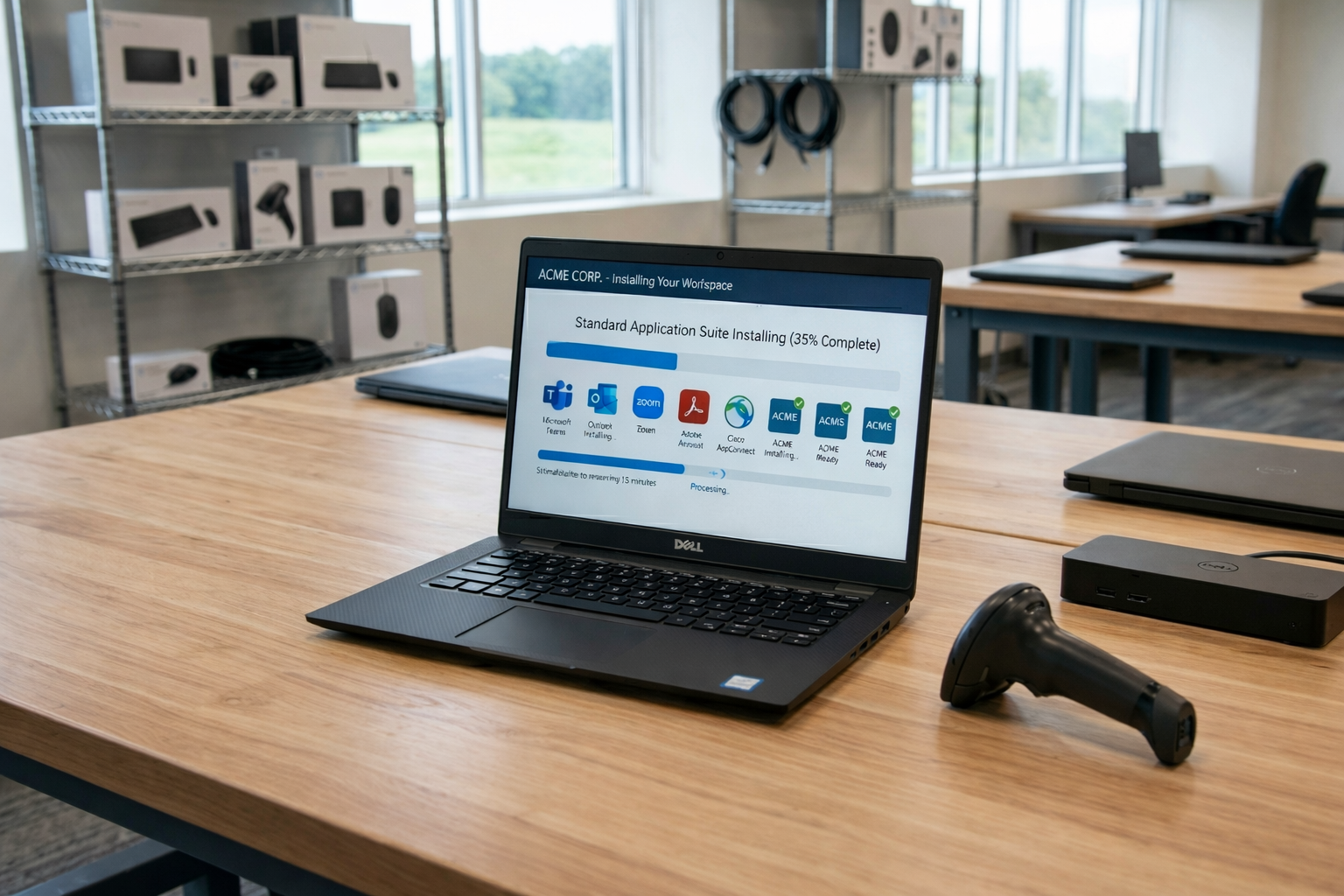
Laptop procurement moves faster when IT plans demand early, standardizes device requirements, simplifies approvals, sources closer to employees, and keeps supplier and inventory availability visible. The goal is not only to order laptops faster. It is to reduce the time between an approved request and a ready device reaching the employee.
For global teams, procurement speed also depends on regional stock, supplier coverage, delivery routes, and clear device standards. A laptop that is easy to source in one country may take much longer in another.
The strongest procurement model combines demand planning, approved device standards, regional sourcing, clear approvals, and coordinated device readiness. Provisioning supports that process, but it is only one part of getting a laptop to an employee on time.
Why laptop procurement slows down
Laptop procurement often slows down before the order is even placed. IT may need to confirm the employee role, choose a device, request approval, find local stock, compare suppliers, and check delivery timing before purchasing can begin.
Global operations add more variables. The same laptop model may not be available in every country, while local warranty coverage, accessories, pricing, and delivery options can also differ.
Current market conditions make early planning more important. Gartner noted in June 2026 that higher PC costs and supply chain fragility are causing organizations to reassess their procurement and deployment strategies.
Device procurement can also become an onboarding bottleneck. In Electric’s employee onboarding research, 32% of respondents identified device procurement and provisioning as a challenge, showing how procurement delays can affect employee readiness.
The most common causes of delay are unclear requirements, slow approvals, limited supplier stock, too many device models, regional availability differences, and poor visibility into devices that are already available for reuse.
How can companies expedite laptop procurement?
The fastest procurement process is not the one with the fewest controls. It is the one that removes repeated decisions while keeping clear standards for cost, security, and employee needs.
Forecast laptop demand before hiring starts
Do not wait for every new hire to create a new purchasing process. Use hiring forecasts, planned team growth, refresh schedules, and spare inventory levels to estimate upcoming demand.
Microsoft reported that about 70% of new hires receive a device by their first day, with a target of 98%, showing how closely procurement planning and device availability affect employee readiness.
This gives IT more time to confirm stock and prepare alternatives before a device becomes urgent. It also reduces the need for expensive last minute purchases.
For roles with predictable hiring patterns, IT can define expected monthly or quarterly demand. The goal is not to hold excessive inventory. It is to understand what the company is likely to need before each request arrives.
Standardize laptops by role
Approved device standards reduce the time spent comparing models for every employee.
Define laptop requirements around job function, performance needs, security standards, and budget. A general business employee may need a different specification from a developer or designer.
For global teams, standardize the specification rather than relying on one exact model number everywhere. This allows IT to approve an equivalent regional device when the preferred model is unavailable.
A smaller approved catalogue also makes pricing, support, repairs, and replacement planning easier.
Simplify procurement approvals
Long approval chains can add days before IT contacts a supplier.
Set approved device categories, budget limits, and clear exception rules in advance. Standard requests can then move through a simpler workflow, while unusual or higher cost requests receive additional review.
The purchase request should contain the information needed to make a decision the first time, including the employee role, location, device requirement, cost, delivery date, and budget owner.
This reduces repeated questions between IT, finance, People Ops, and hiring managers.
Source devices closer to employees
Regional sourcing can reduce unnecessary shipping time and make warranty support easier.
Instead of sending every laptop from headquarters, companies can source approved devices within or closer to the employee’s market where reliable suppliers are available.
This matters more as the company expands. A central purchasing policy can remain consistent even when the supplier or exact device model changes by region.
Teams should still maintain one asset record and one set of procurement standards so local sourcing does not create fragmented device management.
Keep supplier and inventory availability visible
Procurement teams need to know what they can deploy now and what they need to order.
Before buying another laptop, check whether the company already has a suitable spare or recovered device. If a new purchase is required, confirm supplier availability before promising a start date.
Inventory visibility should show which devices are available, assigned, in transit, under repair, or waiting for reuse. Supplier visibility should show which approved models are currently available in each market.
This prevents IT from creating a new order when a suitable asset already exists.
Coordinate device readiness before delivery
Fast purchasing has limited value if the laptop arrives and still needs several days of setup.
Define the required configuration before placing the order. Depending on the company’s environment, that may include enrollment, security policies, required applications, and employee access.
Automated laptop provisioning can reduce setup work after procurement, especially when devices use tools such as Windows Autopilot or Apple automated enrollment. However, provisioning should support the procurement workflow rather than replace it.
How should global teams handle laptop procurement?
Global laptop procurement works best when companies standardize what employees need but localize how devices are fulfilled.
Keep device specifications, security requirements, approval rules, budgets, and asset records consistent across the company. Then allow regional sourcing, equivalent device models, local currencies, delivery routes, and warranty options to vary where needed.
The same regional approach should also extend to post delivery support, since global hardware support can help companies coordinate repairs and replacements closer to employees.
For example, IT may approve a business laptop specification based on processor, memory, storage, operating system, and security requirements. One country may receive one model while another receives an equivalent regional option.
This approach gives IT more flexibility when stock changes without creating a completely different procurement policy for every market.
For companies that do not want to coordinate separate suppliers in each country, a global procurement provider can manage sourcing and delivery through one operating model. Esevel supports device procurement across global teams, with a standard catalogue lead time of 3 to 5 working days.
How does device standardization reduce procurement lead time?
Device standardization removes repeated selection work.
When IT already knows which specifications and price ranges are approved, teams can move directly from request to availability and purchasing. Finance also has clearer expectations because standard device categories already have defined budgets.
Standardization can also improve supplier planning. IT can ask suppliers about availability for a smaller set of approved configurations rather than checking a large number of possible devices.
However, global teams should avoid making standards too rigid. Requiring one exact model worldwide can create delays when regional stock changes. Approved equivalents give procurement teams room to move faster while maintaining the required performance and security level.
How should IT measure laptop procurement performance?
Procurement speed should be measured across the full journey, not just shipping time.
| Metric | What it shows |
| Request to approval time | How quickly internal decisions are made |
| Approval to order time | How efficiently procurement executes approved requests |
| Order to delivery time | How long the supplier and delivery process takes |
| On time fulfillment | Whether devices arrive within the expected window |
| Stock availability | How often approved devices are available when requested |
| Procurement exceptions | How often orders need manual intervention or alternative sourcing |
| Ready by start date | Whether the employee receives a usable device on time |
Esevel’s actual historical order data shows an average order to delivery time of 2-3 business days across markets. Its standard catalogue typically has a 3 to 5 working day lead time. These figures measure different parts of the process, so teams should define each procurement metric clearly before comparing supplier performance.
Tracking these measures over time can show whether delays come from internal approvals, supplier availability, delivery, or device preparation.
When should companies use a global laptop procurement provider?
A global provider can make sense when IT spends too much time coordinating local suppliers, checking regional availability, managing deliveries, and keeping procurement records consistent across countries.
It becomes more useful as hiring expands across markets and the number of local supplier relationships grows. The provider should still work within the company’s approved device standards, security requirements, budgets, and asset processes.
Esevel supports device procurement and delivery as part of a broader device lifecycle model, including setup, tracking, hardware support, recovery, and redeployment. This can reduce the number of separate handoffs IT needs to coordinate when employees work across regions.
The right model depends on how much sourcing and fulfillment work the internal team wants to manage directly.
Frequently asked questions
How can companies expedite laptop procurement?
Companies can expedite laptop procurement by forecasting demand, standardizing approved devices, simplifying approvals, checking existing inventory, sourcing regionally, and confirming supplier availability early. Device readiness should also be planned before delivery.
What affects laptop procurement lead time?
Laptop procurement lead time can be affected by internal approvals, supplier stock, device standards, regional availability, shipping, configuration requirements, and delivery location. Global teams should also plan for differences between local markets.
How far in advance should IT order laptops for new hires?
IT should start procurement as soon as the hire and delivery location are confirmed, using the expected supplier lead time plus enough buffer for setup and unexpected stock or delivery issues. The required buffer will vary by country, device, and supplier.
Make procurement speed repeatable
Expediting laptop procurement is less about rushing individual orders and more about removing repeated decisions from the process. Demand forecasting, approved device standards, simpler approvals, regional sourcing, and clear inventory visibility make procurement faster without reducing control.
For distributed teams, the same model should also work across different markets. Esevel helps coordinate global laptop procurement, delivery, setup, tracking, and ongoing device operations so IT teams can keep employee device readiness consistent as the company grows.

Maytiska Omar Maytiska is an experienced content writer and blog specialist with 4+ years of expertise in creating engaging, SEO-driven content. She focuses on IT and digital topics, turning complex ideas into clear, reader-friendly insights. Her work helps position Esevel as a trusted voice in the digital space.
Updated by: Maytiska Omar