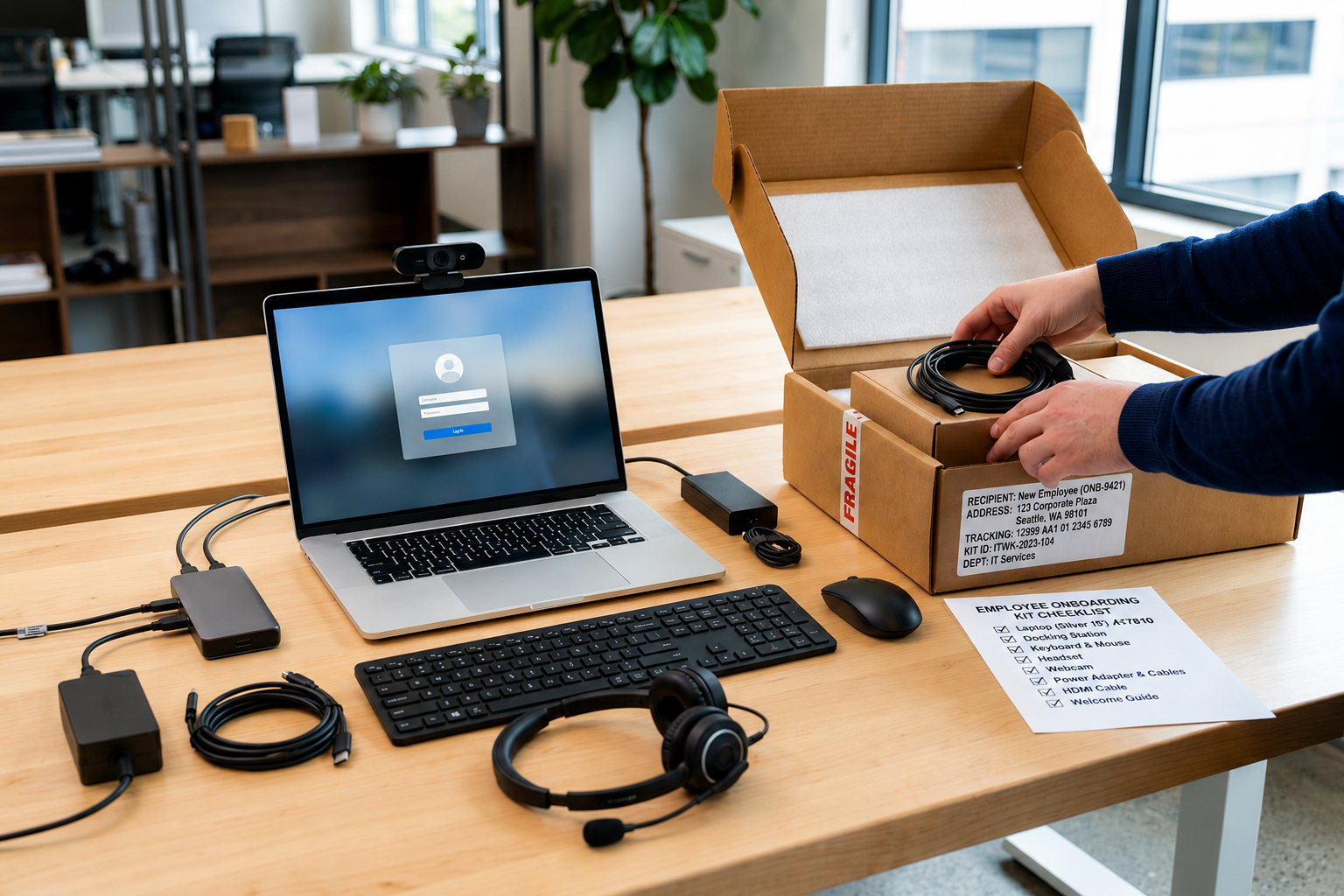
The international procurement process for IT equipment is a coordinated workflow for defining hardware standards, sourcing devices across markets, evaluating total cost, approving purchases, managing country specific logistics, configuring equipment, delivering it to employees, and recording each asset for visibility.
For global IT teams, purchasing is only one part of the process. A company may want consistent laptop specifications, security requirements, budgets, and approval rules, but availability, taxes, warranty coverage, accessories, and delivery conditions can vary by country. The scalable approach is to centralize standards and visibility while allowing controlled local execution.
Cross border complexity also has a measurable cost. A 2025 WTO review found that transit delays can account for up to 44% of transport costs, showing why logistics and customs decisions need to be considered before an order is placed.
What is the international procurement process for IT equipment?
International IT procurement covers requirements planning, hardware standardization, budget approval, supplier sourcing, purchase orders, local or cross-border fulfillment, customs coordination where needed, device configuration, employee delivery, and asset assignment.
It differs from domestic procurement because of variables domestic buying doesn’t face: multiple currencies, regional pricing, product availability, local taxes, import duties, warranty restrictions, keyboard and language requirements, and plug and power compatibility. The same approved laptop model might need a different regional SKU depending on where the employee sits.
Why does international IT procurement need centralized control and local execution?
Global consistency does not require identical execution in every country. Companies can standardize the outcome they expect while allowing sourcing and fulfillment to adapt to local conditions.
| Keep centralized | Allow local execution |
| Approved device specifications | Local supplier selection |
| Role based hardware standards | Approved product substitutes |
| Budget limits | Local pricing and currency |
| Approval rules | Taxes and import requirements |
| Security requirements | Warranty arrangements |
| Supplier criteria | Delivery providers |
| Asset data requirements | Regional accessories |
| Reporting | Last mile logistics |
For example, IT may specify a minimum processor, memory, operating system, security configuration, and warranty standard rather than requiring one exact laptop SKU everywhere. A locally available equivalent can then satisfy the same standard when the preferred model is unavailable.
The operating principle is simple: centralize policy, localize execution, and centralize visibility. This gives procurement teams consistency without forcing every market into the same sourcing route.
A structured procurement plan can document these standards, approval paths, budgets, and supplier requirements before individual orders begin.
What are the steps in the international procurement process?
A scalable international procurement process for IT equipment can be organized into eight stages.
Step 1: Define IT equipment requirements
Start with what the employee actually needs. Record the employee role, workload, destination country, required delivery date, device type, operating system, accessories, hardware specifications, and security requirements.
The goal is to answer one question first: what does this employee need to work productively and securely?
Step 2: Standardize devices by role and market
Create an approved device catalog with minimum specifications and acceptable regional equivalents.
Confirm elements such as keyboard layout, power adapter, operating system, warranty coverage, MDM compatibility, and security requirements. Standardizing specifications rather than exact SKUs gives teams more flexibility when the preferred model is unavailable locally.
Step 3: Choose the right sourcing model
Decide whether to source locally, purchase regionally, ship across borders, reuse existing stock, or work through a global procurement partner.
Local sourcing often works well when products are available nearby, warranty support is local, import costs are high, or onboarding timelines are tight.
Cross border sourcing may make more sense when specialized equipment is unavailable locally or the company already owns suitable inventory elsewhere.
Step 4: Evaluate suppliers and total landed cost
Do not compare suppliers only on laptop price. Include freight, insurance, duties, taxes, customs fees, currency exposure, configuration, warranty, and replacement support.
The U.S. International Trade Administration defines landed cost as the total price once a product reaches the buyer, including the original price, freight, insurance, tariffs, taxes, and other fees.
For IT equipment, configuration and warranty support should also influence the sourcing decision.
Step 5: Approve the purchase and place the order
Standardize the purchase request, budget approval, supplier approval, quotation, purchase order, delivery address, required date, and procurement record.
Define an exception process as well. If an approved device is unavailable, teams should know who can approve an equivalent model, different supplier, or alternative sourcing route.
Step 6: Manage international logistics and local requirements
Before shipping, confirm the destination, documentation, customs responsibilities, duties and taxes, and local delivery requirements.
Then track the order through international and last mile logistics. Teams also need a clear process for customs holds, damaged packages, failed deliveries, employee address changes, and other exceptions.
Requirements differ by destination, so customs and import rules should always be verified for the specific country rather than applied globally.
Step 7: Configure and deploy the equipment
Delivery alone does not make an international procurement order successful.
Before employee handover, configure the device, enroll it in MDM where required, install necessary applications, apply security controls, assign an asset tag, complete quality checks, and connect the device with the correct employee.
The standard should be work ready, not simply delivered.
Step 8: Record and track the device
Procurement data should become the starting point for the asset record.
Capture the model, serial number, supplier, purchase date, cost, warranty, employee, location, country, and device status. This gives IT visibility from the moment the asset enters the company instead of trying to rebuild records later.
Should you source IT equipment locally or ship it internationally?
Neither approach is always better. Companies should choose between local and cross border sourcing based on the requirements of each destination while keeping the decision within one global procurement policy.
| Factor | Local sourcing may be better | Cross border sourcing may be better |
| Availability | Approved device exists locally | Required device is unavailable |
| Delivery | Onboarding deadline is tight | Timeline is flexible |
| Customs | Local purchase avoids imports | Import process is manageable |
| Warranty | Local support is important | International warranty applies |
| Cost | Import costs are high | Central pricing offsets logistics |
| Standardization | Regional equivalent is approved | Exact model is mandatory |
| Inventory | No suitable central stock | Existing stock can be reused |
The decision should consider total landed cost, lead time, warranty, device consistency, inventory, local support, security configuration, and import requirements.
The important point is not to standardize the sourcing route. Standardize the decision criteria.
What costs should international IT procurement include?
International IT procurement should compare the cost of getting a usable device to its destination, not just the supplier’s quoted hardware price.
Include three cost groups:
- Purchase costs: hardware, accessories, configuration.
- International costs: freight, insurance, duties, tariffs, VAT/GST, customs fees, currency conversion.
- Operational costs: setup, delivery exceptions, warranty, repair, replacement, Internal vendor coordination.
Total landed cost matters because a lower purchase price can become more expensive after freight, duty, tax, and other charges are included. Tariffs and taxes also vary by importing market and can change, so estimates should be checked against current destination requirements.
How should companies manage international IT suppliers?
Managing international IT suppliers requires a balance between centralized standards and regional flexibility. Companies should keep the same expectations across markets, even when different local vendors are involved.
Standardize supplier management around:
- Device availability and authenticity
- Pricing transparency
- Delivery reliability
- Warranty coverage
- Configuration support
- Replacement capability
- Service levels
- Quote response time
- Order accuracy
- Delivery time
- Exception rate
- Warranty support
- Replacement speed
Supplier information should also stay centralized. Contracts, pricing, supported countries, contacts, order history, and escalation paths should be visible in one place so procurement teams can compare performance across regions.
Consolidating suppliers can reduce coordination work, but using fewer vendors should not be the goal by itself. Local specialists may still be valuable where product availability, warranty terms, or market requirements differ. The better approach is to manage regional vendors under one consistent IT supplier management framework while keeping enough flexibility to source effectively in each country.
How does international procurement affect employee onboarding?
International procurement has a direct impact on whether a new employee can start work on time. A device may reach the destination before the start date, but onboarding can still be delayed if the wrong regional model was ordered, required applications are missing, security settings are incomplete, or the device has not been assigned to the employee.
For that reason, procurement performance should be measured against employee readiness, not just delivery. The process needs to account for sourcing lead time, configuration, security setup, regional compatibility, and final handover. Esevel’s historical operational data shows an average order to delivery time of 6-8 business days across all markets, with 89.2% on time fulfilment across 241 completed orders.
The impact becomes clearer in practice. Luno reduced onboarding from two weeks to three days after centralizing procurement, customs coordination, configuration, and delivery, helping new hires receive work ready devices faster.
What international IT procurement mistakes should companies avoid?
Common mistakes usually happen when companies apply a domestic purchasing model to international execution.
- Using one sourcing method everywhere: Compare local and cross border options for each market.
- Standardizing exact SKUs: Standardize requirements and define approved regional equivalents.
- Comparing only device prices: Use total landed cost.
- Ignoring warranty coverage: Confirm where and how the device can be repaired.
- Checking imports too late: Validate destination requirements during sourcing.
- Treating delivery as completion: Confirm configuration and employee readiness.
- Creating asset records later: Start the record with procurement data.
- Managing every regional vendor differently: Centralize supplier standards and reporting.
These controls help global teams maintain consistency without ignoring the realities of each market.
Frequently asked questions about international IT procurement
What is the international procurement process?
The international procurement process coordinates requirements, supplier sourcing, approvals, purchasing, international logistics, delivery, and record keeping across countries. For IT equipment, it should also include device compatibility, configuration, security, and employee assignment.
How do you procure IT equipment internationally?
Define requirements, standardize approved devices, choose a sourcing model, evaluate suppliers and landed cost, approve the order, manage logistics, configure the device, and record it against the employee.
Should companies source laptops locally or internationally?
It depends on local availability, lead time, landed cost, warranty, import requirements, and existing inventory. Companies should evaluate both routes per market rather than applying one sourcing approach globally.
What is total landed cost in international procurement?
Total landed cost is the full cost of bringing a product to its destination. It typically includes the product price, freight, insurance, tariffs, taxes, and other fees associated with the shipment.
How can companies standardize IT equipment across countries?
Standardize hardware requirements, security rules, budgets, approved equivalents, and asset data centrally. Then allow controlled local sourcing when product availability, warranty, logistics, or regional specifications require a different execution path.
Build one global procurement process without forcing one local model
International IT procurement works best when standards stay global while execution adapts to each market. Requirements, budgets, supplier criteria, security rules, and visibility can stay centralized even when devices come from different local suppliers or follow different delivery routes.
Procurement should ultimately produce a work ready, assigned, and visible device, not simply a closed purchase order.
Esevel connects global device sourcing, delivery, configuration, order visibility, and related IT operations through one operating model. Its device procurement service is built for companies managing IT equipment across multiple regions.

Maytiska Omar Maytiska is an experienced content writer and blog specialist with 4+ years of expertise in creating engaging, SEO-driven content. She focuses on IT and digital topics, turning complex ideas into clear, reader-friendly insights. Her work helps position Esevel as a trusted voice in the digital space.