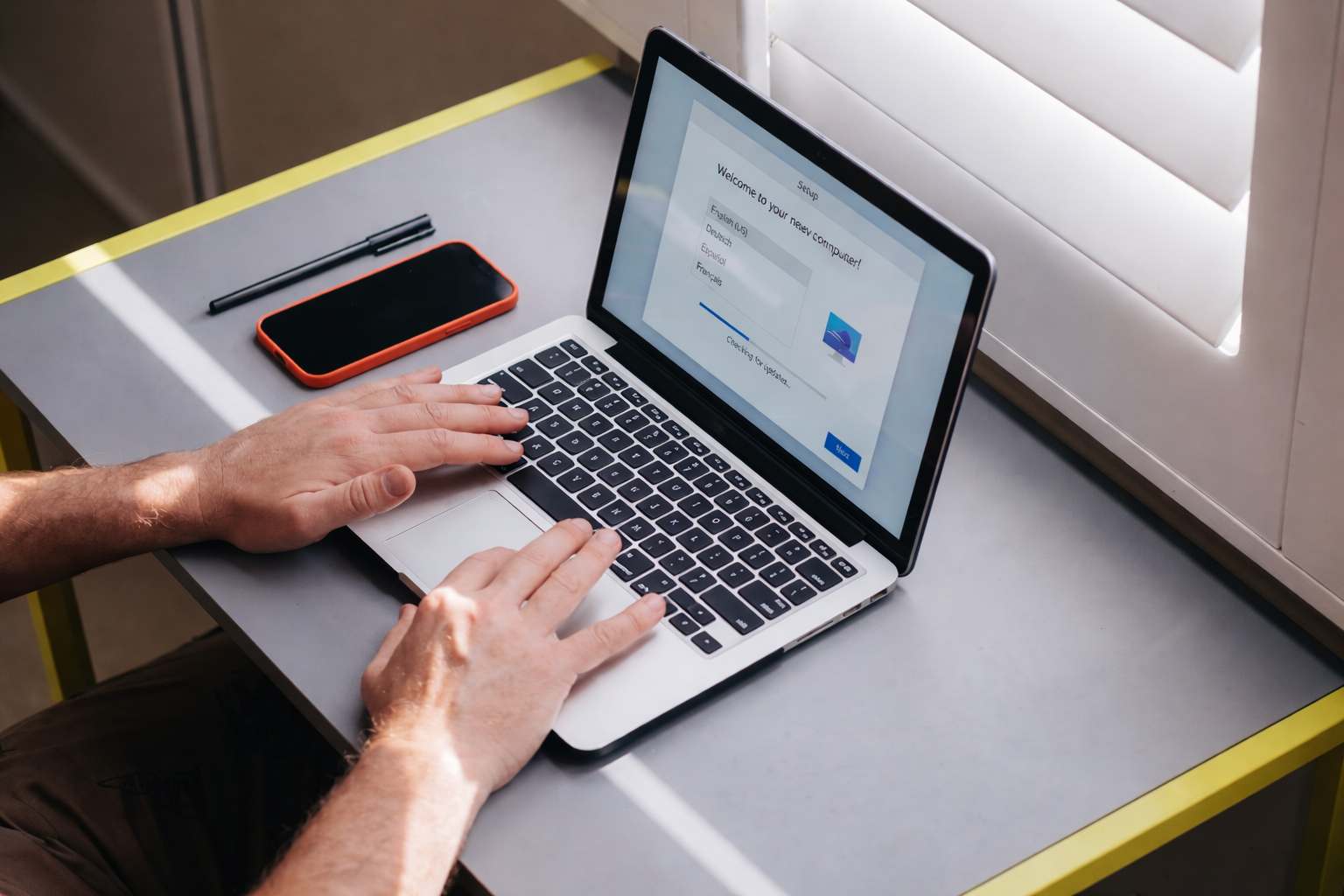
A global platform for device procurement and IT helpdesk support is a single provider that buys, configures and delivers employee devices in each country, then resolves the tickets those devices generate under the same contract. This gives IT teams one asset record, one escalation path and one accountable team for each device across its life.
What does a platform that handles device procurement and helpdesk support include?
A combined platform covers the full device lifecycle management loop under one contract, running through seven fixed stages from request through wipe or redeployment.
Request → Procure in-country → Configure → Deliver → Support → Retrieve → Wipe or redeploy
- In-country procurement: devices are bought and delivered locally, with local warranties, keyboard layouts and power adapters.
- Zero-touch configuration: accounts, apps and security policies are applied through MDM before the device arrives.
- IT asset tracking software: a live record of who holds each device, where it is and what condition it is in.
- Remote IT support services: a helpdesk that resolves software, access and hardware tickets.
- Hardware support: repairs, swaps and secure storage.
- Retrieval: collection, data wipe and redeployment at offboarding.
The asset record is what holds these stages together. When procurement, MDM and the helpdesk all write to the same record, a ticket opens with the purchase date, warranty country and configuration already attached. That shared record is also why combining the two functions matters more as the number of countries grows.
Why does combining procurement and helpdesk matter for companies in five or more countries?
Many hardware tickets can depend on facts held by whoever bought the device. A useful comparison is a car dealership’s service desk. Because it sold the car, it holds the service history, so the mechanic starts from that record and skips a from-scratch diagnosis. A helpdesk that also procured the laptop works the same way: it already knows the model, the configuration and where the warranty is valid.
When procurement and support sit with different vendors, the helpdesk has to request that context. Each request is a handoff, and handoffs can stall across time zones. The result can include:
- Warranty claims raised in a country other than the one where the device is.
- Replacement devices shipped across borders and held at customs.
- New hires starting without a working laptop because the order and the setup ticket sit in separate systems.
HR experiences this as a delayed Day One. Finance experiences it as invoices that do not match local entities. With the cause clear, the next question is which platform models actually close the gap.
What types of global platforms handle both procurement and IT helpdesk support in 2026?
Four models cover both functions. The main difference between them is how many contracts sit between a device purchase and a resolved ticket. IMARC Group’s 2026 device-as-a-service market report projects that the global device-as-a-service market will grow at a compound annual growth rate of 26.66 percent over 2026-2034, which points to continued growth in service-based device sourcing.
| Model | Procurement | Helpdesk | Contracts | Best fit |
|---|---|---|---|---|
| Unified device lifecycle platform | In-country, by the provider | Built in | One | Many countries, one accountable partner |
| Hardware as a service | Leased or subscribed devices | Varies by provider | One or more | Teams that prefer subscription spend and managed refresh |
| Logistics platform plus IT helpdesk outsourcing | Logistics provider | Separate MSP | Two or more | Teams with an existing MSP |
| IT asset management platform or MDM plus local resellers | Resellers in each country | In-house or outsourced | Many | Teams with strong regional IT staff |
1. Esevel
Esevel is a unified platform that combines procurement, MDM-based control, a 24/5 helpdesk and retrieval, delivered through local partners and regional hubs.
- Key features: in-country procurement with standardised device options, zero-touch deployment, real-time asset tracking with an audit trail for every device, and a helpdesk available through ticketing and Slack that follows ITIL-aligned processes. It integrates with JumpCloud, Intune, Jira, Okta and Entra ID.
- Pros: one contract, one escalation path and a named account manager. Esevel earns on the service, not the device, and competes on total cost of ownership. Onboarding timelines can drop from weeks to days. In-country operations in 75+ countries and coverage in 120+ countries.
- Cons: teams that only need policy software may not need the physical services. Service depth also varies by market, so in-country operations should be confirmed for each country.
Request a live demo to see how Esevel handles onboarding, offboarding and an emergency shipment. The other three models suit different starting points and vendor relationships.
2. Hardware as a service providers
- Descriptor: devices supplied on subscription or lease.
- Key features: periodic pricing and managed refresh.
- Pros: predictable spend.
- Cons: helpdesk scope varies, so check whether software and access tickets are included.
3. Logistics platforms plus IT helpdesk outsourcing
- Descriptor: one vendor ships devices and a managed service provider runs support.
- Key features: a specialist for each function.
- Pros: keeps existing MSP relationships in place.
- Cons: two escalation paths, and asset data has to be synced between them.
4. MDM tools plus local resellers
- Descriptor: JumpCloud device management or Intune enforces policy while local resellers supply hardware.
- Key features: strong identity and policy control.
- Pros: fits teams that already have regional IT staff.
- Cons: MDM governs devices after enrolment, not their purchase or repair, and the number of resellers grows with each country.
The fit depends on whether IT teams prioritize one accountable partner or prefer to maintain separate relationships for procurement and support.
How should IT teams evaluate a combined procurement and helpdesk platform?
Evaluation should start from the failure case. A platform that looks complete at purchase can still break down at the first cross-border repair.
- Step 1: Map current flows. Check: for every country, who buys devices, who answers tickets and where the asset record lives.
- Step 2: Confirm in-country execution. Ask: is each device bought and delivered locally? Red flags: a country count that does not separate in-country operations from wider coverage.
- Step 3: Test the ticket-to-hardware handoff. Ask: when a laptop fails abroad, who files the warranty claim and who ships the swap? Red flags: an answer that names two vendors.
- Step 4: Compare total cost of ownership. Ask: what drives pricing, device volume or service delivery? Check: whether invoices go to each local entity.
- Step 5: Verify evidence. Check: the scope of the ISO 27001 certificate, GDPR handling and integrations with your MDM, ITSM and identity tools. Red flags: certifications claimed but not produced when requested.
These five tests answer most of the questions IT leaders raise in early conversations with vendors.
Frequently Asked Questions
Is hardware as a service the same as a combined platform?
No. Hardware as a service describes how devices are financed. A combined platform describes who buys, supports and retrieves them. Some providers offer both.
Does a combined platform replace JumpCloud or Intune?
Usually not. Most combined platforms integrate with existing MDM tools and use them to apply policy at deployment.
Can IT helpdesk outsourcing work alongside an internal IT team?
Yes. A common split keeps identity, security and escalations in-house, while outsourced remote IT support services handle first-line tickets across time zones.
What should IT asset tracking software record?
At a minimum: the custodian, location, purchase country, warranty status, configuration and every change of hands. This keeps the audit trail intact through offboarding.
What does 24/5 helpdesk coverage mean?
Support is available around the clock on working days. Confirm in the contract how weekend issues are handled.
About Esevel
Esevel is an IT asset management platform for device lifecycle management across distributed companies. It covers procurement, deployment, tracking, helpdesk support, repair and retrieval. Devices are bought in-country through partners and regional hubs, which avoids cross-border shipping and customs holds. Teams work with one contract, a named account manager and a 24/5 helpdesk, supported by ISO 27001:2022 certification and GDPR compliance.
Same Day One, in London or Manila.

Maytiska Omar Maytiska is an experienced content writer and blog specialist with 4+ years of expertise in creating engaging, SEO-driven content. She focuses on IT and digital topics, turning complex ideas into clear, reader-friendly insights. Her work helps position Esevel as a trusted voice in the digital space.