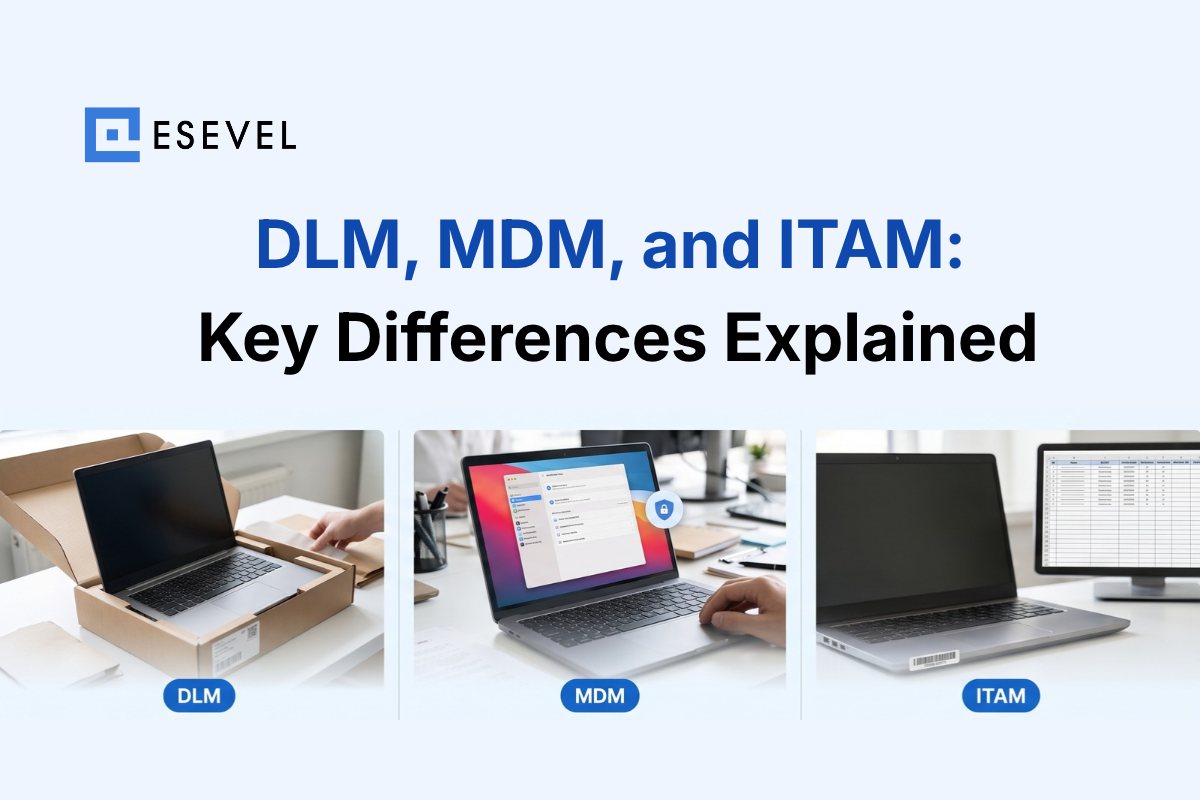
DLM vs MDM vs ITAM comes down to three jobs: Mobile Device Management (MDM) controls and secures endpoints, IT Asset Management (ITAM) maintains reliable asset records, and Device Lifecycle Management (DLM) coordinates the physical work of getting devices to employees, supporting them, and recovering them.
These functions overlap, but they are not interchangeable. MDM can lock a laptop remotely, while ITAM records who has it. Neither necessarily arranges a courier to retrieve it when an employee leaves.
For remote teams, the right choice depends on the gap in their current operations. Companies working across countries may need all three capabilities, connected through shared device records and clear responsibilities.
What is the difference between DLM, MDM, and ITAM?
MDM handles device control, ITAM handles asset accountability, and DLM handles physical execution. The clearest way to compare them is by the question each answers.
| Category | Main question | Primary responsibility |
| MDM | Can IT configure and secure the device? | Enrollment, policies, apps, compliance, remote actions |
| ITAM | Who has this asset, and what is its status and cost? | Inventory, ownership, assignment, warranty, lifecycle records |
| DLM | Who gets the physical work done? | Procurement, delivery, repair, retrieval, storage, redeployment |
A device can appear in an inventory and comply with security policies, yet still be broken or stranded in another country. That’s the gap physical lifecycle operations address.
How do you choose between DLM, MDM, and ITAM?
Step 1: Identify the problem
If devices lack consistent security settings or remote control, prioritize MDM. If IT cannot identify who owns a laptop, what it cost, or whether it is under warranty, prioritize ITAM. If delivery, repair, and collection depend on manual coordination, assess DLM.
Step 2: Check what your existing systems already cover
A company using Microsoft Intune or Jamf may not need another endpoint management platform. Likewise, a reliable asset database may already solve the inventory problem. Focus on missing capabilities rather than duplicating software.
Step 3: Consider geographic complexity
A single-office team can often manage hardware directly. Employees spread across countries introduce local suppliers, warranties, repairs, courier arrangements, and storage needs. Check which physical services are actually available in each employee market.
Step 4: Define integration and ownership
Decide which system maintains the authoritative asset record and who updates it. Confirm serial-number matching, employee assignment, MDM enrollment status, and repair or retrieval updates.
Verify integrations rather than assuming an available API means ready-made, two-way synchronization.
What do DLM, MDM, and ITAM actually manage?
Mobile Device Management: Control and security
MDM helps IT enroll, configure, and secure supported laptops, desktops, phones, and tablets from a central system. It typically manages security settings, applications, updates, compliance checks, and actions such as remote lock or wipe.
Microsoft’s Intune documentation describes these endpoint management capabilities. Modern MDM tools also provide device inventory, but they generally do not purchase laptops, ship them internationally, or coordinate physical repairs and returns.
Best when: Devices need consistent configuration, security policies, and remote control.
IT Asset Management: Records and accountability
ITAM tracks technology assets and the information needed to govern them: serial numbers, employee assignments, locations, purchase costs, warranties, ownership, condition, and retirement status.
IBM’s ITAM definition includes financial, contractual, and inventory information throughout the asset lifecycle. Accurate records matter when laptops move between people, offices, repair providers, and storage locations.
The Flexera 2026 State of ITAM Report reported that 36% of surveyed organizations had complete visibility across their IT assets, down from 43% in 2025. This measures the broader IT environment, not laptops alone, but shows why asset visibility remains difficult.
ITAM can identify a laptop that needs retrieval. It does not necessarily arrange the collection. A structured IT asset management process keeps the record accurate as others perform that work.
Best when: Inventory, ownership, cost, or audit records are unreliable.
Device Lifecycle Management: Physical operations
DLM coordinates procurement, configuration and delivery, hardware support, repairs, retrieval, regional storage, redeployment, and secure end-of-life handling.
For example, when an employee’s laptop fails abroad, ITAM can show its warranty and MDM can provide device information. A DLM partner can arrange the local repair or replacement and coordinate the return of the damaged unit.
The device lifecycle management process extends beyond initial deployment. Its purpose here is to close the gap between what IT systems know and what actually happens to hardware.
Best when: Procurement, repairs, returns, or redeployment require manual coordination across locations.
DLM vs MDM vs ITAM: Which system owns each task?
| Task | DLM | MDM | ITAM |
| Buy and deliver laptops | Primary | Not primary | Records purchase and status |
| Enroll devices | Coordinates | Primary | Records enrollment |
| Apply security policies | Integrates | Primary | Not primary |
| Deploy applications | Integrates | Primary | May record |
| Track serial numbers | Supported | Often supported | Primary |
| Track assignment, cost, warranty | May support | Some data | Primary |
| Remote lock or wipe | Via MDM where supported | Primary | Records status |
| Repair and retrieve hardware | Primary | Not primary | Tracks events |
| Store and redeploy devices | Primary | Not primary | Updates records |
| Retire devices securely | Coordinates physical process | Can support data wipe | Records retirement |
These are typical responsibilities, not strict boundaries. Capabilities vary, and some products span more than one category.
The practical distinction is between controlling the device, recording its status, and carrying out physical tasks.
How do all three work together for a remote employee?
Consider a company in London hiring someone in Manila. The same laptop passes through three common situations.
When the employee joins: DLM sources and delivers an approved device. MDM enrolls it and applies security policies. ITAM records the serial number, purchase details, location, and assigned employee.
When the laptop breaks: MDM provides available remote information. ITAM records the warranty and repair status. DLM coordinates physical repair or replacement with an appropriate service provider.
When the employee leaves: MDM performs appropriate security actions. DLM arranges collection and potential storage or reuse. ITAM updates custody, condition, and status.
Secure reuse needs more than a recorded wipe command. NIST SP 800-88 Revision 2, published in September 2025, provides guidance on choosing and documenting suitable media sanitization methods.
Device recovery also has an environmental dimension. The Global E-waste Monitor 2024 reported 62 million tonnes of global e-waste in 2022, with 22.3% documented as formally collected and recycled. These are all-electronics figures, not laptop-specific results, but they underline the importance of responsible recovery and end-of-life practices.
How should DLM, MDM, and ITAM integrate?
Integration works best when the systems share a device identifier and each has a defined responsibility. MDM owns endpoint configuration and compliance; ITAM owns the authoritative asset record; DLM supplies updates on physical events such as delivery, repair, retrieval, and redeployment.
An HR offboarding event, for instance, can initiate security actions, a device collection request, and an asset status update. The exact automation depends on supported integrations and the company’s workflows.
A centralized device tracking and management approach helps keep employee assignments and physical device events aligned, without asking IT to update multiple records by hand.
Which approach is right for your remote team?
| Main challenge | Prioritize |
| Security, configuration, remote actions | MDM |
| Inventory, assignments, costs, warranties | ITAM |
| Purchasing, repairs, retrieval across locations | DLM |
| All three, across a distributed workforce | Connected MDM, ITAM, and DLM capabilities |
MDM controls the endpoint. ITAM governs the asset record. DLM makes the physical lifecycle happen. Most organizations do not need to choose one at the expense of the others; they need clear ownership of each job.
When is a DLM platform the missing layer?
A DLM provider may be useful when IT already has MDM and asset records, but still faces problems such as:
- Ordering approved laptops from different suppliers in each country.
- Arranging repairs and replacements through separate local vendors.
- Chasing employees and couriers during offboarding.
- Storing recovered laptops and redeploying them to future hires.
These are physical execution problems. Another MDM or ITAM license may not solve them.
How Esevel supports the physical device lifecycle
Esevel provides device lifecycle management for distributed teams, coordinating in-country procurement where supported, deployment, serial-level tracking, hardware support, retrieval, and redeployment through one accountable partner.
It offers coverage in 120+ countries, with in-country presence in 75+. Companies can retain their preferred endpoint and IT systems while Esevel coordinates physical device operations. Supported integrations and managed MDM options should be assessed against each company’s existing stack.
In a published Milieu Insights customer story, the company reported a 50% reduction in IT procurement time across its regional operations. This is a customer-specific result, not a guaranteed outcome.
For buyers comparing service providers, the best device lifecycle management tools covers vendor selection in more detail.
Frequently asked questions
Is DLM the same as MDM?
No. MDM manages endpoint policies, applications, and remote actions. DLM coordinates physical procurement, delivery, repair, retrieval, and reuse.
Can MDM replace ITAM?
Not entirely. MDM often has inventory features, while ITAM covers wider ownership, financial, contractual, and lifecycle records.
Does ITAM include DLM?
ITAM tracks assets across their lifecycle, but it does not necessarily perform physical activities such as shipping or retrieval.
Do remote teams need all three?
Not always. Teams with simple operations may cover several functions internally. Multi-country teams often benefit from connected security, asset records, and physical execution.
Keep Device Security, Asset Records, and Physical Operations Connected
Your MDM can secure a laptop, and your ITAM system can track it. But IT still needs a reliable way to buy, deliver, repair, and retrieve devices across countries.
Esevel brings those physical operations under one accountable partner, with in-country sourcing at fair market prices where supported. IT keeps control of its standards and systems while reducing the work of coordinating hardware across borders. Request a live demo to see how Esevel fits alongside your MDM and ITAM tools.

Maytiska Omar Maytiska is an experienced content writer and blog specialist with 4+ years of expertise in creating engaging, SEO-driven content. She focuses on IT and digital topics, turning complex ideas into clear, reader-friendly insights. Her work helps position Esevel as a trusted voice in the digital space.