Running global IT without regional IT staff means one central team keeps identity, security policy and asset records, and an in-country partner does the physical work that cannot be done remotely: buying, delivering, repairing, retrieving and wiping devices. This gives a lean IT team control over every laptop in each country the company operates in, without adding IT headcount in each one.
Esevel works on this split every day. It provides device lifecycle management with coverage in 120+ countries, with in-country presence in 75+. In that work, the hard problems are rarely software. They are usually physical: a laptop held at customs, the wrong keyboard layout, or a departing employee’s device that never comes back.
About this article: Esevel is ISO 27001 certified and GDPR compliant. It supports lean IT teams across the US, UK and Europe, and in harder markets including India, the Philippines, Vietnam and the UAE.
What does running global IT without regional staff actually involve?
It involves separating the IT work that can be done remotely from the work that needs a person in the country.
| Work | Can be done remotely? | Owner |
|---|---|---|
| Identity and SSO | Yes | Central IT |
| MDM policy, patching, remote lock | Yes | Central IT |
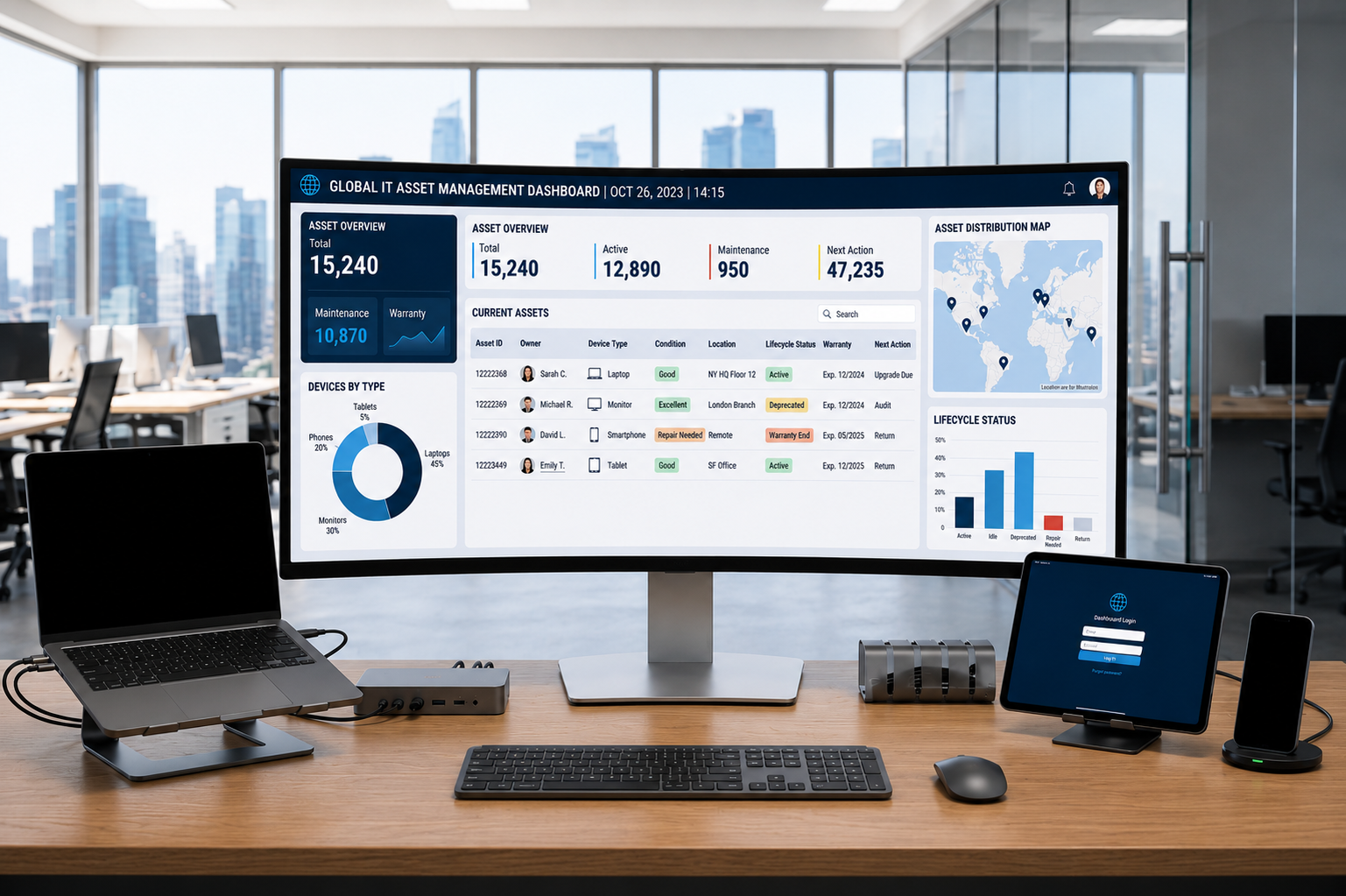
| IT asset management records | Yes, if the partner’s data reconciles | Central IT, fed by the partner |
| Buying devices with local warranties and power adapters | No | In-country partner |
| Delivery before Day One, repairs, loaner devices | No | In-country partner |
| Retrieval and wipe | Partly (remote wipe only) | Partner recovers, central IT verifies |
This split also explains why the usual first fix, hiring someone locally, often targets the wrong problem.
Why do scaling companies hire regional IT staff in the first place?
Most regional IT hires are made to handle logistics, not to fill a technical gap. The usual triggers are:
- Hiring outside HQ or entering a new country
- An incumbent vendor failing or a contract ending
- An acquisition that adds an unfamiliar fleet
- Audit or IPO preparation that exposes gaps in device records
A regional IT generalist who spends most of the week chasing couriers and resellers rarely meets that test. The economics point the same way. ITC Infotech’s 2026 case study reports that a multinational beverage company achieved 51 percent cost savings over three years after centralizing IT operations across 23 markets into a single tech hub.
Once the physical work has an owner, the central team’s job is to make the software half work in every market.
How does a central team handle remote device management across countries?
Remote device management is the software layer that lets one IT team enforce policy on devices it never touches. Market Research Future’s 2026 Mobile Device Management Market report projects that the global MDM market will grow at a compound annual growth rate of 17.10 percent between 2026 and 2035.
- Zero-touch deployment: Apple Business Manager and Microsoft Autopilot enrol a device on first boot, so it arrives already managed.
- Intune vs Jamf: Intune is usually chosen for Windows-heavy fleets running Microsoft 365. Jamf is an Apple specialist. Teams comparing Jamf alternatives for mixed fleets often look at JumpCloud, which covers Mac, Windows and Linux.
- Regional limits: Check that Apple Business Manager and Microsoft Autopilot enrolment is supported in each country before relying on zero-touch.
The practical lesson is to check MDM support for each country before the first hire there. Zero-touch only works where the enrolment service works, which makes the physical lifecycle the next thing to design.
How should the device lifecycle be split between central IT and an in-country partner?
Device lifecycle management covers every stage a device passes through, and in this model each stage has a clear owner. Central IT defines the device standard and MDM profile. The partner sources a laptop with the right keyboard layout and plug, then enrols it so the same profile applies on first boot. The inputs differ by country, but the result is the same everywhere.
The workflow runs: Hire → Ticket → Procure → Enrol → Deliver → Support → Retrieve → Wipe.
- Stage 1, Procure: Central IT sets the catalogue. The partner buys the devices in-country, which means fewer customs holds and local warranties.
- Stage 2, Deploy: For remote employee onboarding, HR raises a ticket and the laptop is configured and ready before Day One.
- Stage 3, Support: A help desk handles software issues. The partner coordinates repairs and loaner devices.
- Stage 4, Retrieve: Offboarding triggers a retrieval kit, a courier pickup and a condition check.
- Stage 5, Wipe and dispose: A secure data wipe is completed and recorded before the device is reused, resold or recycled.
Every stage that touches data must also meet GDPR in the EU and local data residency laws. Export controls such as the US Export Administration Regulations also restrict moving certain technology and software across borders.
Esevel’s model follows this split. Devices are bought in-country through operations in 75+ countries, at fair market prices with transparent, published rates. Esevel earns on the service, not the device. Requests reach a 24/5 help desk with a real person, not a chatbot, and first responses in minutes, not hours. Integrations with Intune, Jamf, JumpCloud, Okta, Jira Service Management and Jira Assets (via API) connect Esevel to the central team’s own tools.
With the stages assigned, the remaining decision is which partner should own them. Request a live demo with Esevel to see how the model works in your country footprint.
What should IT teams check when choosing outsourced IT support for other countries?
Judge outsourced IT support for a distributed fleet on how it performs in named countries, not on the length of its coverage list.
Check:
- In-country presence in each market you hire in, separate from total coverage
- Serial-level records that reconcile to your system of record
- Local invoicing to each legal entity
Ask:
- Which markets offer next-business-day dispatch, with stock held locally?
- Who owns escalation when a delivery date slips?
- How is retrieval handled when a departing employee stops responding?
Red flags:
- Asset status changes with no proof of delivery or pickup
- Remote IT support services available in only one time zone
- A separate contract for each country
Even a well-chosen partner is not the right answer for every team.
When does this model not fit?
The model fits companies spread across several countries, and it has clear limits:
- A small team in a single country may not need a lifecycle partner.
- Buyers who only need MDM may not need physical lifecycle services.
- Esevel’s help desk is 24/5, not 24/7.
- Esevel’s in-country operations cover 75+ of the 120+ countries it serves, so confirm in-country support per country.
Frequently Asked Questions
Can one central IT team support employees in many countries?
Yes. It works when the team keeps identity, MDM and records central and hands physical tasks to an in-country partner.
What is zero-touch deployment?
It is enrolment through Apple Business Manager or Microsoft Autopilot that applies company policy on first boot, so IT never handles the device.
Intune vs Jamf: which suits global teams?
Intune usually suits Windows-heavy Microsoft 365 fleets, and Jamf suits Apple fleets. Check both against regional enrolment and data hosting limits.
How is a secure data wipe confirmed for remote staff?
Recover the device, wipe it through MDM or a certified process, and record the result against its serial number.
Is IT asset management still needed with a partner?
Yes. The partner supplies the data, but the central team owns the system of record.
About Esevel
Esevel provides device lifecycle management for distributed teams, with coverage in 120+ countries and in-country presence in 75+. It buys and delivers devices in-country where it has in-country presence, then supports, retrieves and wipes them, with hardware at fair market prices, so central IT teams can run global fleets without regional hires. Esevel is ISO 27001 certified and GDPR compliant, and gives customers a named account manager and one escalation path. It integrates with MDM, identity and ticketing tools including Intune, Jamf, Okta and Jira.
References
- A Startups Guide To Hiring & Building For Scale (google.com)

Maytiska Omar Maytiska is an experienced content writer and blog specialist with 4+ years of expertise in creating engaging, SEO-driven content. She focuses on IT and digital topics, turning complex ideas into clear, reader-friendly insights. Her work helps position Esevel as a trusted voice in the digital space.